Request a Demo
In Japan, cosmetics products include a part of quasi-drugs which are considered as beauty products, such as medicated toothpaste, hair dyes and permanent waving agent. Both cosmetics and quasi-drugs are regulated by the Pharmaceutical and Medical Devices Law (PMDL, formerly Pharmaceutical Affairs Law). Therefore, based on Japan's unique application of cosmetics, how is the animal testing system for cosmetics regulated in Japan?
No Mandatory Animal Testing for Cosmetics
In 2001, the former Pharmaceutical Affairs Law was amended in Japan, requiring full ingredient labeling for cosmetics and eliminating the pre-market approval system. As a result, manufacturers became fully responsible for proving the safety of their products on their own accord. While the law does not require animal testing for cosmetics.
However, if there is a need to add or revise certain ingredients and quantities allowed for preservatives, UV absorbers, and tar dyes that are specified in the Standards for Cosmetics (Positive Lists), safety test data must be provided.
Not All Quasi Drugs Require Animal Testing
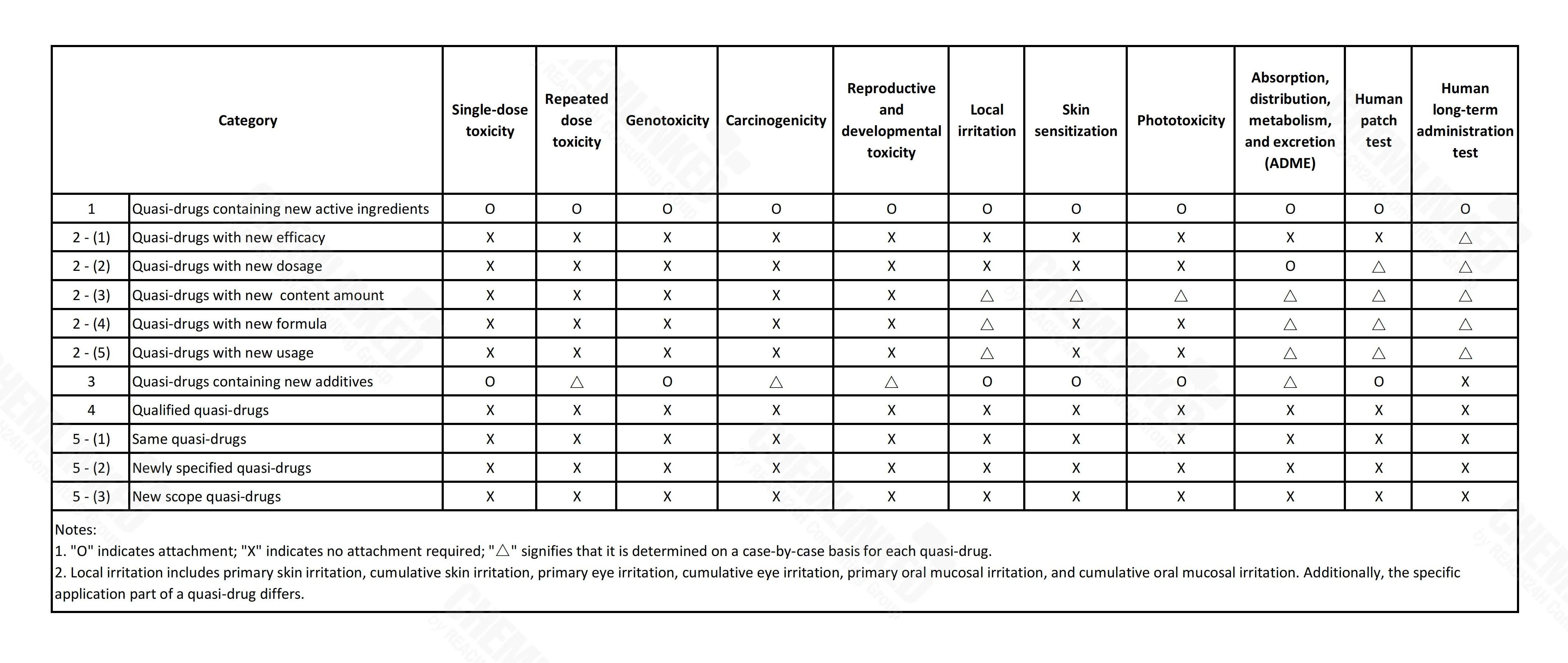
Unlike regular cosmetics, quasi-drugs, which are formulated with active ingredients, possess special efficacy that falls between pharmaceuticals and cosmetics. Japan takes its safety very seriously. As a result, quasi-drugs products are subject to a stringent approval system, which places emphasis on evaluating the efficacy, safety, and quality specifications of their ingredients. Quasi-drugs are classified into five categories. It's important to note that animal testing is not obligatory for all quasi-drugs. Among them, "Category 1 quasi-drugs containing new active ingredients" always requires animal testing, while other categories may require animal testing in certain cases.
Current Alternative Methods
The Ministry of Health, Labour and Welfare (MHLW) provides guidance on the following alternatives to animal test.
Category | No. | Alternative method | Implementation Date | Status |
Phototoxicity test | 1 | In vitro 3T3 NRU | 2012.4.26 | |
Skin sensitization test | 2 | Murine Local Lymph Node Assay (LLNA) | 2012.4.26 | |
3 | LLNA: DA | 2013.5.30 | ||
4 | LLNA: BrdU-ELISA | 2013.5.30 | ||
Eye irritation test | 5 | Bovine Corneal Opacity and Permeability Assay (BCOP) | 2014.2.4 | |
6 | Isolated Chicken Eye Test (ICE) | 2015.11.16 | ||
7 | Short Time Exposure In Vitro Test Method (SET) | 2018.12.18 | ||
8 | Reconstructed human Cornea-like Epithelium Test Method (RhCE) | 2019.6.24 |
You can explore further details regarding alternative methods and supporting guidance documents in ChemLinked Database.
Advancements in Alternative Test Methods
The Japanese Center for the Validation of Alternative Methods (JaCVAM) works in partnership with the International Cooperation on Alternative Test Methods (ICATM), an international initiative dedicated to advancing alternative test methods. To be more detailed, JaCVAM plays a crucial role in gathering information on alternative test methods, encompassing newly developed and revised test methods, and conducting assessments to determine their validity.
Test methods endorsed by JaCVAM:
Ros (Reactive Oxygen Species) Assay for Photoreactivity
Fluorescein Leakage (FL) Test Method
In Chemico Skin Sensitisation, Direct Peptide Reactivity Assay (DPRA)
In Vitro Skin Sensitisation, ARE-Nrf2 LuciferaseTest Method
...
When cosmetic companies are mandated to provide safety test data as per governmental requirements, it is highly advisable to consider the alternative test method outlined in JaCVAM’s guidance document.
In Western countries with advanced animal experimentation, there are specific legal provisions that define the conditions and procedures for conducting lawful animal experiments. In contrast, Japan does not have specific laws in this regard. While animal mistreatment is a criminal offense, animal experimentation is still considered a lawful act due to its justification for the benefit of humans and scientific progress.
However, the relevant regulatory authorities and cosmetics industry are actively engaged in the development and adoption of alternative test methods to replace animal testing. This endeavor includes:
In 2022, the Japan Cosmetic Industry Association (JCIA) established the Next Generation Risk Assessment Working Group (NGRA WG) to initiate discussions on safety assessment methods for cosmetics and cosmetic ingredients that do not rely on animal testing.
Shiseido established a safety assurance system based on alternative methods, and has discontinued animal testing in the development of cosmetics and quasi-drugs since April 2013.
 We provide full-scale global cosmetic market entry services (including cosmetic registering & filing, regulatory consultation, customized training, market research, branding strategy). Please contact us to discuss how we can help you by