Request a Demo
On March 29, 2024, China National Institutes for Food and Drug Control (NIFDC) unveiled two draft guidance documents aimed at enhancing cosmetics safety assessment procedures. These documents, namely the Guidelines for Submission of Cosmetics Safety Assessment Dossiers (Draft for Comments) (the Submission Guidelines) and the Technical Guidelines for Identification and Assessment of Cosmetic Risk Substances (Draft for Comments) (the Technical Guidelines for Risk Substances), are currently open for public feedback until April 8, 2024. Interested parties are encouraged to submit their comments to [email protected] before the deadline.
This article primarily focuses on the key contents of the Submission Guidelines, while a separate analysis of the Technical Guidelines for Risk Substances is also available.
Key highlights of the Submission Guidelines are as follows:
1. Implementing Product Classification Management Based on Risk Management
This draft introduces additional classification criteria on the basis of existing classification criteria of efficacy claims, application areas, dosage forms, and target users outlined in the Cosmetic Classification Rules and Catalogs. The new classification criteria include the use of new cosmetic ingredients (NCIs) that are in the safety monitoring period, the use of nano ingredients, and the consideration of pH range, etc. Based on these criteria, cosmetics are divided into three categories:
Category 1 Cosmetics: Primarily includes children's cosmetics, cosmetics containing NCIs within the monitoring period, and those posing high safety risks to human health, such as whitening and anti-wrinkle cosmetics with significant biological activity.
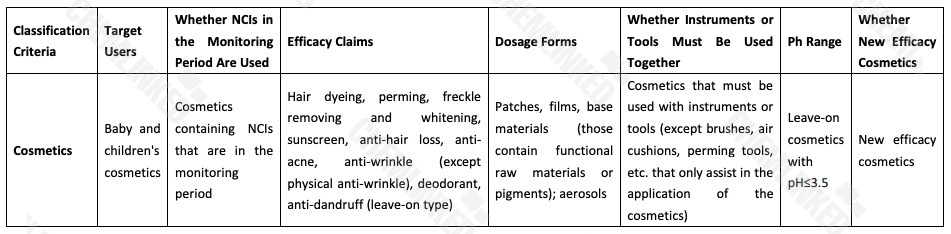 Table 1 Category 1 Cosmetics
Category 2 Cosmetics: Primarily include cosmetics with higher-risk ingredients, such as nano ingredients and exfoliating functional ingredients. The safety assessment of base materials should be highly concerned.
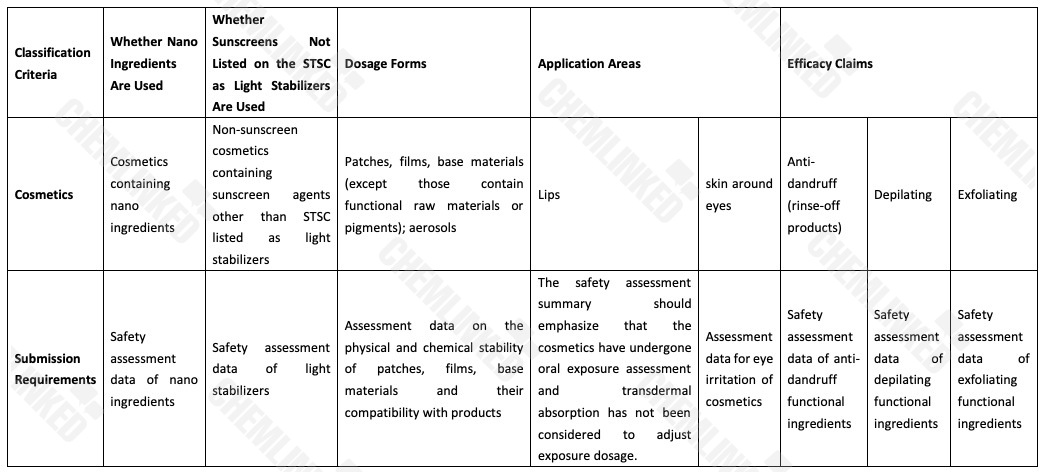 Table 2 Category 2 Cosmetics
Category 3 Cosmetics: General cosmetics that do not fall under Category 1 or Category 2.
2. Establishing a Classified Submission System for Safety Assessment Reports
In contrast to previous management approaches for safety assessment reports, this draft no longer mandates enterprises to provide safety assessment reports for all products. Instead, it proposes that, based on the aforementioned product classifications, products in different categories are subject to different types of dossiers to be submitted.
Product Classification | Required Submission Dossier |
Category 1 Cosmetics | A full version of the safety assessment report should be submitted. |
Category 2 Cosmetics, provided that the production enterprise holding relevant qualifications for production quality management system satisfying the dossier prerequisites outlined in Table 2 above. | Archived for future reference with conditions The safety assessment conclusions should be submitted, along with the certification materials related to the corresponding categories in Table 2 above. The safety assessment report can be archived by enterprises for future reference. |
Category 3 Cosmetics | Archive for future reference Only the safety assessment conclusions need to be submitted, while the safety assessment report can be archived for future reference. |
Notes: A full safety assessment report is still required if any of the following conditions apply to the product:
| |
This measure aims to alleviate the burden on enterprises. Companies manufacturing Class 2 and 3 cosmetics can now conduct self-inspection and provide safety assessment conclusions during registration or notification. However, it's crucial to understand that this exemption does not imply a complete waiver of safety assessment. In case that the company get regulatory penalties, it will be required to promptly submit or supplement product safety assessment reports.
3. Incorporating "Key Points for Self-Inspection of Cosmetics Safety Assessment Reports" (the "Key Points") in the Annex to assist companies in conducting self-inspections on product safety assessment reports and forming safety assessment conclusions.
As per the Key Points, the safety assessment report must include the assessment of each ingredient in the cosmetics, possible risk substances, cosmetic stability, compatibility with cosmetic packaging, microbiology, preservative challenges, etc.
Regarding evidence types, acceptable evidence can be the Safety and Technical Standards for Cosmetics (STSC), evaluation conclusions from Chinese domestic and foreign authoritative institutions, safe consumption history, three-year safe use history, threshold of toxicological concern (TTC), read across, and the four-step risk assessment procedure in the Technical Guidelines for Cosmetic Safety Assessment.

 We provide full-scale global cosmetic market entry services (including cosmetic registering & filing, regulatory consultation, customized training, market research, branding strategy). Please contact us to discuss how we can help you by