Request a Demo
In March 2022, China National Medical Products Administration (NMPA) released the draft Inspection Points and Judgment Principles of Cosmetic Good Manufacturing Practices (Points). Seven months after its release, on October 25, 2022, NMPA released the finalized version, which will take effect on December 1, 2022. 1
Compared to the previous draft, the finalized Points adopts minor amendments. Following the framework set in the draft, it consists of 105 inspection points, and sets separate inspection items for manufacturing and entrusting enterprises. Besides, it introduces the judgment principles of cosmetics regulatory departments, offering enterprises guidance on complying with the Good Manufacturing Practices for Cosmetics.
Highlights of the Points
1. Stipulating the entrusting enterprise's duty in cosmetics manufacturing practices
The Points is established to repeal the current Practice for Cosmetics Production Licensing, which is only applicable to manufacturing enterprises. As an upgraded version to its predecessor, the Points applies to three categories of enterprises, including:
Category 1: cosmetics registrants, notifiers and entrusted manufacturing enterprises engaged in actual production activities (actual manufacturing enterprises);
Category 2: cosmetics registrants and notifiers who entrust production enterprises to produce cosmetics (entrusting enterprises);
Category 3: cosmetics registrants and notifiers engaged in both self-production and entrusted production activities.
Respectively in its Attachment 1 and Attachment 2, the Points sets inspection items for enterprises of category 1 and category 2. For enterprises of category 3, separate inspection and judgement will be made in accordance with Attachment 1 and 2.
2. Emphasizing the importance of ingredient use, product quality and safety control, as well as product release management in cosmetics manufacturing practices
In terms of the inspection item's impact on product quality and safety, the Points further divides the items into key items (including critical items and other key items) and general items. Compared to the draft, for both manufacturing enterprises and entrusting enterprises, the number of critical inspection items has been reduced in the finalized Points.
| Applicable Enterprises | Draft Points | Finalized Points |
Manufacturing Enterprises (Attachment 1) | 82 inspection items: - 29 key items (5 critical items and 24 other key items) - 53 general items | 81 inspection items: - 29 key items (3 critical items and 26 other key items) - 52 general items |
Entrusting Enterprises (Attachment 2) | 24 inspection items: - 9 key items (2 critical items and 7 other key items) - 15 general items | 24 inspection items: - 9 key items (1 critical item and 8 other key items) - 15 general items |
Inspection items defined as critical items are those involve vital activities in cosmetics manufacturing practices. For manufacturing enterprises, items related to ingredient use, product quality and safety control, as well as product release management are critical inspection items. For entrusting enterprises, inspection on the product release management acts as the principal focus, as they do not engage in the actual production. Details of these critical items are compiled in the table below.
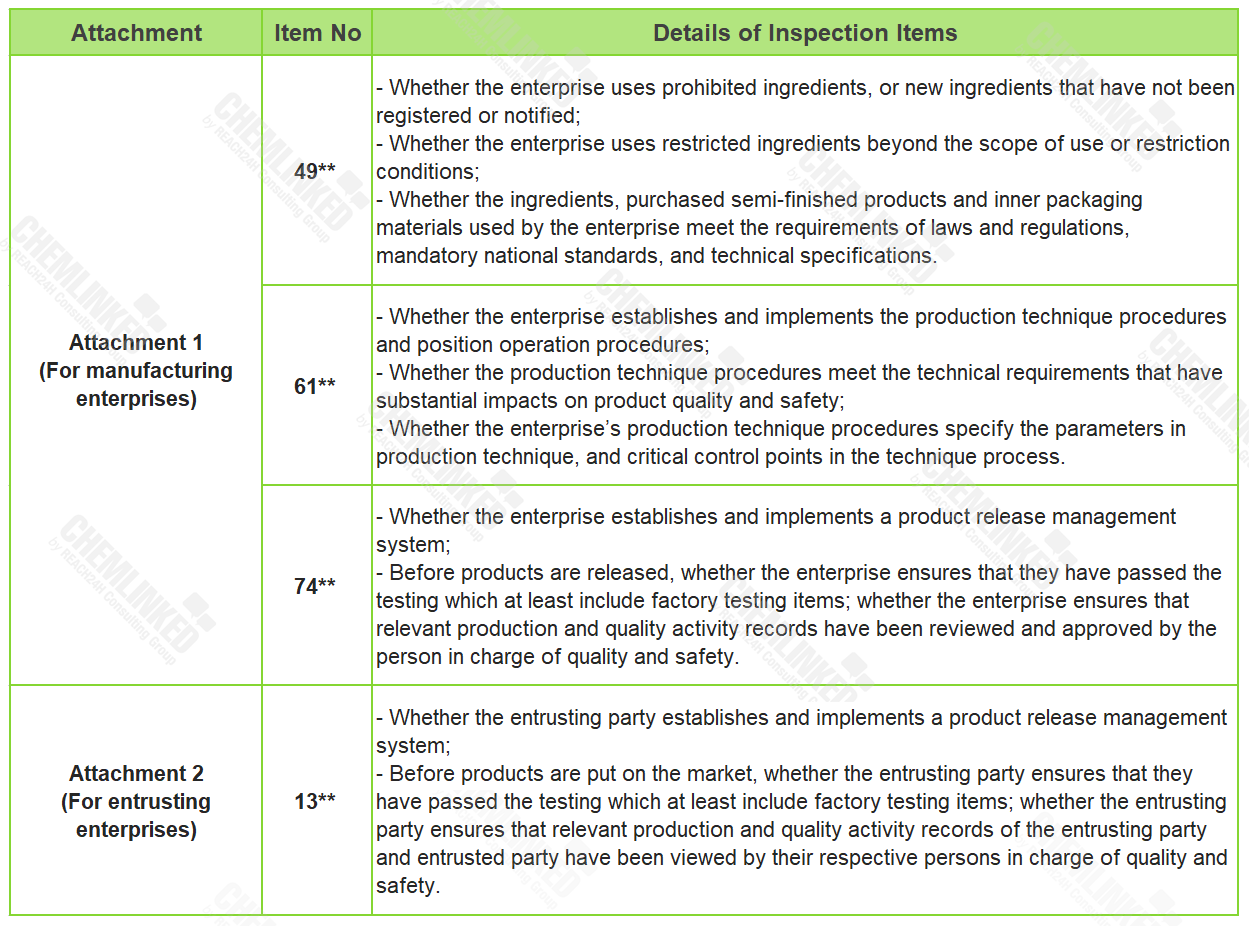

3. Specifying the non-compliant situations in the inspection, and their corresponding punitive measures
Inspection on cosmetic's manufacturing practices includes on-site inspection for the issuance of production license, on-site inspection after production license renewal, as well as routine supervision and inspection. Enterprise will obtain a pass if all items meet requirements. Otherwise, enterprise will be ordered to make rectification or receive punishment based on specific inspection conclusions.
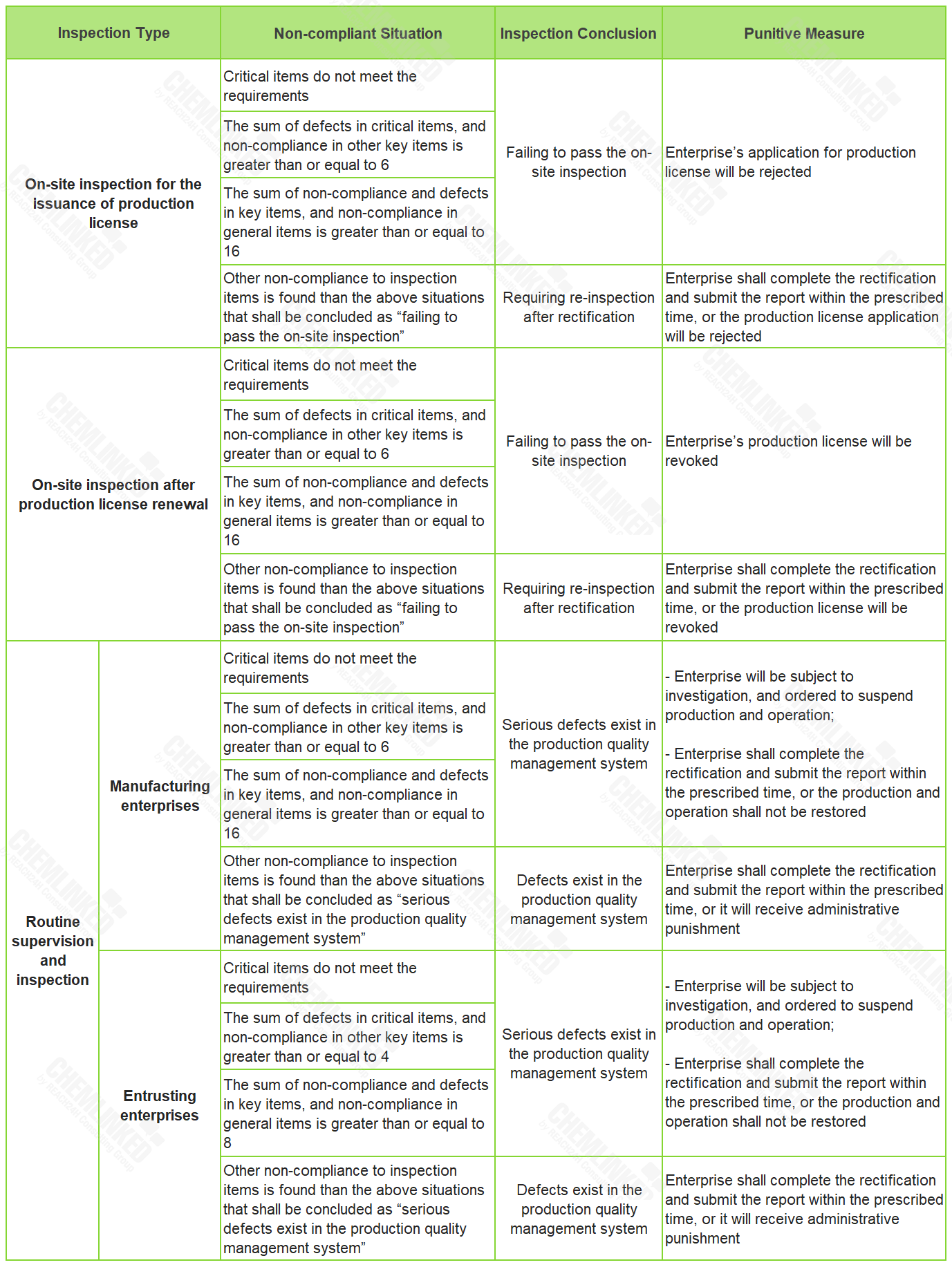 According to the draft Points, enterprises can either pass or fail the on-site inspection. Different from its draft, the finalized Points newly includes an intermediate situation where enterprises are allowed to make correction to the non-compliant items. As long as enterprises complete the rectification and submit the report as required, and pass the re-inspection, they can gain the production license or be allowed to renew it. This adjustment gives enterprises time to make transitions in accordance with the Points, and helps them meet the latest requirements.
As supplementary to the non-compliant situations described above, the finalized Points also stipulates that, non-compliance to the following items is considered as a possible violation of Cosmetic Supervision and Administration Regulation (CSAR). The enterprises involved shall be punished once the non-compliance is verified in the investigation.
| Attachment | Inspection Items No. in the Finalized Points |
| Attachment 1 (For manufacturing enterprises) | Item 5, 11, 22, 49, 50, 52, 54, 57, 58, 59, 73, 76, 77, 80 or 81 |
| Attachment 2 (For entrusting enterprises) | Item 2, 4, 9, 11, 12, 14, 19, 20, 23 or 24 |
 We provide full-scale global cosmetic market entry services (including cosmetic registering & filing, regulatory consultation, customized training, market research, branding strategy). Please contact us to discuss how we can help you by