Request a Demo
On November 11, 2022, the EU released the Commission Regulation (EU) 2022/2195, introducing new amendments to the use requirements for cosmetic ingredients in Regulation (EC) No 1223/2009 (Cosmetics Regulation). All amendments aim at the lists of restricted ingredients and permitted UV filters, based on the opinions from Scientific Committee on Consumer Safety (SCCS). 1
1. List of Restricted Ingredients: two added and one revised
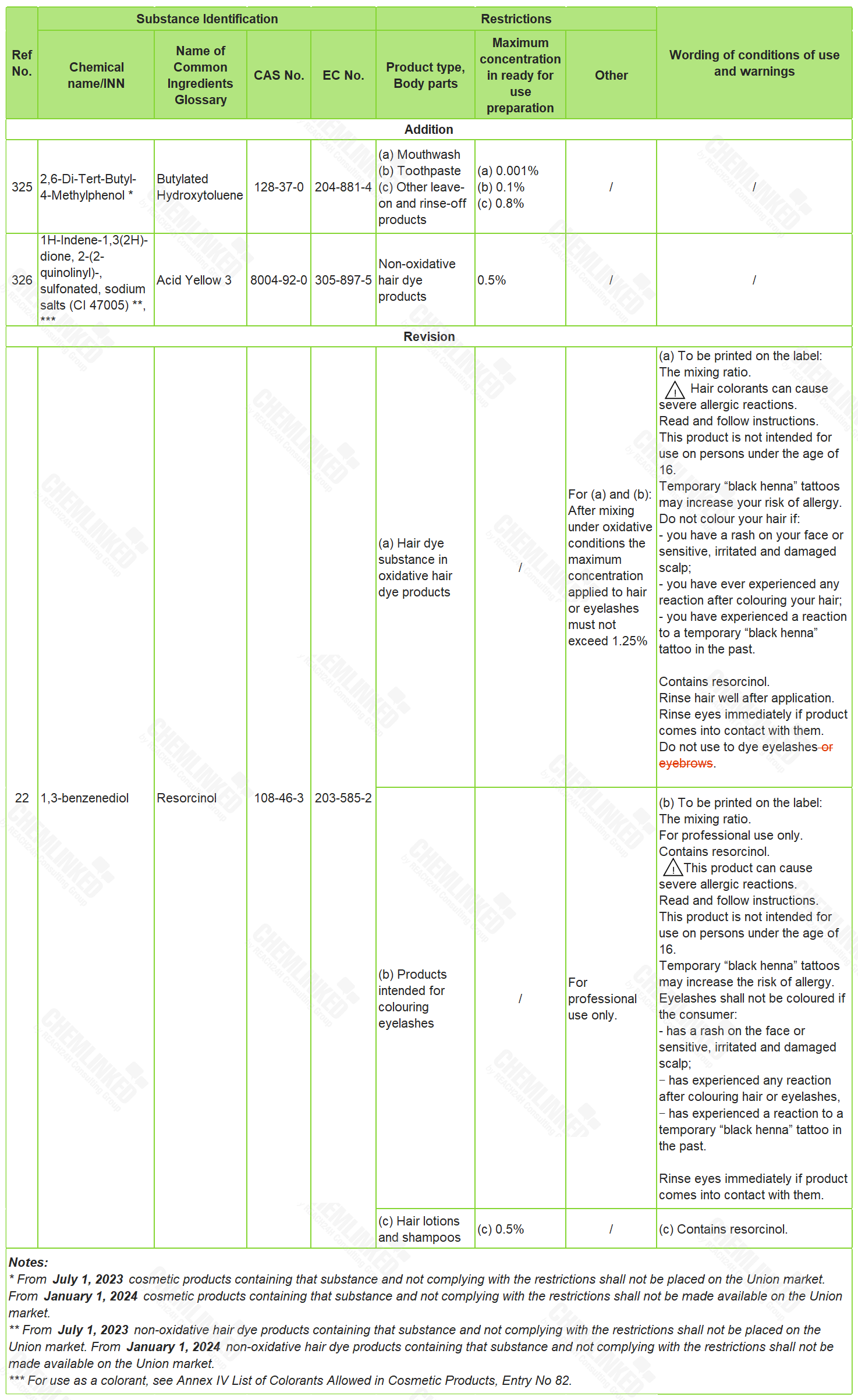
Butylated Hydroxytoluene (CAS No 128-37-0) is currently not included in the ingredient lists in the Cosmetics Regulation, while Acid Yellow 3 (CAS No 8004-92-0) is an annexed colorant allowed for use in cosmetics without maximum concentration. In 2021, SCCS provided its advice on the safe use of Butylated Hydroxytoluene and Acid Yellow 3 in cosmetics respectively. In view of SCCS's opinions, these two ingredients are newly included into the List of Restricted Ingredients with use restrictions.
Resorcinol (CAS No 108-46-3) is listed under Entry 22 of the restricted ingredients list. When used in hair dye products, products containing Resorcinol shall be labelled with "Do not use to dye eyelashes or eyebrows". Since hair product includes product intended for coloring eyebrows in accordance with the Cosmetics Regulation, the warning in current labelling requirement should therefore be amended.
The details of these amendments are shown in the table below (the text in red indicates changes to the previous list):

2. List of Permitted UV Filters: two added and one revised
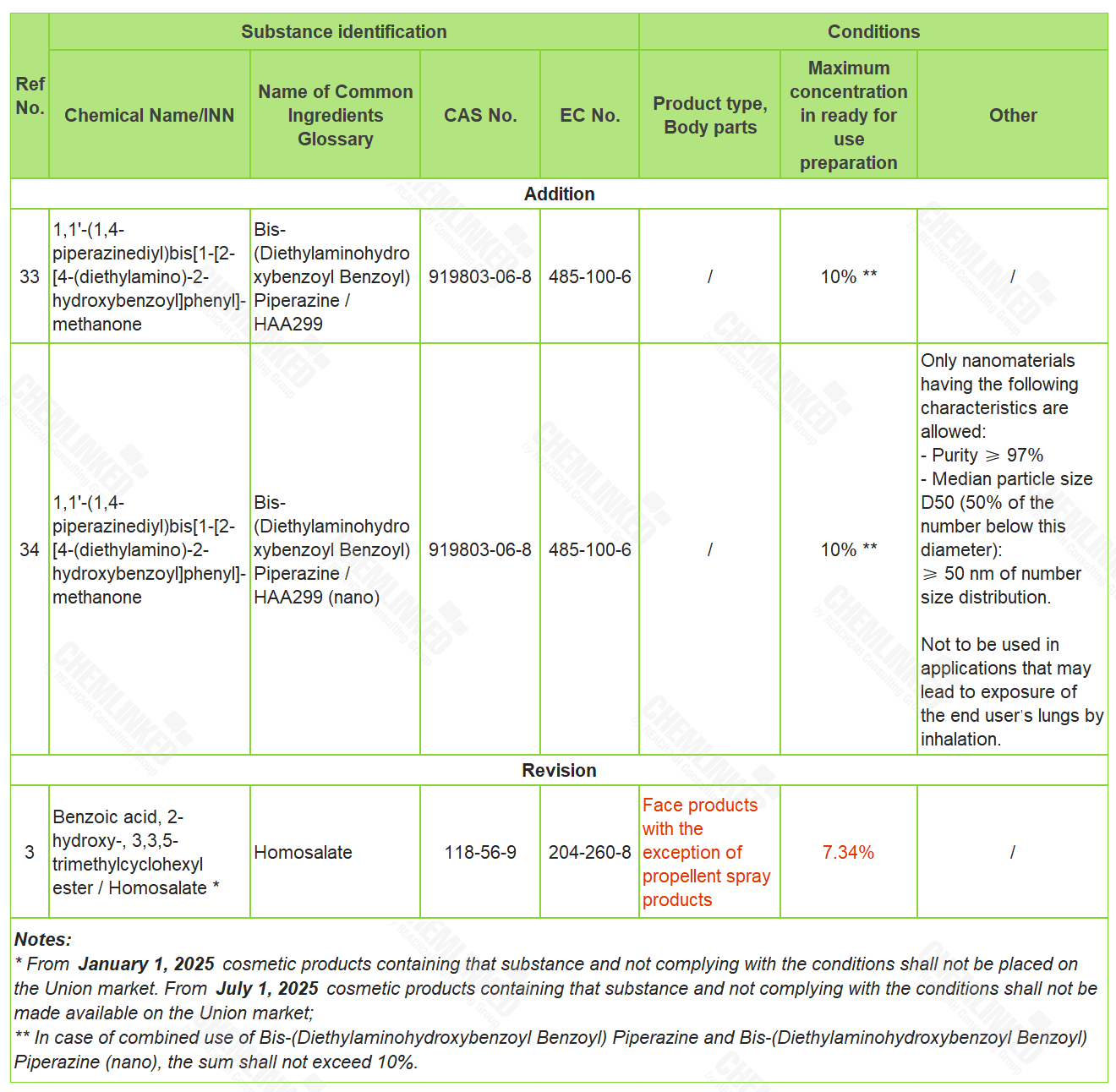
HAA299 (CAS No 919803-06-8) is currently not regulated under the Cosmetics Regulation. Based on the data provided by the industry, SCCS released the opinion SCCS/1533/14 and SCCS/1634/21, and concluded that the use of HAA299 (in non-nano or nano form) as a UV-filter in cosmetics would result in a potential risk to human health when its concentration had exceeded a certain level. In light of SCCS's opinions, this ingredient should therefore be included into the Cosmetics Regulation to ensure its safe use in cosmetics.
Homosalate (CAS No 118-56-9) is a UV filter included in the List of Permitted UV Filters. As a response to industry's concern for its potential endocrine disrupting properties, SCCS carried out a safety assessment, whose result shows that the use in cosmetics at the concentrations currently allowed may pose a risk to human health. In accordance with SCCS's safety assessment result, the use requirement of Homosalate shall be amended accordingly.
The details of these amendments are shown in the table below:
 We provide full-scale global cosmetic market entry services (including cosmetic registering & filing, regulatory consultation, customized training, market research, branding strategy). Please contact us to discuss how we can help you by