Request a Demo
On September 11th, Japan Ministry of Health, Labour and Welfare (MHLW) issued a notice to amend the specifications of 48 ingredients in the Japanese Standards of Quasi-drug Ingredients 2006 (JSQI, please refer to Cosme-List for all the lists). The revisions were promulgated on September 11, 2019. A 1.5-year grace period which will end on March 31, 2021 was granted for stakeholders to prepare for enforcement of the new requirements.
Revisions to the JSQI
The 48 amended ingredients are:
Dicocoyl Dimethyl Ammonium Chloride
N-[2-Hydroxy-3-(cocoalkyldimethylammonio)propyl] Hydrolyzed Keratin Chloride
N-[2-Hydroxy-3-(cocoalkyldimethylammonio)propyl] Hydrolyzed Wheat Protein Chloride Solution
N-[2-Hydroxy-3-(cocoyldimethylammonio)propyl] Hydrolyzed Collagen Chloride
N-[2-Hydroxy-3-(cocoalkyldimethylammonio)propyl] Hydrolyzed Silk Chloride Solution
N-[2-Hydroxy-3-(cocoalkyldimethylammonio)propyl] Hydrolyzed Soybean Protein Chloride Solution
Glyceryl Caprylate/Caprate/Cocoate
Sodium Hydrogenated Glyceryl Cocoate Sulfate
Higher Fatty Acid Pentaerythritol Citrate・Beeswax・Nonion Emulsifying Mixture
Polyethylene Glycol・Epichlorohydrine・Cocoalkyl Amine・Dipropylene Triamine Condensate Solution
Polyoxyethylene Glyceryl Monococoate
Polyoxyethylene Cocoalkyl Amine
Polyoxyethylene Cocoalkyl Dimethyl Amine Oxide Solution
Polyoxyethylene Coconut Fatty Acid Amide (5E.O.)
Disodium Polyoxyethylene Coconut Fatty Acid Isopropanolamide Sulfosuccinate Solution
Polyoxyethylene Glyceryl Monococoate
Polyoxyethylene Coconut Fatty Acid Monoethanolamide Sodium Sulfate Solution
Polyoxypropylene Coconut Fatty Acid Monoisopropanolamide (1P.O.)
Condensate of Methylsilanol and Polyoxyethylene Glyceryl Monococoate
Cocoalkyl Dimethyl Amine Oxide Solution
Cocoalkyl Dimethyl Glycine Solution
Magnesium・Triethanolamine Coco Sulfate Solution
Potassium Cocoyl Soap Solution
Coconut Fatty Acid
DL-Pyrrolidonecarboxylic Acid Salt of N-Cocoyl-L-Arginine Ethyl Ester
Potassium N-Cocoyl-Hydrolyzed Yeast
Sodium N-Cocoyl-N′-Carboxyethyl-N′-Hydroxyethyl Ethylenediamine
Disodium N-Cocoyl- N′-Carboxyethoxyethyl-N′-Carboxyethyl Ethylenediamine Solution
Disodium N-Cocoacyl-N-carboxymethoxyethyl-N-carboxy methylethylenediamine Polyoxyethylene Tridecyl Sulfate Solution
Disodium N-Cocoyl-N-carboxymethoxyethyl-N-carboxymethylethylenediamine
Disodium N-Cocoyl-N′-Carboxymethoxyethyl- N′-Carboxymethyl Ethylenediamine Lauryl Sulfate
N-Cocoyl-L-Glutamic Acid
Potassium N-Cocoyl-L-Glutamate
Triethanolamine N-Cocoyl-L-Glutamate Solution
Sodium N-Cocoyl-L-Glutamate
Coconut Fatty Acid Amide
Cocoyl Amide Propyldimethyl Glycine
Cocoyl Amide Propyldimethyl Glycine Solution
Sodium Cocoyl Ethyl Ester Sulfonate
Hydrolyzed Collagen Cocoate Solution
Coconut Fatty Acid Diethanolamide
Sodium Cocoyl Taurate
N-Cocoyl-N-methyl-β-alanine
Sodium Cocoyl N-Methyl β-Alaninate Solution
Coconut Fatty Acid N-Methylethanolamide
Potassium N-Cocoyl-N-Methyl Taurate Solution
Sodium N-Cocoyl-N-Methyl Taurate
Magnesium Cocoyl Methyl Taurate Solution
Revisions to the approval of quasi-drugs
Along with the revisions to the specifications of quasi-drug ingredients, the relevant application for quasi-drugs manufacturing and marketing licenses has been modified accordingly.
As per the Notice, for quasi drugs containing one of the 48 ingredients and which are newly manufactured in line with the amended specifications, stakeholders shall comply with new rules and apply for manufacturing and marketing licenses. This requires applicants to select “Japanese Standards of Quasi-drug Ingredients (‘外原規’ in Japanese)” in the “Ingredient and Content” column of the application form, instead of filling the specific specification of ingredients as per previous requirements.
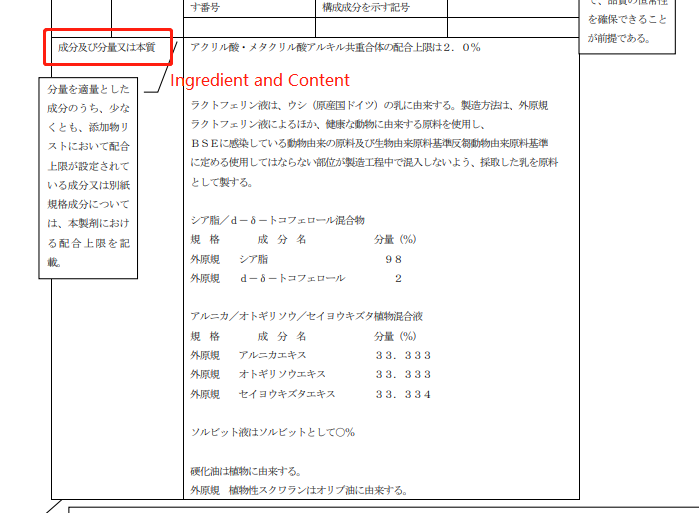
In cases where stakeholders have products which contain any of the 48 ingredients and have already applied for or obtained a manufacturing or marketing license under the old specifications, the application or license will be valid until the end of the grace period.
Stakeholders shall apply for slight modification to prepare for the new specifications. An application form of slight modification shall be submitted before March 31, 2021. In the remark’s column it should be indicated that “The application is made on the basis of the No.1 Notice issued by Japan MHLW on the partial revisions to the Japanese Standards of Quasi-drug Ingredients 2006”.Besides, an additional paper shall be attached indicating the specification and experimental methods of the ingredient in the Japanese Standards of Quasi-drug Ingredients 2006.
 We provide full-scale global cosmetic market entry services (including cosmetic registering & filing, regulatory consultation, customized training, market research, branding strategy). Please contact us to discuss how we can help you by