Request a Demo
 The State Food and Drug Administration (SFDA) which is responsible for cosmetic management in China was busy reforming the legislation and regulations governing areas of the cosmetics industry involving existing and new ingredients, labelling, children's cosmetics, alternative to animal testing etc. This article addresses the following topics:
Contents
Tabel 1: Main Regulatory Development for Cosmetics in 2012
Regulation EN Title | Regulation CN Title | Issue Date | Implementation Date |
Regulations concerning the Hygiene Supervision over cosmetics | under revision | ||
SFDA only released the body text for public consultation | |||
已使用化妆品原料名称 目录 | Three draft batches has been released | ||
Regulations for Cosmetics Label Instructions | 2013/4/1 | 2013/7/1 | |
2012/10/12 | 2013/2/1 | ||
2011/8/10 | 2012/2/1 | ||
Update of Vital Regulations
The overriding Regulations concerning the Hygiene Supervision over Cosmetics, published by the Ministry of Health (MoH) in 1989, has been implemented for more than 20 years but never been amended since, essentially rendering it incompatible with the lower-level cosmetic regulations. The SFDA is revising it at present which may take two or three years before finally being enacted. The pre-market registration of cosmetics is expected to be relaxed but the post-market supervision is expected to be intensified. However, little is known about whether the future amendments would be huge or trivial.
The Hygienic Standard for Cosmetics 2007, released by the MoH, acts as an indispensable standard for all cosmetic products in China. It contains lists of prohibited and restricted substances in cosmetics and the testing and evaluation methods.
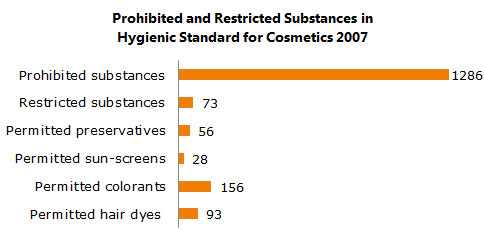
The last five years saw the rapid development of the cosmetic industry, during which the Chinese government realized that only supervising the quality of cosmetic products but neglecting the safety of raw materials is far from enough. Besides, many testing methods have been improved or innovated. In an effort to incorporate these recent updates in cosmetic industry, the SFDA made the revision and re-named it as the "Technical Safety Standard for Cosmetics". The main changes are summarized as follows:
Highlight the safety of ingredients by putting general and technical requirements on them;
Update lists of prohibited and restricted substances and improve the test methods;
Reduce the limits of Pb/As in cosmetics from 40 and 10 to 10 and 4 (mg/kg), respectively.
See the Table below for comparisons between the structures of the old and new standards:
Regulation | Structure | |
Hygienic Standard for Cosmetics 2007 | Part 1 | General Provisions, including prohibited and restricted substances in cosmetics |
Part 2 | Methods of Toxicological Test | |
Part 3 | Methods of Hygienic Chemical Test | |
Part 4 | Methods of Microbiological Test | |
Part 5 | Human Safety and Efficacy Evaluation Test Method | |
Technical Safety Standard for Cosmetics
| Part 1 | General Provisions |
Part 2 | General requirements for safe use of cosmetic ingredients | |
Part 3 | General requirements for safe use of cosmetic products | |
Annex I | Technical requirements for cosmetic ingredients | |
Annex II | Requirements for prohibited and restricted substances in cosmetics, including prohibited and restricted substances in cosmetics | |
Annex III | Test and evaluation methods (physic-chemical/ microbiological/toxicological/human safety/efficacy) | |
Cosmetic Ingredient
Existing Ingredient
Ingredients to be included in the Inventory of Existing Cosmetic Ingredients in China (IECIC) are exempt from registration. Based on the IECIC 2003 issued by the MoH, the SFDA released the revised IECIC in three batches for public comments in 2012.
The Picture below shows how many ingredients each batch contains:
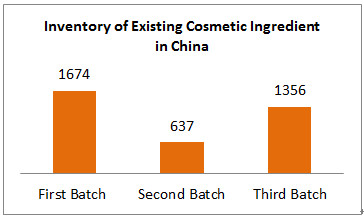
It is noted that the new inventory not only lists the Chinese names and the INCI names of existing cosmetic ingredients but also specifies the limit for ingredients restricted to be used in cosmetics.
New Cosmetic Ingredient
PM-Lysine (CAS No. 543700-70-5), Nivitol (CAS No. 869743-37-3) and Phenylethyl Resorcinol (CAS No. 85-27-8) are three new cosmetic ingredients (NCI) approved by the SFDA in 2012. According to the overriding Regulations concerning the Hygiene Supervision over Cosmetics, before a new ingredient is used to make cosmetics, an application must be made to the SFDA for approval. However, due to the lack of risk assessment guidelines, since 2004, only 9 NCIs were announced to be registered successfully. Nevertheless, the SFDA is dedicated to fill the regulatory blank by enacting the guidance for risk assessment of substances with potential risks in cosmetics and the guidance for the registration of NCIs. Furthermore, the Institute of Environmental Health and Related Product Safety under China CDC has also drafted the guideline to assess the cosmetic raw materials, which is not effective yet.

Cosmetic Labelling
Regulations for cosmetics label instructions together with its guidance were notified by the China SFDA to the WTO. Compared with the well-known GB 5296.3-2008, no big changes yet slight differences exist between the new regulation and the old national standard. For instance, cosmetics with net quantity equal to or less than 15/g or 15/ml are now required to label the approval license number if there is one.
Children's Cosmetics
The SFDA issued the Guidance on Application and Review of Children's Cosmetics to regulate products made for children from the age 0-12. Higher requirements on the ingredients for children's products have been raised. Producers shall adopt minimum varieties of ingredients and avoid the use of ingredients with special functions of whitening, freckle-removing, acne treatment, depilation, deodorization, hair nourishing, hair dyeing, hair perming, slimming, etc. As long as the effectiveness can be maintained, it is recommended to use less or no fragrance, colorants, preservatives and surfactant in cosmetics. what's more, the ingredients selected should have a certain period of safe use. Those that are manufactured through genetic and nano technology are not encouraged.
Classifications Management on Non-Special Use Cosmetics
Based on the concept of risk management, the SFDA has consulted on opinions on classification management of non-special use cosmetics, among which products that are acknowledged to present relatively high risk (like cosmetics for skin whitening and acne treatment) will be incorporated into the special-use cosmetics, which means it will be tougher to have them registered and they will receive stricter surveillance.
Testing Institutions for Registration of Cosmetics
To meet the rising demand of cosmetic testing, another 4 testing institutions (marked in Orange in the table below) are designated by the SFDA to carry out microbiological, hygienic chemical and toxicological tests on cosmetics. In China, only testing reports issued by the SFDA-approved testing units are valid for the registration of cosmetics. By the end of 2012, the SFDA has approved 27 cosmetic testing institutions in total. Every test unit has its own number.
Type | Testing institution | Number |
hygiene safety testing institution (microbiological test, hygienic chemical test, toxicological test) | Institute of Environmental Health and Related Product Safety, China CDC | 001 |
002 | ||
003 | ||
004 | ||
005 | ||
006 | ||
007 | ||
008 | ||
014 | ||
015 | ||
016 | ||
018 | ||
019 | ||
020 | ||
021 | ||
022 | ||
023 | ||
024 | ||
025 | ||
026 | ||
027 | ||
human safety testing institutions (human safety test and test in vivo of UV protection efficacy of cosmetic sunscreens) | General Hospital of Chinese People's Liberation Army Air Force | 009 |
010 | ||
011 | ||
012 | ||
013 | ||
017 |
Import and Export of Cosmetics
On 1 Feb 2012, China General Administration of Quality Supervision, Inspection and Quarantine (AQSIQ) bought into force the Measures for the Administration of Imported and Exported Cosmetics Inspection and Quarantine Supervision. Cosmetics included in the Catalogue of Entry-Exit Commodities Inspected and Quarantined by the Competent Entry-Exit Inspection and Quarantine Authority are subject to application. Later on 30 July, the AQSIQ released the Announcement of 110 to further specify the documents required for inspection and quarantine and highlight the cosmetic products' safety information.
Alternatives to Animal Testing
Very different from the animal testing ban in the European Union, non-animal tests are not officially accepted by the Chinese government to be used for assessment of cosmetic products and ingredients. Only testing reports based on animal tests are valid for cosmetics registration, which has caused tremendous dissatisfaction among companies and animal protection organizations. Nevertheless, China has made continued efforts in recent years to adopt the very first alternative method, the 3T3 Neutral Red Uptake Phototoxicity Assay, for cosmetic ingredients. This has been notified to the WTO last year and will be the milestone of alternative toxicological method development in China once it is adopted by China.
Reference Links
Regulations concerning the Hygiene Supervision over Cosmetics
Hygienic Standard for Cosmetics 2007
Technical Safety Standard for Cosmetics
Inventory of Existing Cosmetic Ingredients in China (IECIC)
Regulations for cosmetics label instructions
Guidance for cosmetics label instructions
Guidance on Application and Review of Children's Cosmetics
Opinions on classification management of non-special use cosmetics
 We provide full-scale global cosmetic market entry services (including cosmetic registering & filing, regulatory consultation, customized training, market research, branding strategy). Please contact us to discuss how we can help you by