Request a Demo
According to statistics from Shanghai Municipal Commission of Commerce, growth in China’s cosmetics sector is an excellent surrogate marker to demonstrate overall growth in consumerism. The rising fortunes of China’s cosmetic sector encapsulates key drivers of growth and changing consumer preferences which are shaping China’s economy. The retail sales of cosmetics in the Shanghai market in 2018 increased by 15% over the previous year. Shanghai Customs reported that Japanese beauty and skincare cosmetics imported though Shanghai port were valued at 6.29 billion RMB in 2018. Japanese cosmetics are trending in China with the largest increase of imports from any geographical location attributed to Japanese cosmetics, which increased by 98.4% from the year before. The huge growth of imported Japanese beauty and skincare products shows not only Chinese consumers’ increasing desire for “Beauty” but also an increased desired for products considered safe and high quality. [1]
China’s promising cosmetic market means that many large multinational cosmetic brands are now entering the sector. However, China’s complicated regulatory compliance framework has been a major stumbling block. The article will interpret the compliance requirements of cosmetics importation with the focus on the customs inspection and quarantine.
Regulatory Foundations
For all imported cosmetics manufacturers and operators, equipping themselves with basic procedural knowledge and abiding by relevant regulations is a prerequisite for efficient and quick customs clearance. Currently there are two guiding regulations for customs inspection and quarantine:
Administrative Measures on Inspection and Quarantine of Import and Export Cosmetics
Notice on the Implementation of Administrative Measures on Inspection and Quarantine of Import and Export Cosmetics
As per Administrative Measures on Inspection and Quarantine of Import and Export Cosmetics, China General Administration of Customs is responsible for the inspection and quarantine work of imported cosmetics nationwide and local customs oversee the work within their jurisdiction.
The consignee of the imported cosmetics who takes charge of follow-up inspection and quarantine work are subject to filing management, and shall truthfully record the flow of imported cosmetics through the supply chain. The retention period of records shall not be less than 2 years.
Before being placed on the Chinese market for sale and use, imported cosmetics must go through the formalities of custom inspection and quarantine. For the inspection and quarantine of first imported cosmetics, the following requirements shall be fulfilled:
|
The labeling of imported cosmetics shall comply with the mandatory requirements of relevant laws, administrative regulations and national technical specifications. The customs will review whether the contents of cosmetic label meet the stipulated requirements, and verify the authenticity and accuracy of the content related to quality.
The specific inspection and quarantine items include on-site inspection and quarantine, sample investigation, laboratory test and report, and the final receipt of a Certificate of Entry Inspection and Quarantine of Goods. Significantly, cosmetics that are imported for the first time or in very large volumes or have records of safety and quality problems are subject to stringent sampling requirements.
Imported cosmetics which fail to pass the inspection and quarantine safety, hygiene and environmental impact assessment are subject to rejection by customs who may demand the parties to destroy them, or issue a notice on returning the goods, and the parties shall go through the formalities for returning the goods. If other items of the cosmetics are unqualified, technical rectification shall be conducted on them under the supervision of the customs. The cosmetics can only be sold and used after re-inspection and approval.
Specific Procedures
In line with the administrative regulations on customs inspection and taking Shanghai bonded warehouse as the case, the basic flow of cosmetic importation shows below:
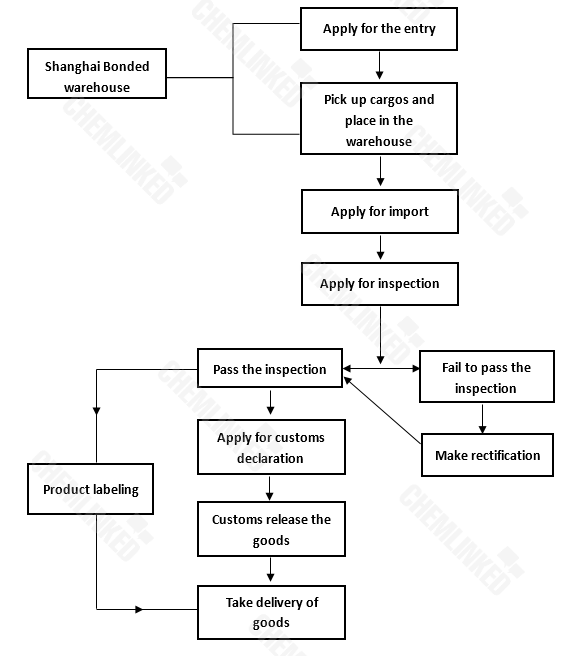
In the whole process, two phases should be in particular attention:
1. Pre-shipment preparations
1) To apply for pre-market approval
Generally, first imported cosmetics shall apply for pre-market approval with China National Medical Products Administration (NMPA) or provincial MPA 6 month prior to import. The specific application procedures can be read here on cosmepedia. With the obtained registration or filing certificate, the consignee of imported cosmetics can go through the formalities of customs inspection.
It should be noted that imported cosmetics are categorized as imported ordinary and dangerous cosmetics based on the pre-shipment assessment of properties of constituent chemical ingredients. Cosmetics containing hazardous substances shall be managed under special packaging and transportation standards of dangerous cargos and shall declare to the maritime bureau upon arrival.
The dangerous cosmetics might be:
Nail polish: Nitrocellulose, one of the common additives in nail polish, is spontaneously flammable in air.
Perfume/Floral water: The flammable liquid, alcohol, often appears as solvent in perfumes and floral water products.
In addition to the information required for the inspection of imported ordinary cosmetics, it is also necessary to provide Chinese and English MSDS (short for “Material Safety Data Sheets”), the entry declaration of dangerous goods and etc.
2) To apply for the consignee filing of imported cosmetics
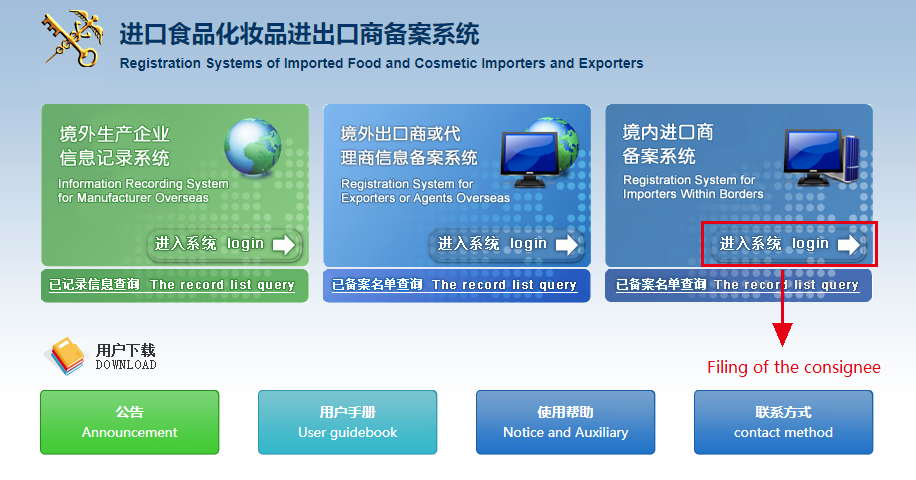
The domestic consignee of imported cosmetics refers to importers who are located in mainland China and have signed the trade contracts with the foreigner enterprises and should apply for filing via online Registration Systems of Imported Food and Cosmetic Importers and Exporters [2] in advance.
| Filing of the domestic consignee | |
| Required information | Each material shall be stamped with the enterprise’s official seal:
|
| Procedures |
|
It is worth noting that products such as toothpaste, mouthwash, soap and hand sanitizer are also classified as cosmetic category according to the import inspection and quarantine regulations even though they fall outside the definition of cosmetics under the overarching Cosmetics Hygiene Supervision Regulations. Hence, these products do not require pre-market registration or filing certificate and only need to complete the filing of imported cosmetic consignee before import.
2. Customs declaration and inspection preparations
After cosmetic registration/filing and consignee filing, the cosmetics can then be shipped to China to apply for customs declaration and inspection.
Dossiers for customs declaration
| Required Materials | Remarks |
Invoice | It must display the trade terms, country of origin, insurance, cargo lot number, cargo validity. |
Packing list | |
Trade contract | It must display trade terms and invoice number. |
IPPC wood packaging declaration / Non-wood packaging certificate | IPPC refers to “International Plant Protection Convention”. |
Chinese name | |
Customs HS code and corresponding elements for customs declaration | HS code is short for “harmonized system code”. |
Ten-digit code for importer’s customs declaration and inspection | |
Certificate of Origin |
Dossiers for customs inspection
The safety commitment of imported cosmetics
Certificate of Free Sales
Sales record
Certificate of Origin
Responsibility letter of imported cosmetics consignee
Quality and Safety Qualification Certificate
Business license of the importer
Letter of commitment that cosmetic ingredients meet the requirements for prohibited or restricted high-risk substances from Mad Disease Area
Product formula, Chinese label, original label, Chinese translation of the original label, labeling position
Points for Attention
The key to expedited customs clearance and efficient importation is to comply with the norms, especially in the phase of preparing required documents.
Cosmetics are usually small packaged products and have many varieties. Therefore, checking the quantity and variety of products with the consignor to ensure a consistent issuance policy and consistent bills before the customs declaration is essential.
The lot number of cosmetics will be specifically listed on the inspection and hygiene certificate. If there is an error, it will greatly affect the sale of the subsequent goods.
Note: The article is written by Angela from Agility [3], translated by Winnie.
 We provide full-scale global cosmetic market entry services (including cosmetic registering & filing, regulatory consultation, customized training, market research, branding strategy). Please contact us to discuss how we can help you by