Request a Demo
Under Vietnamese regulations, introducing cosmetics to the market requires prior notification to the authorities, which must be fulfilled for imported cosmetic products before the products cross the Customs Gate. Consequently, to allow sufficient time for the requisite cosmetic notification procedure, thorough preplanning is imperative for enterprises intending to launch new products.
Furthermore, cosmetic notification in Vietnam is valid for five years from the date of issuance. Noteworthy alterations to the products may mandate a fresh cosmetic notification. Therefore, importers must ensure the utilization of accurate and valid cosmetic notifications for their imported cosmetic products.
1. Competent Authority
The competent authority for cosmetics in Vietnam is the Ministry of Health (MoH), which drafts and releases regulations and guidelines for cosmetic management. Under the MoH, the Drug Administration of Vietnam (DAV) is responsible for accepting and processing the applications, issuing notification receipt numbers, as well as conducting post-marketing surveillance.
2. Legal Framework
The following are the critical legal documents that provide the foundation for cosmetic notification regulations in Vietnam.
Document Name | Implementation Date | Status | Introduction |
ASEAN Cosmetic Directive (ACD) | 1 January 2008 | In force | This document is of great significance as it serves as the foundation for all legal regulations concerning cosmetics in Vietnam. Legal regulations within Vietnam must be in line with the provisions laid out in this document. |
16 March 2021 | In force | This regulation holds the highest significance in Vietnam, as it establishes comprehensive requirements for cosmetics, encompassing areas such as notification, sub-labeling, and product information files. | |
10 February 2012 | In force | This is the DAV’s guidelines on cosmetic classification and characteristics/intended uses that companies should pay attention to when proceeding for cosmetic notification. | |
Decree No. 69/2018/NĐ-CP on guidelines for the law on foreign trade management | 15 May 2018 | In force | This document provides details of requirements for the certificate of free sale (CFS). |
12 November 2018 | In force | This document removes the requirement of providing business registration certificate when submitting cosmetic notification in Vietnam. |
3. Cosmetic Notification Documents and Procedure
3.1 Documents and Information Required
The following documents and information are required to notify imported cosmetics in Vietnam.
1) Basic information:
a. Brand name/product name/shade name
b. Product type and presentation, for example, makeup products in various colors.
c. Intended use of the product. The DAV places strong emphasis on the intended use, requiring meticulous attention when specifying it in the notification request. Please refer to Decision 1609/QLD-MP of the DAV to guide the product classification and determine acceptable intended uses.
d. Information of manufacturer(s), assembler(s), importer, notifier, and exporting country
e. List of ingredients:
Provide a list of ingredients by using International Nomenclature of Cosmetic Ingredients (INCI) names.
Include the percentage composition of ingredients with restrictions and conditions stipulated by the ACD Annex.
2) Letter of Authorization (LOA) from the product owner to the notifier with prescribed information. The document must be in Vietnamese and/or English and legalized by the Vietnamese embassy in the issuing country.
3) Certificate of free sale (CFS):
It could be from the made-in or exporting country.
CFS is exempted or replaced by other documents in some instances. For example, products made in the CPTPP* countries are exempted from submitting the CFS.
It must be legalized in the issuing country.
It must be in Vietnamese and/or English.
It should include mandatory information.
4) Additional information and documents: The DAV may require supplementary documents, such as artwork or a GMP certificate, to complement the notification request.
*CPTPP: On 8 March, 2018, Vietnam and ten other countries (Australia, Brunei, Chile, Japan, Malaysia, Mexico, New Zealand, Peru, Singapore, and Canada) signed a free trade agreement named the Comprehensive and Progressive Agreement for Trans-Pacific Partnership (CPTPP). The CPTPP provided preferential access to markets of the participating countries. On 14 January, 2019, the CPTPP entered into force for Vietnam.
3.2 Procedure and Timeline
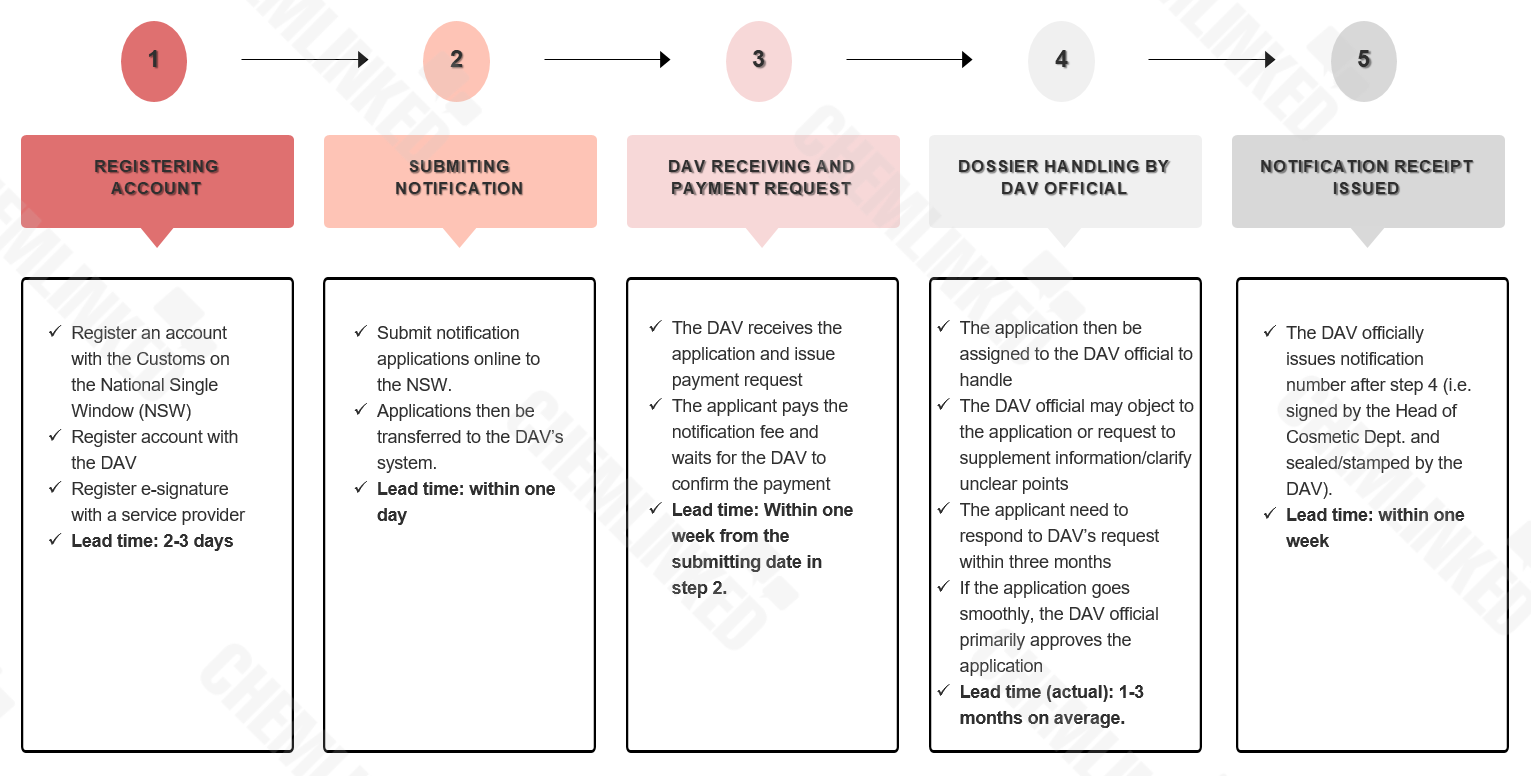 Vietnam Cosmetic Notification Flowchart
This flowchart outlines the process and timeline for notification of imported cosmetics in Vietnam:
As all submissions for imported cosmetics are made online, first, you must register an account with the National Single Window to upload your cosmetic notification requests. You can also register an account with the DAV to better watch your request proceeding. Also, to submit and transfer the request, you must register with or buy a token from the service provider for e-signature. The lead time for this step is 2-3 days.
The second step is submitting your notification request to the National Single Window System, which is usually immediate but may occasionally take up to one day due to system backlog.
In the third step, the DAV receives your request and fee payment, typically taking a few days to a week.
The request is then assigned to the DAV expert. It will be approved if your request proceeds smoothly without needing clarification or supplements. However, if the DAV expert raises concerns, you will have a three-month window to respond. For example, the DAV expert may object to the notification request because the intended use is considered not acceptable/over claimed; or the information is inconsistent in the dossier.
If the request goes smoothly, or if your response to all concerns raised by the DAV is satisfactory, your request will be approved. Typically, it takes a few days to a week for the notification receipt to be issued and released on the National Single Window.
The whole notification process typically takes one to three months to complete.
4. Change of Notification
1) A new product notification is required in case any of the following changes:
Brand name
Product name
Shade name (for products that have shades, like makeup products)
Notifier
Product type
Intended use
Formula (ingredients)
Manufacturer or assembler (name and/or address)
2) Any other change in current notifications subject to updates, including:
Change of the product presentation
Change of the tame and/or address of notifier when the number of certificate of business registration or investment certificate is not changed
Change of the name and/or address of the importer/importing country
Change of the company representative
5. Advice for Companies Entering the Vietnamese Market
As the responsible company must submit a cosmetic notification to the DAV for approval before importing cosmetics to Vietnam, it is very important to plan well to ensure cosmetic notification is ready when your products arrive at the Customs Gate. Waiting for notification approval after your products arrived can lead to additional costs for Customs' warehousing, and the risk of product damage and loss during storage.
Make sure you have a local business entity or a local partner who has permission to trade cosmetic products in Vietnam, as they are the ones who can submit the notification dossier online.
Prepare the notification dossier with required documents, including basic information, CFS and LOA.
Check the validity of the CFS and the LOA and make sure they include all prescribed information. The inconsistency in information would be the reason of objection to your notification request. For example, the objection may happen when the manufacturer's address is inconsistent between the CFS and the LOA.
ChemLinked Service
To meet users' increasing demand in Vietnam's cosmetic market, ChemLinked provides cosmetic consulting and notification services in Vietnam.
For stakeholders looking to explore our compliance services in Vietnam, we recommend the following resources as valuable references:
 We provide full-scale global cosmetic market entry services (including cosmetic registering & filing, regulatory consultation, customized training, market research, branding strategy). Please contact us to discuss how we can help you by