Request a Demo
Key terms:
HPA Law: Law of the Republic of Indonesia Number 33 Year 2014 concerning Halal Product Assurance
BPJPH: Halal Products Certification Agency from Oct. 17, 2019 (Badan Penanggulangan Jaminan Produk Halal)
LPH: Halal Audit Institution (Lembaga Pemeriksa Halal)
MUI: Current Halal Certificate Issuing Institution (Majelis Ulama Indonesia)
LPPOM MUI: Certification body which is the MUI Food, Drugs and Cosmetics Assessment Body
Indonesia is the fourth biggest country in the world with about 260 million people, of whom more than 86% are Islamic, making Indonesia the largest Muslim country in the world. Muslims have strict standards on diet and consumer products. For the same kind of products, Muslim consumers will give priority to products with halal certification labels.
1. Introduction on Halal Certification
1.1 Competent authorities
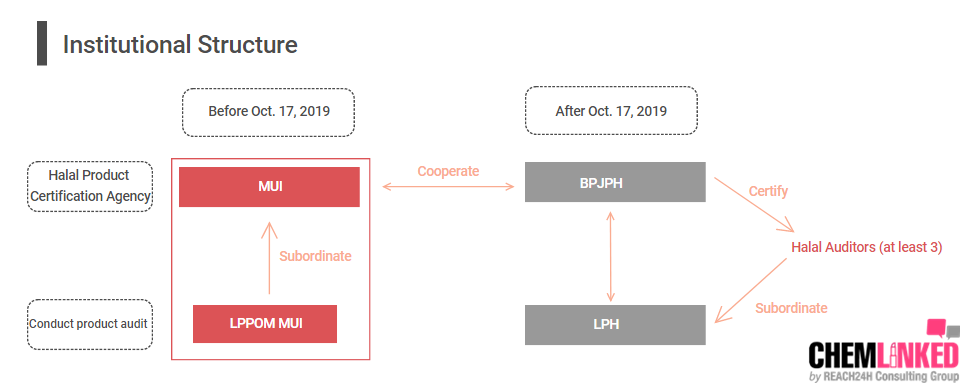
The current halal certificate issuing institution is the MUI. MUI is the supreme and most authoritative Islamic organization in Indonesia, with LPPOM MUI for halal certification audit for cosmetics, food and medicines. At present, halal certification is voluntary. Products without halal-certified can be sold in the Indonesian market.
To give consumers a guarantee of whether products are halal, on Oct. 17, 2014, Indonesia issued Law Number 33 Year 2014 concerning Halal Product Assurance, which would be effective on Oct. 17, 2019. The Article 4 of the HPA Law stipulated that all halal products which are imported, distributed and traded in Indonesia or services related to cosmetics, foods, beverages, medicines, chemical products, biologic products and genetically modified products must be certified halal from Oct. 17, 2019. Halal-certified products must label “Halal” on the outer packaging, or non-halal information for which is not certified as halal, indicating that it is a non-halal product.
BPJPH has been newly founded in 2017 to take charge of halal certification responsibilities, but is not fully ready yet to start its operation. It will cooperate with MUI to start to handle the application for halal certification from Oct. 17, 2019.
According to the Article 6 of the HPA Law[1], BPJPH has the authority to 1) formulate and establish the policies concerning halal product guarantee, 2) establish the norms, the standards, the procedures and the criteria for halal product guarantee, 3) issue and annul halal certificates and halal label and 4) register halal certificates of foreign products, etc. Specific duties, functions and the organizational structure of BPJPH are to be stipulated in President Regulation.
1.2 Halal certification process
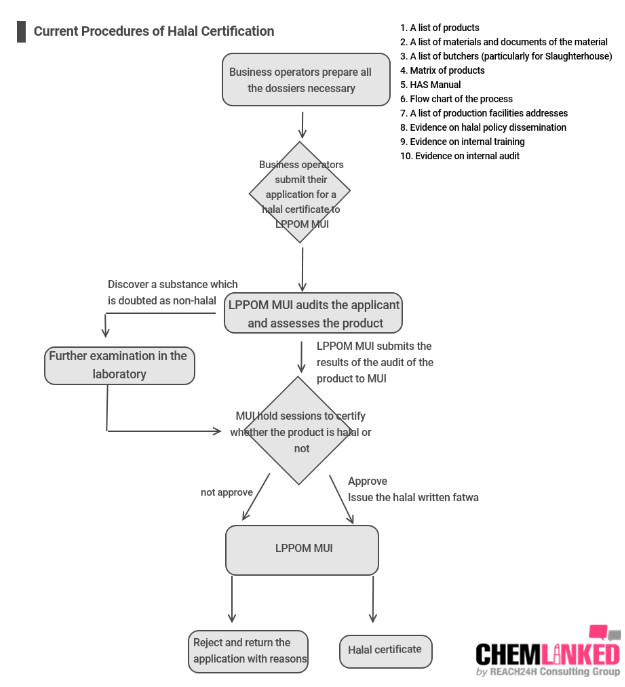
Now - Oct. 17, 2019:
Currently if enterprises want to obtain a halal certificate, they can apply to LPPOM MUI voluntarily after all the dossiers are ready. After LPPOM MUI conducting formal audit, it will submit the results to MUI. If MUI approved, a halal certificate will be issued. The entire process takes an average of 75 days. But the timeline is not included the document preparation before the submission and it will be longer under certain conditions, we expect it to take an average of 6 months.
Oct. 17, 2019 – Future:
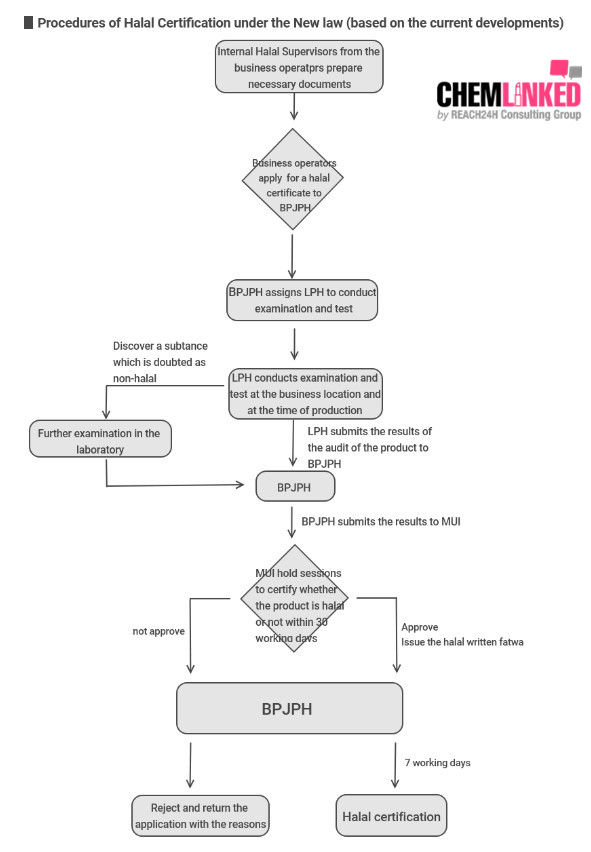
After the implementation of the HPA Law, business operators will face more complicated halal certification procedures.
Throughout the halal certification process under the HPA law, BPJPH needs to cooperate with other units, at least involve 4 governmental and non-governmental organizations. The business operator first applies to BPJPH, BPJPH assigns LPH for examination and test. The inspection report will be sent back to BPJPH, and BPJPH will submit it to MUI to determine whether the product can obtain halal certification. If MUI approved, BPJPH will issue a halal certificate to the applicant.
Due to the complexity of the application process compared to the current procedures, there may be a delay in the issuance of certificates. According to Baker McKenzie, BPJPH aims to take less than 60 working days for the entire certification process, but there is no articles in the HPA Law that could back up this aim since it does not provide a clear timeline for how long the audit process by LPH will take. For business operators, a more complicated halal certification procedures will increase costs, especially for the products that require regular inspections.
1.3 Latest Updates
Sukoso, the head of BPJPH, recently said that the authorities will not require all the products to be halal-certified immediately, but to implement the HPA Law step by step, likely meaning there will be some form of grace period offered. A simple timeline could be as follows:
Year 1-5 (2019-2024): Focus on food and beverages first, realize the goal that most of the halal food and beverages are certified;
Year 5-7 (2024-2026): Focus on health products and drugs.
If some of the products do not meet the standards of halal certification, the manufacturers have 5 years to improve their products.
Indonesia estimates that it will issue at least 100,000 halal certificates in 2020 and increase the personnel of halal certification audit to 5000. Halal certificate issued by BPJPH after Oct. 17, 2019 will be valid for 4 years. The renewal of the halal certificate must be applied no later than 3 months before the validity of the halal certificate expires. Halal certificates issued by MUI before HPA Law takes effect are still effective until they expire [2].
2. Problems may occur on Halal Certification
The HPA Law covers a wide range of consumer products and is the first law to adopt mandatory halal certification in the world, it may have a negative impact on import and export trade. Although the Enforcement Rule of the HPA Law hasn’t been released yet, HPA Law has caused widespread controversy internationally, mainly focusing on the following 3 aspects.
2.1 The HPA Law prohibits non-halal products?
The European Union once questioned [3] whether or not the halal certification will be used to distinguish between halal or non-halal products, or used to prohibit non-halal products from entering the Indonesian market. Indonesian authorities subsequently stated that halal certification was developed to assure the halal status of products and reassure consumers when making purchasing decisions, and will not be used to prohibit non-halal products from entering Indonesian market.
2.2 Increase SMEs cost burden
2.2.1 Mandatory Labelling of “Halal” and Non-halal Information
According to Article 25 and Article 26 of the HPA Law, halal-certified products must label “Halal” on the outer packaging, or non-halal information for which is not certified as halal. For consumers, labelling “Halal” on the outer packaging is enough to identify halal products. Mandatory requirement of non-halal labeling will increase the cost burden of SMEs, affect product pricing and consumer demand.
Except for mandatory labelling, the HPA Law also has strict requirements for the way labels are marked. “Business operators that have obtained halal certificate must include the halal label on product packaging, specific part of the product or specific place on the product”, “The Halal label must be easy to see and read as well as not easily erase, detach and damage”. These strict and mandatory labelling requirements are likely to impose a significant barrier to market entry for many existing stakeholders. The HPA Law does not give examples of a qualified labelling, it is subject to the Enforcement Rule which will be released in the future.
Note: The Enforcement Rule has been submitted to the president for approval on Jun. 30, 2018. According to The Jakarta Post[4], it has been supported and signed by all relevant ministers, which is expected to be released soon.
2.2.2. Halal logistics and storage
According to Article 25 of the HPA Law, ”Business operators must separate the location, place and equipment for processing, storing, packaging, distributing, selling, and presenting between Halal and non-halal product”. This Article emphasizes the importance of halal logistics and storage. For example, a halal product is deemed to be non-halal if it is stored using non-halal packaging [5].
The major doubts in various countries are that it will ultimately increase the logistics and storage cost of manufacturers and the consequences of these separations will be borne by consumers. This means that there is a possibility that halal products will become more expensive and spend more time on the market, especially for products from non-Muslim countries. There may be no corresponding logistics measures in non-Muslim countries, which requires a substantial increase in costs. If this Article is strictly implemented, it may reduce the number of imported halal products.
2.3 Trade barriers on imported halal certified products
According to Article 47 of the HPA Law, foreign halal products that are imported into Indonesia do not require Halal Certificate application to BPJPH, but must be issued with a Halal Certificate issued by a BPJPH approved foreign halal certification body.
Updated January 2019, LPPOM MUI recognized halal certificates issued by 45 approved halal certification bodies from 26 foreign countries. For products produced in Europe any approved halal certification body located in Europe is acceptable. But if the Halal Certificate is not issued by any certification bodies on the list, BPJPH will re-evaluate whether the product meets the Indonesian halal standards.
Another problem is that after Oct.17, 2019, it is still not clear whether the approval procedures of foreign halal certification bodies are the same with the current procedures, and whether the current approved foreign halal certification bodies are still valid.
In addition to the above 3 problems, there are other doubts surrounding the Indonesian HPA Law. But the Enforcement Rule has not yet been released with the implementation deadlines of mandatory halal certification approaching, thus the grace period for business operators will be very short. It is advisable that businesses involved in halal products be ready and keep yourself updated on the implementation of the HPA Law.
For other information about halal certification, please refer to CL News, expert articles and related webinars.
*The article is written based on the current developments and the limited information provided under the HPA Law, still subject to the Enforcement Rule to be issued later.
 We provide full-scale global cosmetic market entry services (including cosmetic registering & filing, regulatory consultation, customized training, market research, branding strategy). Please contact us to discuss how we can help you by