Request a Demo
On August 8, 2022, Shanghai Minhang District Administration for Market Regulation (AMR) released an administrative penalty, punishing a cosmetic company that claimed its essence had anti-aging (抗衰老) efficacy in its Tmall flagship store. 1
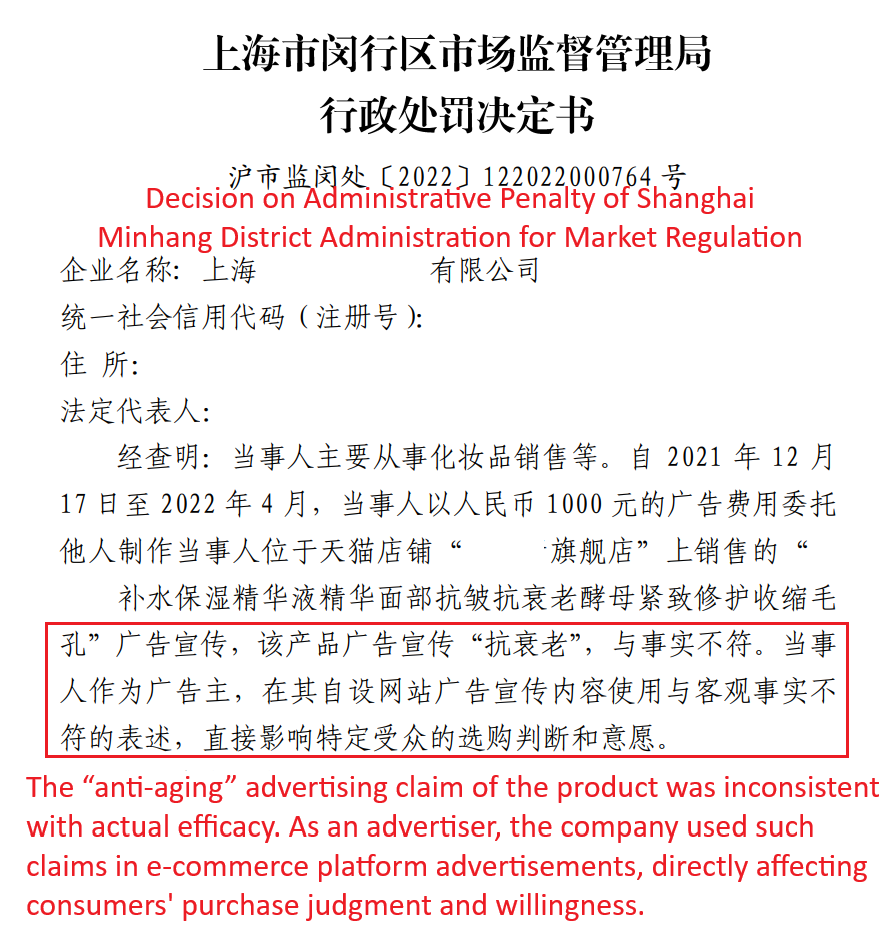 Screenshot of the Decision on Administrative Penalty of Minhang AMR
Based on relevant evidence, Minhang AMR determined that the “anti-aging” advertising claim of the product was inconsistent with actual efficacy. As an advertiser, the company used such claims in e-commerce platform advertisements, directly affecting consumers' purchase judgment and willingness. This behavior violated Article 4 of the Advertising Law of the People’s Republic of China (Advertising Law) and constituted the conduct of false advertising under Article 28 of Advertising Law. Minhang AMR ordered the company to stop publishing the advertisement and eliminate the influence, and fined the company 4,000 yuan.
Article 4 of Advertising Law | Advertisements shall not have any false or misleading content and shall not defraud or mislead consumers. The advertiser shall be responsible for the authenticity of the advertising content. |
Article 28 of Advertising Law | Any advertisement that defrauds or misleads consumers with any false or misleading content constitutes a false advertisement. An advertisement that falls under any of the following circumstances shall be a false advertisement:
(II) Regarding the good's performance, efficacy, origin, use, quality, specification, ingredient, price, producer, expiration date, sales status, and honors received, etc., or the service's content, provider, form, quality, price, sales status, and honors received, etc., or any commitments made on the good or service, there is any inconsistency with the actual situation, which has a substantial impact on purchases. (Circumstances I, III, IV, V are omitted.) |
Anti-wrinkle Efficacy Evaluation Report Is Insufficient to Support Anti-aging Efficacy
Searching on the NMPA notification information disclosure platform, the penalized product was notified as a Chinese domestic general cosmetic in October 2021; the efficacy evaluation was completed in January 2022. The evaluation summary publicized on the platform includes the efficacy evaluation for moisturizing, anti-wrinkle, and soothing; the evaluation method adopted is the zebrafish-related testing method.
The penalized company told a Chinese domestic media that the explanation for the penalty given by the regulatory authority was, "The scope of ‘anti-aging’ is too large. Only an anti-wrinkle efficacy evaluation report cannot fully support that this product has an anti-aging efficacy. It is not recommended for cosmetics to claim anti-aging. If the stakeholder wants to claim anti-aging for a product, it is required to conduct all the efficacy evaluation items of cosmetics, and provide the evidence issued by the hospital to support the claim." 2
Currently, this product is still on sale in the Tmall flagship store. The anti-aging claim was removed from the product information page, while the claims of moisturizing, soothing, anti-wrinkle and firming, etc. were retained.
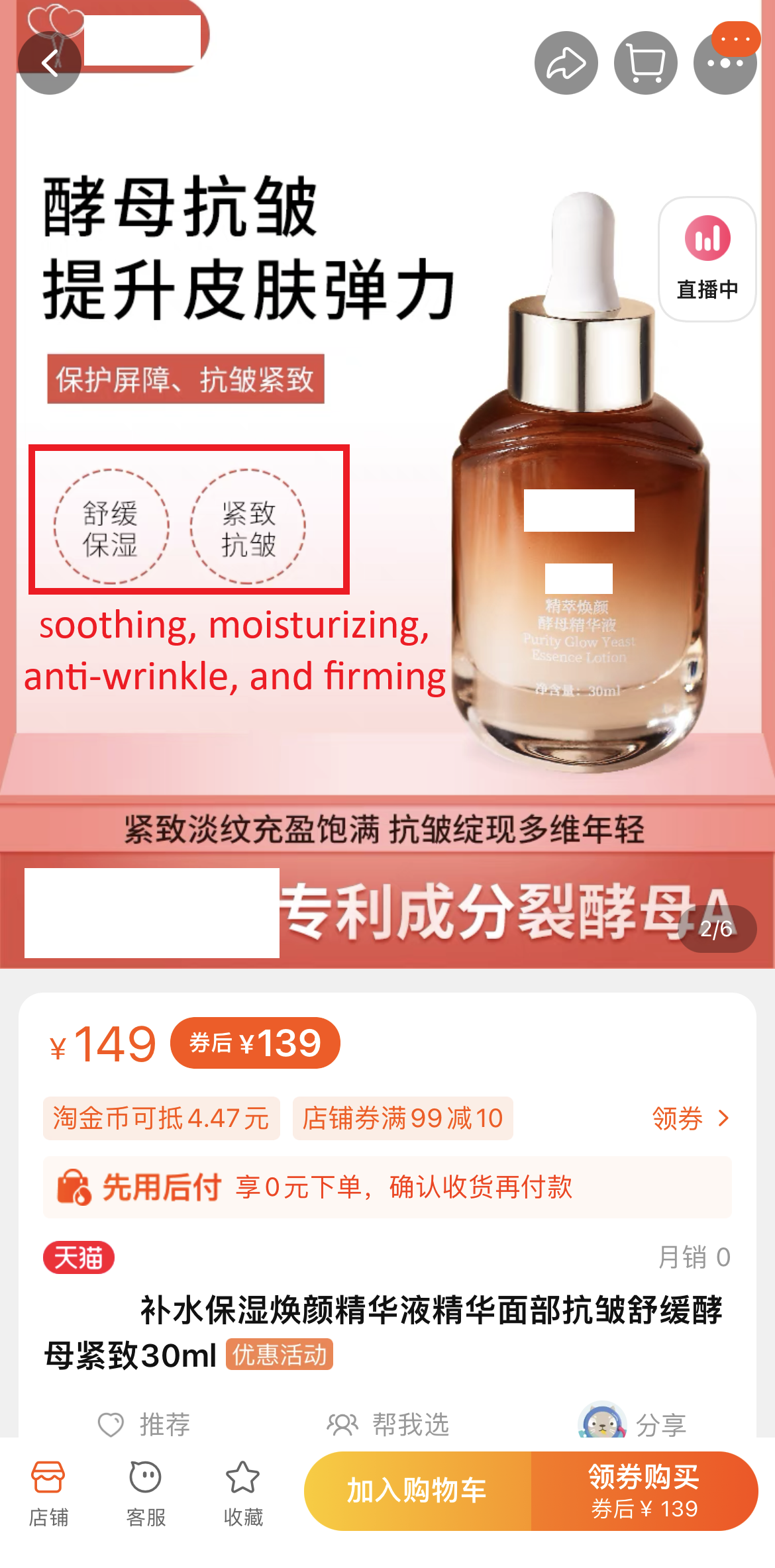 Screenshot of the Penalized Product Page
The Previous Penalty for Product Claiming Anti-aging
This isn't the first time a product has been penalized for claiming anti-aging. In January 2022, a cosmetic company was punished by Shanghai Jing’an AMR for using the claims of “anti-aging” and “continuous anti-aging and firming” in the product title and image of the flagship store on Xiaohongshu. 3
According to an overseas experimental report provided by the penalized company, the product can reduce the length, depth and volume of wrinkles in the skin. However, there is no relevant evidence or experimental data in the report supporting that the product has an anti-aging efficacy. Moreover, the penalized company cannot provide another testing report to support that the product has an anti-aging efficacy.
Jing'an AMR believed that the anti-wrinkle efficacy of this product is only aimed at improving the skin aging phenomenon, and cannot be overgeneralized as "anti-aging" efficacy. Without sufficient scientific basis, the company advertised the product’s anti-wrinkle efficacy as anti-aging, which was an inaccurate description of the product’s efficacy, violating Paragraph 1, Article 8 of the Advertising Law. The company was ordered to stop publishing the advertisements and imposed a fine of 30,000 yuan.
Paragraph 1, Article 8 of the Advertising Law | Where an advertisement describes the good’s performance, efficacy, origin, use, quality, ingredient, price, producer, expiration date, and commitment, or the service’s content, provider, form, quality, price, and commitment, such description shall be accurate, clear, and understandable. |
Industry Opinions on Anti-aging Claim
Anti-aging claim is not on the list of the 26 efficacy categories
Under the CSAR regulatory framework, when registrant and notifier apply for cosmetics registration or notification, they shall fill in the product classification code in accordance with Cosmetics Classification Rules and Classification Catalog (Catalog). The Catalog divides cosmetic efficacies into 26 categories and new efficacies, while the claim of “anti-aging” is not listed in the Catalog.
Regulatory ambiguity remains over anti-aging claim
The person in charge of the product R&D of Yatsen Global said that currently there is no detailed and unified standard for the correlation of the 26 efficacy categories and the specific efficacy claims. The industry has different understandings of the words and expressions that are allowed to be claimed under a certain efficacy category. 2
In the opinion of an industry insider, Li Jincong, although CSAR has clarified that the product’s efficacy claims shall be supported by sufficient scientific basis, practitioners still face much confusion in efficacy evaluation and claims.
For some claims such as "anti-aging," the new regulations have not made it clear whether they are allowed to be used, and there are no detailed enforcement standards;
In addition, NMPA has not yet issued official efficacy evaluation methods for some efficacy claims, such as nourishing and repairing, for which human trial is required. Without a unified evaluation method, once NMPA does not recognize the evaluation method, it may lead to not recognizing the product’s efficacy claim. 4
Better to claim the subdivided efficacy related to anti-aging such as anti-wrinkle and firming
"It is better not to claim ‘anti-aging’ for cosmetics directly." Suggested by Guo Qingquan, a cosmetics safety review expert from NMPA. Guo said that the scope of “anti-aging” is extensive, which may refer to combating the aging phenomenon of the skin, or combating the physiological process of human body aging. The standard for anti-aging is not clear enough for now. 2
Li holds a similar opinion, "The definition of 'anti-aging' is too broad, so NMPA has not set 'anti-aging' as an efficacy category in the Catalog to avoid the misunderstanding that the product is used for anti-aging of the entire human body." 4
Among the 26 efficacy categories listed in the Catalog, the efficacies closely related to skin anti-aging are "anti-wrinkle" and "firming." To be prudent, companies are recommended to claim subdivided efficacy related to anti-aging, such as "anti-wrinkle" and "firming," provided that these claims are fully supported by evaluation reports.
Efficacy Category | Interpretation in the Catalog |
Anti-wrinkle | Helpful in slowing down the generation of skin wrinkles or making wrinkles less obvious |
Firming | Helpful in maintaining the firmness and elasticity of the skin |
The introduction of CSAR and its subsidiary regulations is to regulate the development of cosmetic industry. As enforcement rules in some regulatory areas are relatively vague, the industry is still in the stage of probe and attempt, expecting the regulatory authorities to detail the requirements of efficacy claims. In general, when making claims for cosmetics, companies must ensure that the claims are made based on sufficient evidence and the accurate, clear, and understandable product information is conveyed to consumers.
ChemLinked expects to assist companies in reviewing cosmetic product claims and registering/notifying cosmetics in China. If you have any further cosmetic compliance consultation needs, please contact us at [email protected].

 We provide full-scale global cosmetic market entry services (including cosmetic registering & filing, regulatory consultation, customized training, market research, branding strategy). Please contact us to discuss how we can help you by