Request a Demo
Malaysia stands out as a promising market for international cosmetics brands. However, navigating the regulatory landscape can be a challenge. This article delves into the essential “Cosmetic Notification Procedures” that can help stakeholders unlock the vast potential of the Malaysian market for beauty and personal care products.
1. Competent Authority
In Malaysia, Drug Control Authority (DCA) and the National Pharmaceutical Regulatory Agency (NPRA) deal with cosmetic notification. The DCA is the executive body that is responsible for the notification approval for cosmetic products, as well as the issuance of licenses for manufacturers, importers and wholesalers. The NPRA acts as the secretariat to the DCA and implements the quality control, licensing, registration and post-market surveillance of cosmetic products. All cosmetic products marketed in Malaysia must be notified to the NPRA before they can be imported or manufactured for sale in the country.
2. Legal Framework
The below critical legal documents and guidelines form the basis for cosmetic notification regulations in Malaysia:
Document Name | Description | Status |
It comprises a set of regulations established under the Sale of Drugs Act 1952. This document serves as the primary legislation governing the healthcare sector and the regulation of cosmetic products in Malaysia. | In force | |
Guidelines for Control of Cosmetic Products in Malaysia (2022) | The Circular serves as the reference for notification process including quality control, inspection and post-market surveillance activities of cosmetics. | In force |
The circulars issued by the NPRA: … | The two Circulars provide information on the updated status of ingredients in the Annexes of the Guidelines for Control of Cosmetic Products in Malaysia. |
In force |
The Guidelines provides a simple 5-step decision-making process that helps to identify products and claims which can be considered to be cosmetics (Annex I, part 8 of the Guidelines for Control of Cosmetic Products in Malaysia (2022)). | In force | |
Manual for Quest3+ Online Submission for Cosmetic Notification | This Manual explains the step-by-step instruction for cosmetic online submission, including application for the listing of new cosmetic ingredient, cosmetic manufacturer, assembler and importer, Certificate of Free Sales and notification exemption for market sampling, and in-house evaluation. (Annex I, part 4 of the Guidelines for Control of Cosmetic Products in Malaysia (2022)). | In force |
3. Submitter of Cosmetic Notification
Under the regulations of Malaysia, the Cosmetic Notification Holder (CNH) refers to a company who is responsible for placing the cosmetic product in the market. The CNH is responsible to notify the NPRA prior to manufacture, sell, supply, import and possess any cosmetic product.
The CNH must be a locally incorporated company or legal entity in the field of cosmetics, with a permanent address and registered with Companies Commission of Malaysia (with the scope of business related to the health/cosmetic product as it appears in the Memorandum and Article of Association’ of the company.)
Besides, the CNH may or may not be the product owner.
4. Responsibilities of the CNH
CNH is responsible to ensure that:
All transactions with NPRA shall be carried out by CNH’s appointed person(s).
Notified product meets all stipulated regulations and guidelines for cosmetic product.
Product Information File (PIF), including updated information/documents on product quality, safety and claimed benefit, is available and accessible upon request.
If and when directed by NPRA for product recall, CNH must ensure all affected cosmetic products are recalled from the market and discontinued from selling or supplying the product. Product distribution record must be properly kept for recall purpose.
Change(s) to notified product particulars is submitted accordingly.
Manufacturer (and assembler, where applicable) of the cosmetic product is compliant to the current Good Manufacturing Practice (cGMP).
In the incidence of a serious adverse event, CNH shall report to NPRA appropriately.
Particulars given for product notification are truthful where all data and information relevant to the notification has been provided.
Each consignment continues to meet all legal requirements and conforms to standards and specifications declared for the product.
When a product fails to conform to any of the standards or specifications declared for the product, CNH cannot place reliance on the acceptance of the product notification in any legal proceedings.
Correspondence details such as the company’s name, address, contact person, telephone number, fax number and email shall be kept updated.
Cessation of the authorization of the CNH shall be informed to the NPRA in writing.
Any decision to withdraw the notification of a product shall be informed to the NPRA, with reasons
5. Documents and Information Required
The following information is required for cosmetic notification:
A | Particulars of the CNH:
|
Particulars of a person represent the CNH:
| |
B | Particulars of the product:
|
C | Particulars of manufacturer(s) and assembler(s), if any: Name and address |
D | Particulars of importer(s) (if applicable): Name and address
Notes: An applicant may appoint one or more importers. |
E | Particulars of distributor(s) (optional) |
F | Product formulation: Full product ingredient list (the content, i.e., percentage (%), of restricted ingredients must be declared) |
G | Product label |
H | Letter of Authorization/Letter of Declaration
Note: - Letter of Authorization (LOA): The letter is issued by the product owner authorizing the CNH to notify the list of products and brands with the NPRA and to be responsible for all matters pertaining to product notification.
- Letter of Declaration: The letter is produced by the CNH which states the ownership of brand name, including the list of products or brands for product notification with the NPRA and be responsible for all matters pertaining to product notification. |
6. Procedure and Timeline
After submitting the notification form to the Quest system, the CNH will proceed with the payment to the NPRA. Payment can be made via Personal Account (B2C), Corporate Account (B2B) or Credit Card.
A general workflow of a notification process is shown below.
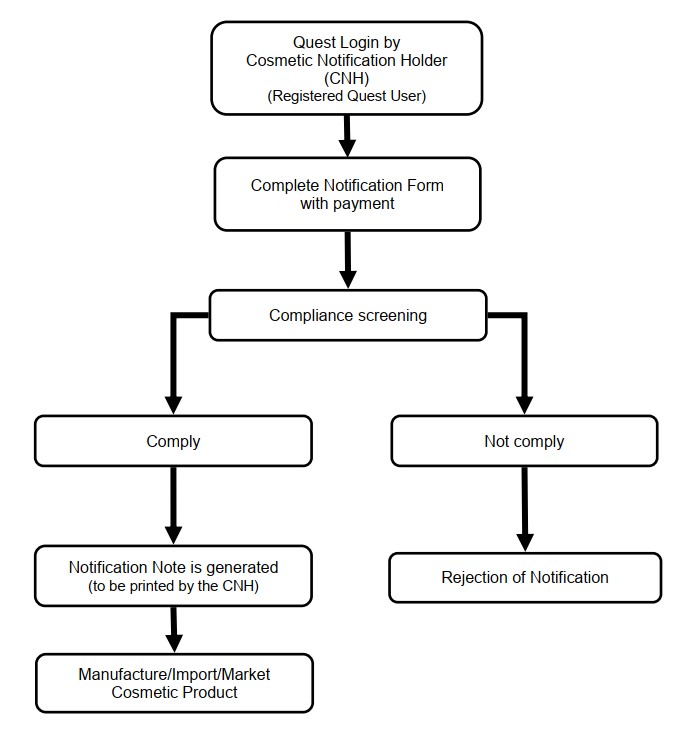 Cosmetic Notification Process in Malaysia
In principle, notification number is to be generated within 1-3 working days after payment confirmation by NPRA to enable printing of the Notification Note by the applicant themselves. This Notification Note will serve as the authorization to market, import, manufacture and wholesale cosmetic products.
Therefore, the conventional timeline for cosmetic notification procedures in Malaysia often ranges from one to two weeks.
7. Renewal and changes of notification
Renewal
In Malaysia, a cosmetic product notification is initially valid for 2 years. If a company intends to continue selling these products after notification expires, they must renew the cosmetic notification. The renewal process should be completed no later than one month before the current notification's expiration date.
Changes of notification
Any subsequent changes to the particulars of the notified cosmetic product must be submitted to the NPRA. There are two types of changes:
Type 1 Changes to the current notification only Items to be changed: 1. Product presentation (single product, palettes in a range, etc.) 2. Person representing company 3. Importer(s)/distributor(s) 4. Letter of Authorization/Letter of Declaration/Letter of Contract Manufacturing 5. Product Label(s) Processing fee: 0 Notification number: Unchanged |
Type 2 Changes subject to a new notification Items to be changed: 1. Brand name 2. Company change due to the change of distribution rights 3. Product types 4. Intended use 5. Product name 6. Formulation 7. Manufacturer and/or assembler (name and/or address) Processing fee: RM 50.00 Notification number: A new notification number will be issued |
Notes:
1. For the change of company name and/or address without change of distribution rights, stakeholders should contact Center of Regulatory Coordination & Strategic Planning.
8. Concluding Thoughts
The cosmetic regulations in Malaysia closely align with the ASEAN Cosmetic Directive, but include specific requirements and variations. Here are some essential compliance notes for companies looking to navigate the Malaysian market:
Establish a Local Presence: Comply with the regulations, the CNH must be a company incorporated in Malaysia and possess a valid trading license. Foreign owners have the option to either establish their own local company to serve as the CNH, or collaborate with a local partner who can fulfill this role and act as the responsible person for cosmetic products marketed in Malaysia.
Timely Notification: Submit the notification through the NPRA Quest system at least 30 working days before the intended importation or manufacturing of the cosmetic products for sale in Malaysia.
Notification Validity: Ensure the ongoing validity of cosmetic notifications throughout the product's lifecycle. It's important to note that a cosmetic product notification remains valid for two years. If a company intends to continue selling these products, they must renew the cosmetic notification in time.
Notification Updates: In cases where changes happen as mentioned in section 7 above, make sure to promptly update the product notification to reflect these alterations.
Stay Informed: Keep informed of any changes in local regulations that may impact cosmetic products, such as updates to regulations on prohibited ingredients.
 We provide full-scale global cosmetic market entry services (including cosmetic registering & filing, regulatory consultation, customized training, market research, branding strategy). Please contact us to discuss how we can help you by