38 Must-Read FAQs on China’s Cosmetic Ingredient Submission Code: A Clear Application Guide
Apr 08, 2022
Winnie Xu
ChemLinked compiled a collection of useful FAQs on cosmetic ingredient submission code to help stakeholders better understand the new regulations, so that they can successfully complete the applications for ingredient submission codes in China. The FAQs are divided into seven categories: current policies, application qualification, general documentation requirements, ingredient safety information, generated code, submission platform, and others.

ChemLinked will keep updating new FAQs. Please stay tuned to get the updates.
It has been four months since the launch of the cosmetic ingredient safety information submission platform ("the submission platform") on December 30, 2021. The application for ingredient submission codes has become an essential task for many ingredient suppliers in 2022. However, in the face of a brand-new system and the lack of accurate submission guidance documents, enterprises have encountered many difficulties and found several problems of the submission platform that need to be solved by the submission platform.
To help stakeholders better understand the new regulations and successfully complete the applications for ingredient submission codes, ChemLinked compiled a collection of useful FAQs based on NMPA or provincial MPA's notices, industry discussions, and customers' inquiries, as well as REACH24H’s rich experience in this area.
1. Current Policies
1. Is it mandatory to obtain an ingredient submission code?
No, it is not mandatory. As per the Provisions for Management of Cosmetic Registration and Notification Dossiers (“the Provisions”) and the Technical Guidance for Submission of Cosmetic Ingredient Safety Information (“the Technical Guidance”), cosmetic registrants, notifiers, or domestic responsible person can submit the cosmetic ingredient safety information in either of the following ways:
Fill in the ingredient submission code generated by the submission platform to associate with the ingredient safety information; or
Fill in the manufacturer information of the ingredients used in the product and upload the ingredient safety information documents (“Annex 14 of the Provisions”) issued by the ingredient manufacturer.
However, ChemLinked recommends that ingredient manufacturers actively apply for submission codes. That's because NMPA will vigorously promote ingredient submission codes as they can help regulators quickly trace products containing problematic ingredients in the event of ingredient safety issues. From the cosmetic finished product companies' point of view, they also prioritize ingredients with submission code, as the code can help them simplify the registration and notification procedures.
2. Applicant Qualification
1. How to define an ingredient manufacturer? Can the ingredient distributor submit the safety-related information of cosmetic ingredients through the submission platform?
Cosmetic ingredient manufacturer refers to the enterprise that should be responsible for the safety of ingredients. It can be:
the actual production enterprise of ingredients; or
the affiliated enterprise belonging to the same group company as the actual production enterprise of the ingredients; or
the entrusting enterprise which entrusts the ingredient production to another party.
If the ingredient distributor is also the ingredient manufacturer, it can submit the cosmetics ingredient's safety information by itself. Otherwise, after submitting the Power of Attorney (POA) issued by the cosmetic ingredient manufacturers, it can gain permission to submit cosmetics ingredient's safety information as an authorized enterprise. The POA should specify the relationship and the scope of authorization, and only one company can be authorized to provide the safety information of the ingredient with the same specification of quality.
2. For overseas ingredients without an entity company, is it possible to submit their ingredient safety information in the name of an individual?
No, only ingredient manufacturers or their authorized enterprises are eligible for the submission, who shall be a corporate legal entity.
3. If a company has an entity both in China and overseas, which entity should be appointed to obtain the submission code? Does it have to be the Chinese entity?
Both entities can conduct the submission, and the entity that submits the information shall be responsible for the safety of the ingredient. However, since the submission platform’s interface and related operation instructions are all in Chinese, we recommend that the Chinese entity serves as the applicant.
4. If our company has own brand name ingredients, but they are manufactured by another company, are we able to apply for a submission code? Or should the applicant be the company that manufactures the ingredient for us?
In this case, you are the entrusting enterprise that entrusts the ingredient production to another company. You can apply for a submission code by yourself.
5. Can an authorized company help more than one company register on the submission platform?
Yes, an enterprise can be authorized by multiple companies to help them obtain ingredient submission codes simultaneously.
6. As an overseas company, if I register my ingredients through an authorized entity in China, and after two years, I decide to change my authorized entity in China, will I lose all my previous submission codes?
One ingredient can only be authorized to one company, and currently it is not possible to change the authorized company. In addition, the submission code obtained belongs to the ingredient manufacturer rather than the authorized company.
3. General Documentation Requirements
1. Do Chinese authorities accept English versions of documents that need to be uploaded, or should all these documents be translated into Chinese?
All required documents shall be translated into Chinese.
2. What is the "enterprise certification" document for international ingredient manufacturers? How long does the certification by the Chinese embassy take?
“Enterprise certification” refers to a certificate proving that an international manufacturer is a legal entity. It can be a business license from the country where the manufacturer is located. The processing time at the Chinese embassies varies. Generally, the certification may take one to two months.
3. Is a GMP certificate required for the submission of ingredient safety information?
GMP certificate is not required for the submission of ingredient information.
4. To authorize a third-party company to carry out the formalities, is the legalization of the company's documents at the embassy sufficient, or does it also have to be notarized by a notary public in China?
You can choose either way, notarized by a Chinese notary public or certified by the Chinese embassy (consulate). Therefore, the legalization of the company’s documents at the embassy is sufficient.
4. Ingredient Safety Information
1. Is there any requirement for the number of significant digits for the composition and content of the reported ingredient?
Neither the Provisions nor the Technical Guidance stipulates the requirements for significant digits of the ingredient submission code. However, given that the cosmetic notification system generally requires the number of significant digits for ingredients’ content be within five digits, we suggest that ingredient suppliers and downstream finished product companies unify the significant digits, which should not exceed five digits, and then apply for the ingredient submission code.
2. Is it possible to fill in the “Recommended Addition Amount in Cosmetics” higher than the ingredient’s highest historical use concentration specified in
IECIC 2021?
Yes. But it’s better to have a certain basis for the recommended addition amount, such as safety assessment data, efficacy factor, or any evidence to prove the concentration is safe.
3. How to fill in the "Typical/Target Value"?
It is a must filled-in item. For the mixture produced by the synthesis process, etc., it is allowed to only fill in the concentration range since it’s difficult to get the exact value, and it is encouraged to also fill in the “typical/target value”. The value can be a theoretical one, an average one obtained by monitoring over a long period of time, or a representative one.
While for a compound/mixed ingredient produced by other reasons such as mixing extraction, addition of necessary solvents or stabilizers, etc., it is required to fill in the "typical/target value." Namely, all added solvents, stabilizers, preservatives, and antioxidants in the compound ingredients must be filled in truthfully.
4. Is it needed to include “Use Purpose” for the ingredient?
The “Use Purpose” shall be provided. It is recommended to select from the options provided by the system rather than filling in manually.
5. How to fill in the “Risk Information and Control Indicators”?
According to the Technical Guidance, this item shall be filled in "when necessary." Applicants should comprehensively judge whether the ingredients will bring heavy metals, microorganisms, and other risky substances, according to the source of ingredients, the characteristics of the production process, etc., and fill in the item according to the actual situation.
6. Is it mandatory to fill in the pesticide residues? What about heavy metals?
Pesticide residue is not a must filled-in item, nor is heavy metal. It will not affect the submission even if these items are not actually controlled. However, considering that plant extracts may have the risk of pesticide residues, we suggest you control the pesticide residue indicator.
7. Which heavy metals must be indicated on the submission platform? Only arsenic, cadmium, lead, and mercury or others?
The heavy metal indicators not only include Arsenic, Cadmium, Lead, and Mercury, but also other heavy metals, such as Chromium, Nickel, Selenium, Beryllium, Stibium, Strontium, Zirconium, Cobalt, etc.
8. What data can be referred to for the "Assessment Conclusions from International Authoritative Institutions"?
At present, we mainly refer to the data of the US Cosmetic Ingredient Review (CIR), the European Food Safety Authority (EFSA), the European Chemicals Agency (ECHA), etc. Regarding the use requirements for other industries, we mainly search for relevant information online.
9. How to fill in the "Quality Control Requirements" in Annex 14?
The quality control requirements mainly include the control information such as the identification method, quantitative control indicator, and microbiological indicators. Generally, you can refer to the information in the Certificate of Analysis (COA).
10. How to fill in the limit requirement of the “Risk Substance Limit Requirements” in Annex 14?
If there are specific limit requirements in the Safety and Technical Standards for Cosmetic 2015 (STSC 2015), it should comply with STSC 2015. If there is no limit requirement in STSC 2015, it is recommended to control the limits within the self-determined safety limit.
11. Many of our suppliers completed Annex 14 forms before the platform came into service. Is this enough, or is a submission code still required?
The completion of Annex 14 is sufficient, but it is recommended to complete the ingredient submission and obtain the ingredient submission code, which is more convenient and can guarantee the confidentiality of information.
5. Generated Ingredient Submission Code
1. Is the ingredient submission code time-limited like the registration license? Does it need to be updated regularly?
Currently, the regulations do not mention this.
2. As a product registrant, can I search for the ingredient submission code in an online catalog? Or can I only obtain this information via the ingredient manufacturer?
You can only obtain the ingredient submission code from the ingredient manufacturer.
3. Can a supplier of ingredient mixtures use the submission code of each single ingredient to get the submission code of its mixture?
No. The mixture will be considered as one ingredient in this case, and it can only have one submission code.
4. Will ingredients manufacturers be informed of final product companies which are using their codes?
The ingredient manufacturer can know who he gives his submission code but cannot know whether the code is actually used for registration or notification applications.
5. Do we need to update the code from time to time?
Currently, after an ingredient obtains a reporting code, the update to its information will not be accepted. If the ingredient supplier updates the ratio of the ingredient, they need to obtain a new code, and thus the finished product may need to be re-notified.
6. Once the application is submitted, would the ingredient code be generated right away or after the submission is approved? How long does the approval by NMPA take after the submission on the platform?
The code will be generated immediately after the submission of the ingredient information, and the submitted information does not need to be approved by NMPA.
7. If the same ingredient comes from two different suppliers, will we need to get two different codes?
The submission code is unique for each ingredient supplier. Although it is the same ingredient, the code will be completely different since it is supplied by different suppliers.
8. Can multiple ingredient submission codes be filled in for an ingredient?
Yes. The general cosmetics notification management system allows filling multiple ingredient submission codes for one ingredient.
6. Submission Platform
1. Is the ingredient submission platform available in English? If not, could you advise how the overseas suppliers register their ingredients on the platform?
At present, the ingredient submission platform is only available in Chinese. Overseas suppliers can entrust a professional organization like REACH24H to assist in obtaining the submission code in the name of their own company or entrust their Chinese distributors to complete the submission.
2. If the ingredient information is wrongly submitted, is it possible to withdraw and correct it? Is it possible to modify the intended use or the specifications of the reported ingredient? What if the company name or address changes due to reasons like corporate mergers and acquisitions?
Only unsubmitted ingredient safety information can be changed. After submission, there is currently no method to delete or modify the ingredient information. If applicants have to change the information, they need to apply for a new submission code. So, it is necessary to ensure the accuracy of the ingredient information when conducting submission.
3. When will the ingredient submission platform allow modification of enterprise information and ingredient information?
We don't have information in this regard so far. Officials mentioned in the cosmetics section of the online platform of the National Public Complaints Proposals Administration that they have realized the problem. However, since the submission platform has just been established, some functions need further perfection. After the platform is upgraded, functions that allow modification of the submitted ingredient information may be added. Please stay tuned to ChemLinked. We'll keep you posted on the latest update of the submission platform.
4. Will the name of the manufacturer remain confidential? If we provide the code to our customers, can the customers discover the name of the manufacturer from the code?
At present, applying for an ingredient submission code or sharing it after the submission will not give away any information about the manufacturer.
5. How to keep ingredient safety information confidential?
The system will keep the ingredient safety information confidential. Companies applying for ingredient submission code do not need to worry about the disclosure of ingredient information when the ingredients are publicized, or when filling in the ingredient submission code to associate with the ingredient safety information document for cosmetic notification.
The ingredient submission publicity platform will not publicize the composition proportion of ingredients, nor the ingredient’s trade name and manufacturer information, but only some figures of the ingredient submission code and part of the composition of ingredients. For example, it only publicizes the first two components for compound ingredients, as shown in the picture below.
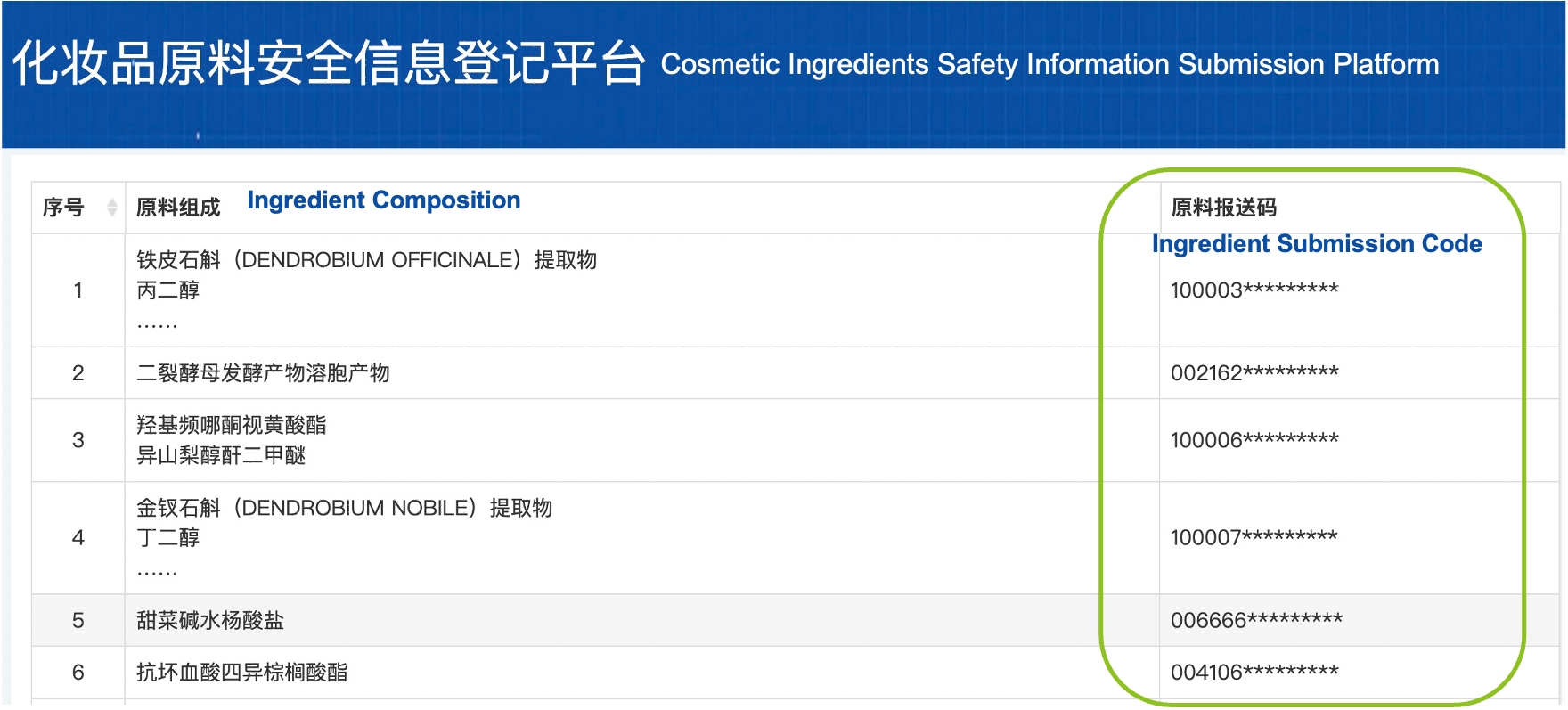 Cosmetic ingredient submission publicity platformWhen filling in the ingredient submission code for cosmetic notification, the ingredient’s safety information document will not be displayed on the notification system. Only the ingredient submission code will be displayed.
7. Others
1. What's the difference between the ingredient submission code and new cosmetic ingredient notification/registration?
New cosmetic ingredient notification/registration targets cosmetic ingredients that are not listed in the IECIC 2021 and are used for the first time in China. The object is single substance, which can be understood as an INCI name. The new cosmetic ingredients can be used in cosmetics only after registration/notification. In contrast, the ingredient submission code is for the existing cosmetic ingredients listed in the IECIC 2021, including single substances and compounds in the form of mixtures.
2. Is this new regulation applied only for finished products?
Yes. The regulations on the submission of cosmetic ingredient information are proposed for the registration or notification of finished products. If an ingredient is used in products that need to be registered or notified in China, it is necessary to provide a safety information form or obtain the submission code of the ingredient.
3. What also shall be noted for filling in the ingredient submission code?
The cosmetic notification management system may prompt that the ingredient submission code filled in for the notification is inconsistent with the data on the submission platform. The notifiers should verify with the ingredient manufacturer (supplier):
Whether the ingredient submission code corresponds to the target ingredients;
Whether the specific ingredients in cosmetic formulations, such as the composition and proportion of compound ingredients, are consistent with the information reported on the submission platform.
*ChemLinked provides services to help brands apply for cosmetic ingredient submission codes. If you have any questions or need further compliance assistance, please feel free to contact us at [email protected].

We provide full-scale global cosmetic market entry services (including cosmetic registering & filing, regulatory consultation, customized training, market research, branding strategy). Please contact us to discuss how we can help you by
[email protected]
Copyright: unless otherwise stated all contents of this website are ©2026 - REACH24H Consulting Group - All Rights Reserved - For permission to use any content on this site, please contact
[email protected]


 Request a Demo