Request a Demo
Editor's note: This article was originally published on April 26, 2024, and was updated on October 11, 2024, as per the latest developments. The updated contents are marked in red below.
On February 11, 2023, the Government of Canada proposed amendments to the Cosmetic Regulations, which were published in the Canada Gazette, Part I, Volume 157, Number 6. 1 The finalized amendments were published on April 24, 2024, in the Canada Gazette, Part II, Volume 158, Number 9. 2
These amendments include requirements for cosmetics to be labeled with fragrance allergens, allowing the full ingredient list of cosmetics sold in small packages to be disclosed on websites, and modifying cosmetic supervision requirements.
On October 9, 2024, the amendments related to website disclosure of ingredient lists and modifications to cosmetic supervision requirements (the second and third part of the following article) took effect. The enhanced detail requirements for cosmetic notifications apply only to submissions made on or after October 9, 2024.
Additionally, the Industry Guide for Cosmetic Labeling, Industry Guide for Cosmetic Notification and the Cosmetic Notification Form have been updated to reflect these changes. The Cosmetic Notification form will require a Canadian address in section 4, with implementation scheduled for a later date, yet to be determined.
The requirement for disclosing fragrance allergens on cosmetic labels (the first part of the following article) will come into effect on April 12, 2026.
The detailed amendments are as follows:
1. Requiring cosmetics to be labeled with fragrance allergens
Health Canada (HC) requires the identified fragrance allergens to be labeled in the ingredient list on the package of cosmetics when their concentration exceeds 0.001% in leave-on products or 0.01% in rinse-off products.
The specific fragrance allergens that need to be labeled are consistent with the 81 entries listed in Annex III (annex of restricted ingredients) of the European Commission’s Cosmetic Products Regulation that identify fragrance allergens for disclosure on cosmetic labels. It is worth noting that this alignment includes the transition period outlined in the Annex. This ensures that the implementation date for fragrance allergens labeling of cosmetics sold on the Canadian market corresponds to the implementation date for cosmetics made available on the EU market.
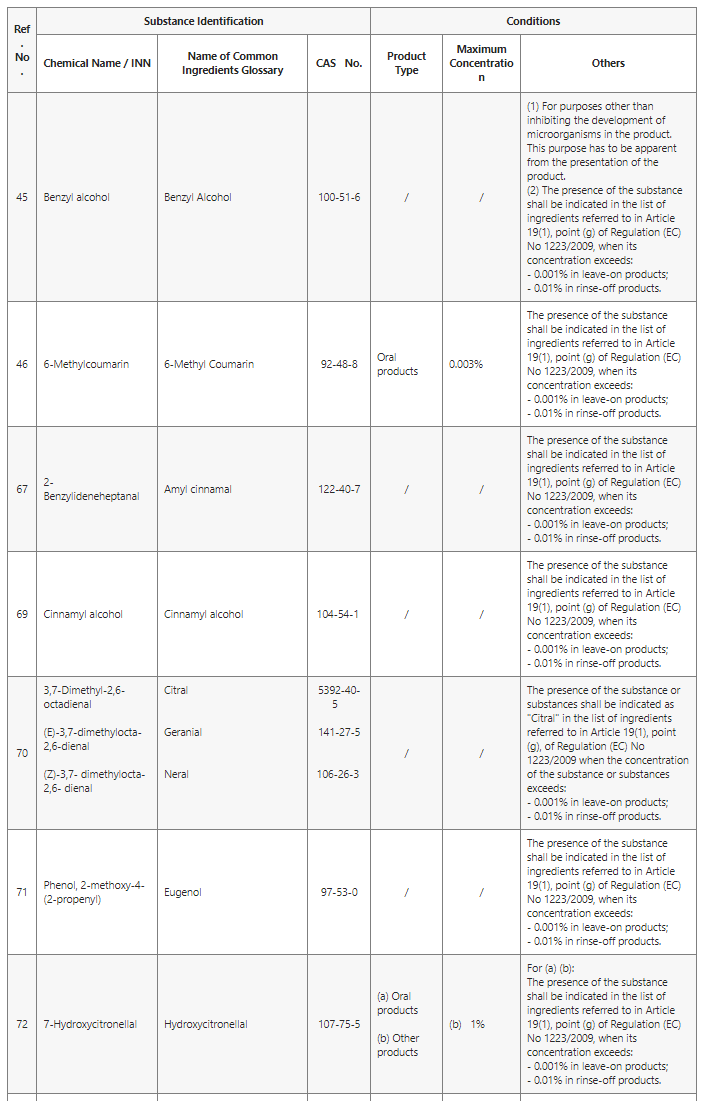 Excerpt of Fragrance Allergens
Details about the coming into force dates for the disclosure of fragrance allergens in Canada are described below:
As of April 12, 2026, new and existing cosmetics have to disclose 24 fragrance allergens (see List 1 in Appendix 1 of Industry Guide for the Labeling of Cosmetics) within the list of ingredients, when present at concentration greater than 0.01% in rinse-off products and 0.001% in leave-on products.
As of August 1, 2026, new cosmetics must disclose 81 fragrance allergens from List 1 and List 2 (see Appendix 1 of Industry Guide for the Labeling of Cosmetics), when present at concentration greater than 0.01% in rinse-off products and 0.001% in leave-on products.
As of August 1, 2028, existing products must disclose the 81 fragrance allergens, when present at a concentration greater than 0.01% in rinse-off products and 0.001% in leave-on products.
2. Allowing the disclosure of the full ingredient list of cosmetics sold in small packages on the website
Previously, cosmetics sold in small packages such as eyeliner pencils, hotel or travel-sized amenities, lipsticks, and nail enamels could have the complete ingredient list attached to the container or package using a tag, tape, or card. HC now permits the disclosure of the full ingredient list, including fragrance allergens, for cosmetics sold in small packages on a website. This is allowed as long as the outer label includes a statement indicating that the list of ingredients can be found on the mentioned website, along with the website's location.
3. Modifying cosmetic supervision requirements
HC amends the Cosmetic Regulations in the following manner to improve the oversight of cosmetics, and to support compliance and enforcement actions.
1) For cosmetic notification application, HC
Clarifies that if HC requests the manufacturer or importer to supplement the information, the manufacturer or importer has 10 days to respond;
Adds a provision to clarify that the discontinuation of sale requires the submission of a notification;
Specifies whether the cosmetic is a “rinse-off” or “leave-on” product should be indicated in the cosmetic notification information;
Requires ingredients disclosed in the cosmetic notification information to be identified by their INCI names. If the INCI name does not exist, the chemical name would be required;
Clarifies that the distributor’s name and address information are no longer required for cosmetic notification;
Amends the table of concentration ranges for cosmetic notification, in which the range increases from the previous 7 to 13 as indicated in the table below.
The exact concentration or concentration range of ingredients shall be submitted at the time of notification. The concentration range can be indicated by either the applicable concentration range set out in column 1 or the number in column 2.
Column 1 | Column 2 |
Concentration Range | Corresponding Number |
More than 80%, up to 100% | 1 |
More than 65%, but not more than 80% | 2 |
More than 50%, but not more than 65% | 3 |
More than 40%, but not more than 50% | 4 |
More than 30%, but not more than 40% | 5 |
More than 20%, but not more than 30% | 6 |
More than 10%, but not more than 20% | 7 |
More than 3%, but not more than 10% | 8 |
More than 1%, but not more than 3% | 9 |
More than 0.3%, but not more than 1% | 10 |
More than 0.1%, but not more than 0.3% | 11 |
More than 0.001%, but not more than 0.1% | 12 |
More than 0%, but not more than 0.001% | 13 |
Notes: The amended and new concentration ranges are highlighted. | |
2) Modernizing the contact information presented on the label
HC requires the inner label to include a telephone number, an email address, a website address, a postal address or any other information that enables consumer to direct any product-related questions to a contact person.
3) Giving HC authority
to stop the sale of a product if the notification requirements are not met, or the information requested is not provided;
to request evidence of safety from the importer. To protect proprietary information, a foreign manufacturer or a third party would be able to provide evidence of safety information to HC on an importer’s behalf.
In addition, HC also makes administrative changes to Cosmetic Regulations, such as revising the definitions of manufacturers and importers, and the expressions and wordings in regulations.
 We provide full-scale global cosmetic market entry services (including cosmetic registering & filing, regulatory consultation, customized training, market research, branding strategy). Please contact us to discuss how we can help you by