Request a Demo
China’s Supervision and Administration Measures on Cosmetics Manufacture and Operation (hereafter referred to as the Measures) was finalized on August 2, 2021, and scheduled to come into force on January 1, 2022. 1 In a move to ensure the quality and safety of cosmetics and the healthy development of the cosmetics industry, China NMPA released a set of enforcement rules of the Measures on November 26, 2021. 2
The enforcement rules center on the following three aspects:
1. Cosmetic Production License
Starting from January 1, 2022, the application for new cosmetic production licenses and the application for changing and renewing cosmetic production licenses shall be conducted per the provisions of the Measures.
The cosmetic production license obtained previously will remain valid within the original validity period, except for those that have the production conditions for eye care cosmetics and children's skincare cosmetics but have not specially marked the corresponding items on the licenses. These enterprises shall replace the cosmetic production license with the new version by July 1, 2022.
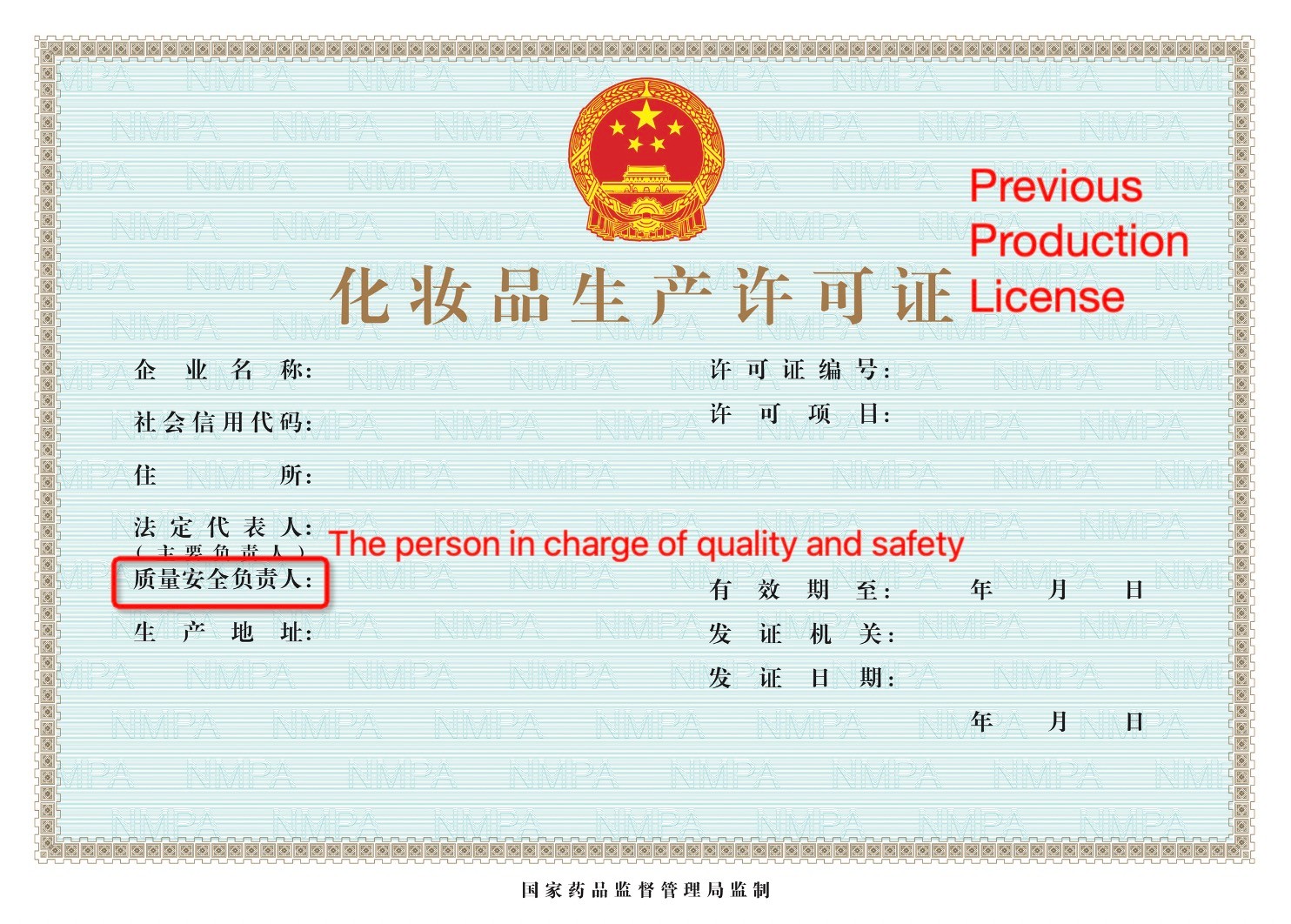
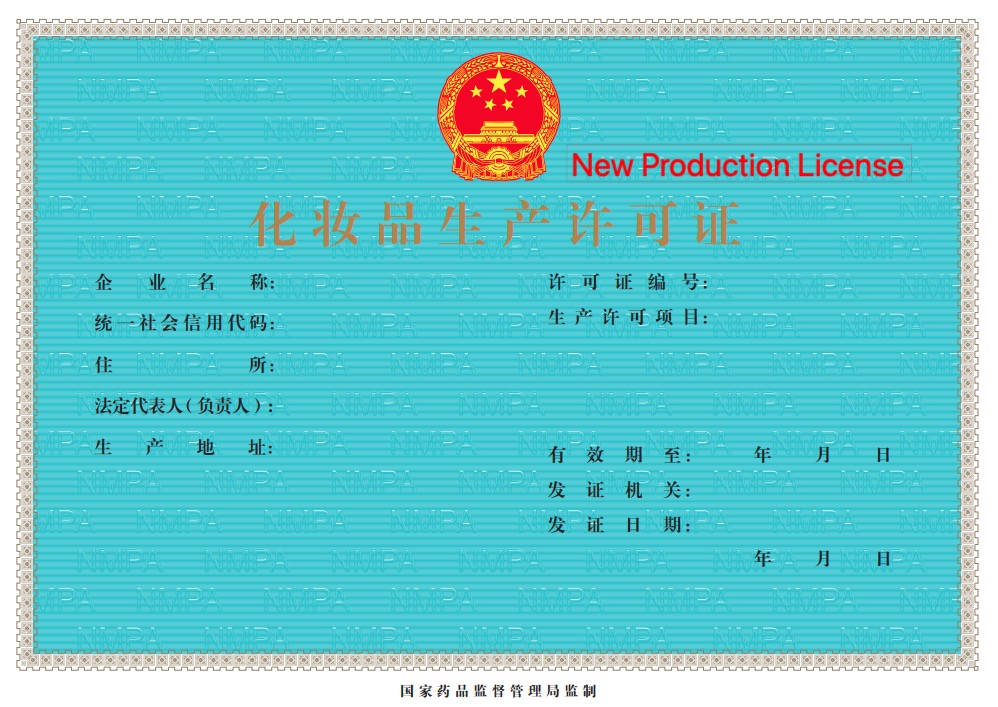
Previous Production License (Left) & New Production License (Right)
Starting from January 1, 2022, newly established enterprises that only engage in the preparation of cosmetic contents should file an application to the medical products administration departments of the provinces, autonomous regions, or municipalities directly under the Central Government where they are located. They can produce only after granted the cosmetic production license. For enterprises engaged in the preparation of cosmetic contents before the effective date, they shall obtain the cosmetic production license by January 1, 2023.
2. Cosmetic Production Management
According to the Measures, cosmetics registrants and notifiers should keep the samples and records of each batch of cosmetic products produced after January 1, 2022. The reserved samples shall be kept in the original sales packaging, and the quantity thereof shall meet the requirements of product quality inspection.
In the case of cosmetic entrusted production, the entrusted production enterprise shall also keep samples and records thereof per provisions of the Measures.
Overseas cosmetics registrants and notifiers shall keep the samples of each batch of products imported into China. The samples and records shall be kept by their responsible persons in China.
3. Cosmetic Operation Management
Since January 1, 2022, initiators of cosmetic centralized trading markets and trade fair organizers shall establish archives for the cosmetics operators who enter the market after January 1, 2022. For cosmetics operators who enter the market before that date, the initiators or organizers shall establish the archives mentioned above by July 1, 2022.
Since January 1, 2022, the organizer of cosmetic fairs shall report the fairs' time, location, and other basic information to the local drugs administration department of the county level before the fairs are held. Beauty and hair salons shall display the sales packaging of the cosmetics they use in operation in a prominent place at their service premises, to facilitate consumers to check all the information on cosmetic labels.

ChemLinked Comments
1. China’s Supervision and Administration Measures on Cosmetics Manufacture and Operation specifies the responsibilities of cosmetics registrants, notifiers, and entrusted production enterprises; optimizes the production license management system; and clarifies the cosmetic production and operation management requirements. However, some finer points of the Measures remain unclear, leaving stakeholders open questions like whether the current production license is still available, how to deal with the current production license for enterprises that have the production conditions for eye care and children's skincare cosmetics but have not made a special marking in the production license items, when and how to keep the samples and records of cosmetics, etc.
NMPA’s notice stipulates the details for cosmetic production license management, cosmetic production management, and cosmetic operation management, including the point-in-time for certificate replacement, the retention of samples, the holding of trade fairs, and the labeling requirements for beauty salons, which further refine the Measures and fills the regulatory gaps.
2. In regard to the cosmetic production license, stakeholders shall note that:
The person in charge of cosmetics quality and safety will no longer be marked on the new version of the license.
Eye care products and children’s skincare products ask for higher requirements for manufacturers. NMPA’s request for stakeholders to switch to new product licenses and make special marking in the production licensing items aims to reassess the company's existing production norms, production environment, staffing, and quality management system so as to urge companies meet the production norms.
"Enterprises engaged in the preparation of cosmetic contents" refers to enterprises that only provide cosmetic formulas and cosmetic contents but are not involved in procedures such as production, packaging, and filling. Usually, some laboratories or ingredient suppliers will prepare the contents of cosmetics by themselves because they have certain technical conditions. The cosmetic contents will be sold to manufacturers, who will then conduct filling.
An industry expert points out that cosmetic manufacturers shall have production licenses from formula preparation to final production. However, some units “engaged in the preparation of cosmetic contents” have completed part of the research and development of cosmetic preparation without obtaining a cosmetics production license. Such behaviors are illegal. NMPA’s recent notice requires “enterprises engaged in the preparation of cosmetic contents” to have a cosmetics production license, which serves as a response to such market chaos. It can cut off the path for non-compliant products to enter the market from the upstream, and ultimately contribute to a more comprehensive supply chain supervision and product lifecycle stewardship. 3
3. Stakeholders shall also pay attention to sample retention and take measures as early as possible. Especially for overseas companies, the samples of each batch of products must be sent to the responsible person in China, which will cost a lot of time and money.
 We provide full-scale global cosmetic market entry services (including cosmetic registering & filing, regulatory consultation, customized training, market research, branding strategy). Please contact us to discuss how we can help you by