Request a Demo
After May 1, 2022, China’s cosmetics industry has officially entered the 2.0 era of scientific and stringent supervision. Due to the implementation of various new regulations, the documents to be submitted for cosmetic registration and notification become more complicated. If the details of relevant documents are not handled properly, or the correct procedures are not followed, the registration or notification application may fail.
In order to improve the pass rate of cosmetics registration and notification, China National Institutes for Food and Drug Control (NIFDC) opened a "FAQs" column under the "Cosmetics Review" section on its official website on April 19, 2022, to answer the issues uppermost for enterprises. So far, there are 24 questions and answers in total, which are divided into two categories: FAQs on cosmetic acceptance process and FAQs on technical review.
Category 1: Cosmetic Acceptance Process | Category 2: Cosmetic Technical Review |
*See FAQs Vol. 9 for further details. |
|
Table 1: Focus of NIFDC’s FAQs
The following are questions in Category 2 Cosmetic Technical Review:
FAQs about Product Formula
As per the Provisions for Management of Cosmetic Registration and Notification Dossiers (the Provisions), the propellant-related information should be separately filled in below the formula table, and the total propellant content should be 100%.
When conducting safety assessment of products containing nano ingredients in their formulas, the ingredient quality specifications issued by the ingredient manufacturer should be provided, along with the safety assessment documents based on the quality specifications of the ingredient and the safety assessment documents supporting its use amount in the formula.
According to the requirements of the Provisions, "(Nanoscale)" should be marked after the names of such ingredients.
Flavors are group ingredients, and they cannot use the highest historical use amount of "flavor" in the Inventory of Existing Cosmetic Ingredients in China 2021 (IECIC 2021) as evaluation evidence. The flavors should be assessed following the principles and requirements of the Technical Guidelines for Cosmetic Safety Assessment 2021, or have relevant certification documents to prove that the flavors used in the products meet the requirements of the International Fragrance Association (IFRA) practice regulations or the relevant national standards in China.
According to the Administrative Measures on Cosmetics Labeling (the Measures), trace ingredients refer to the ingredients in the cosmetic formula that do not exceed 0.1% (w/w). When the product formula contains trace ingredients, such ingredients shall be labeled separately with "other trace ingredients" as the guide language, and are allowed not to be listed in descending order as per the content. Trace ingredients only need to be labeled once, and should not be labelled repeatedly after the guide language "ingredients".

FAQs about Cosmetic Labels
The Measures stipulates that if the name of a specific ingredient or any other vocabulary indicating the category of the ingredient is used in the product generic name, the ingredient shall be consistent with that in the product formula, and the efficacy of such ingredient in the product shall be in line with the product’s efficacy claim. For example, the product name is "XX amino acid mask", and the product efficacy is claimed to be anti-wrinkle, then the product formula should contain amino acids, and the intended purpose of the amino acids should be related to anti-wrinkle.
If the name of an animal, a plant or a mineral is used to describe the odor type, color or shape of the product, such ingredient is allowed not to be contained in the formula, and the product’s generic name can contain the name of the animal, plant or mineral plus the odor type, color, or shape, or the above information can also be noted after the attribute name—for example, cucumber-flavored facial cleanser or facial cleanser (cucumber flavored).
According to the Cosmetic Supervision and Administration Regulation (CASR) and the Measures, cosmetics labels should be marked with the name and address of the registrant, notifier, and entrusted production enterprise. If the registered address and the actual production address are inconsistent, the actual production address stated on the production license shall be marked.
According to the Supervision and Administration Provisions on Children Cosmetics, children cosmetics should be labeled with the children cosmetics’ logo on the display panel of the sales package. In order to make the logo recognizable, the logo shall be marked on the upper left side of the main display surface of the sales package in proportion to the pattern designated by NMPA, and it must be clear and easy to identify. The whole logo shall be gold, and there is no mandatory requirement for the color matching information mentioned in NMPA’s notice. Children cosmetics companies can fine-tune the color and font according to the actual packaging, but it should be clear, durable, and easy to identify and read.
The Measures stipulates that the cosmetic label should indicate the standard Chinese names of all cosmetic ingredients on the visible panel of the sales package.
Cosmetic ingredients are those that are purposefully added to the product formula during the production process and play a role in the final product. The components, such as antioxidants, preservatives, and stabilizers, added in tiny amounts in the ingredients to ensure the ingredient quality can be exempted from being labeled as they are considered non-cosmetic ingredients. However, in order to protect consumers' right to know, companies can also mark them on product labels.
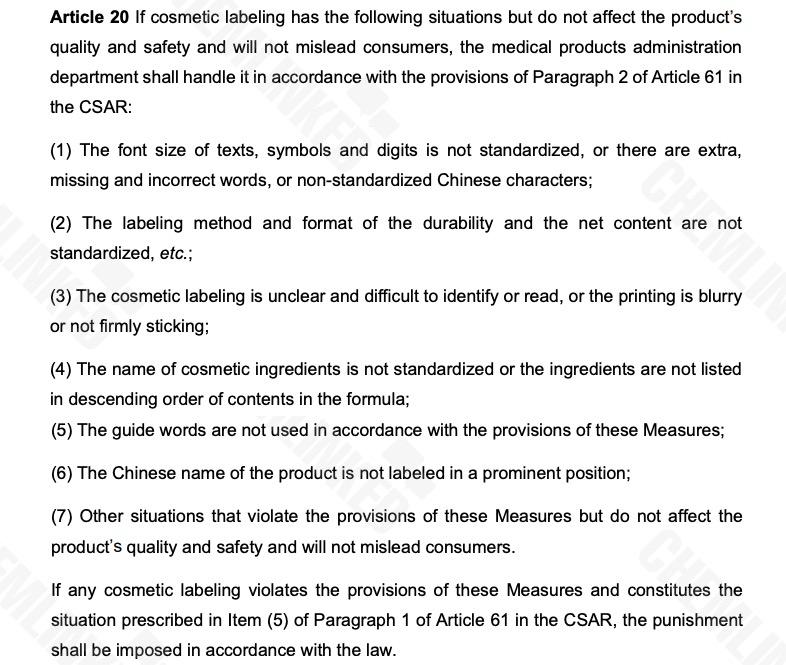
If there are defects in cosmetic labels that do not affect quality and safety and will not mislead consumers, enterprises should correct it in time. They can reprint the label or correct the defects by pasting a new one to cover the old one. The corrected label should be clear, durable, easy to identify and read, and free of any signs of printing blurry or poor adhesion.
FAQs about Cosmetics Information Filling on the Application System
The grouping information of ingredients should be filled in under the "Grouping Information (分相信息)" module of the production process. There is no need to repeatedly fill in the relevant content of the grouping in the "Steps" and "Remarks" columns of the production process.
*Notes: China’s new Cosmetics Registration and Notification Service Platform is mainly composed of 3 sub-systems: the Cosmetic User Management System, the Smart Cosmetics Application and Review System, and the General Cosmetics Notification System. Among them, the Smart Cosmetics Application and Review System is for the registration of domestic and imported special cosmetics, as well as the registration, notification, and monitoring period management of new cosmetic ingredients.
When filling in the application, the SPF value, after-bath SPF value and PA grade in the "Registration Application Form" should be consistent with the Chinese name, the SPF value marked in the label sample manuscript, etc. of the product.
The option "Whether Membrane Carrier Material (是否膜质载体材料)" under the formula table should be checked, the material composition of the main carrier material shall be indicated in the remark column per the requirements of the Provisions, and the documents including its source, preparation process, quality control indicators, etc. shall also be indicated.
According to the requirements of relevant laws and regulations such as the Cosmetic Classification Rules and Catalogs, the classification code of the "Registration Application Form" should be filled in correctly and standardizedly without omissions or errors. The relevant content in the application documents shall be consistent with the classification code filled in. For example, the content of efficacy claims, application methods, application areas, target users in the product label sample manuscript shall be consistent with the classification code. Where propellant is included, the product dosage form shall include "aerosol". If the target users include “infants" and "children", the product should follow the relevant regulations for children cosmetics.
 We provide full-scale global cosmetic market entry services (including cosmetic registering & filing, regulatory consultation, customized training, market research, branding strategy). Please contact us to discuss how we can help you by