Request a Demo
Terms:
JPH (Halal Product Guarantee): Legal assurance of a product's halal status, validated by a halal certificate;
PPH (Halal Product Process): A series of activities that ensure the halalness of a product, encompassing material sourcing, processing, storage, packaging, distribution, sales, and presentation;
SJPH (Halal Product Assurance System): An integrated system designed, implemented, and maintained to regulate materials, production processes, products, resources, and procedures, ensuring the continuity of PPH;
LPH (Halal Inspection Institution): An institution responsible for conducting inspection and/or testing activities to verify the halal status of products.
On October 18, 2024, following the release of Government Regulation (GR) No. 42 of 2024 Regarding Implementation of Halal Product Assurance 1, Indonesia's BPJPH announced the official enforcement of the first phase of mandatory halal certification. This requirement applies to all food and beverage products entering, circulating, or being traded within the Indonesian territory. For imported food products, the enforcement of mandatory halal certification has been postponed until 2026. Mandatory halal certification for cosmetics is set to begin on October 18, 2026.
Compared to the previous GR No. 39 of 2021 on Halal Product Assurance, the key amendments related to cosmetic companies in GR No. 42 of 2024 are as follows:
1. Clarifying the necessary documents for the appointment of the halal supervisor
Companies applying for halal certificate must designate a halal supervisor. To submit the appointment of the halal supervisor to BPJPH, the company must provide the following documents:
a. A copy of the identity card for the halal supervisor residing in Indonesia;
b. A copy of the passport, permanent residence permit, or other identification for the halal supervisor from abroad;
c. A curriculum vitae of the halal supervisor;
d. A copy of the halal supervisor training certificate and/or the competency certificate for micro and small enterprises;
e. A copy of the halal supervisor training certificate and the competency certificate for medium, large, and foreign companies;
f. A copy of the decision confirming the appointment of the halal supervisor.
2. Slightly adjusting the time limits for certain halal certification steps
The following are the halal certification process. The revisions are highlighted in red.
1. Halal Certification Application
Business operators must apply for halal certification to BPJPH through an electronic system. BPJPH will confirm the completeness of the application documents within 1 working day after receiving the submission.
2. Appointment of LPH
BPJPH will appoint an LPH to examine and/or test the halal status of the product. This appointment must occur within 1 working day after the completeness of the documents gets confirmed by BPJPH.
3. Inspection and Testing
The LPH’s responsibilities include:
1) Document inspection, conducted by LPH;
2) Product halalness inspection and/or testing, carried out by a halal auditor appointed by the LPH.
Document inspection should be completed within 2 working days after the LPH's appointment. If additional documents are required, the applicant must submit them to the LPH within 2 working days after receiving the request.
Once the document inspection is complete, the LPH will send the cost details of the product halalness inspection and/or testing to BPJPH. BPJPH will issue a payment invoice for halal certification services through the electronic system. The applicant must make the payment within 5 working days after the invoice date. No fees will be charged for halal certificate application submitted by micro or small business.
The product halalness inspection will take place at the business location during the production process. If any ingredient's halal status is in doubt during the inspection, laboratory testing will be conducted.
Inspection and testing for halalness of both domestically produced and imported products must be completed within 15 working days from the payment date. When necessary, the LPH may request an extension of 10 working days for Indonesian products and 15 working days for imported products.
4. Submission of Results
The LPH will submit the results of the product halalness inspection and/or testing to MUI (Indonesia's halal auditing organization), with a copy sent to BPJPH.
5. Determination of Product Halalness
MUI will determine the product's halal status during the Halal Fatwa Assembly within 3 working days after receiving the results.
The Decree of the Determination of Halal Product (Halal Fatwa) will be submitted by MUI to BPJPH as the basis for issuing the Halal Certificate.
6. Issuance of Halal Certificate
If the Halal Fatwa Assembly determines the product is halal, BPJPH will issue the Halal Certificate within 1 working day. If the product is deemed non-halal, BPJPH will return the application to the business operator with the reasons for rejection within 1 working day.
3. Clarifying the obligations of companies with halal certificates
Businesses that have obtained a halal certificate are required to:
a. Include a Halal Label on products certified as halal;
b. Ensure the halal status of products that have received certification;
c. Separate the locations, equipment, and processes for slaughtering, processing, storage, packaging, distribution, sales, and presentation of halal and non-halal products;
d. Renew the halal certificate if there are changes in the composition of materials or PPH;
e. Report any changes in material composition or PPH to BPJPH.
The halal status of products is verified through a Certificate of Consistency for Halal Products, which is obtained by examining the implementation of SJPH. Relevant departments generally conduct this examination every four years.
4. Clarifying requirements for halal certificate renewal
The halal certificate is valid from the date of issuance by BPJPH and remains valid as long as there are no changes to the composition of materials and/or PPH. Business operators who have modified the composition of materials and/or PPH are required to renew the certificate.
Renewal applications must be submitted through the electronic system and should include the following documents:
a. Documentation of the changes in the composition of materials;
b. Documentation proving the halal status of the changed materials;
c. Documentation of changes in PPH; and/or
d. Documentation of product development.
Renewal of the halal certificate will not alter the original certificate number. Detailed renewal procedures will be determined in the future.
5. Adding exemption for halal labelling
Halal products must bear a halal label; however, exemptions apply for:
a. Products with packaging that is too small to accommodate all required information;
b. Products sold and packaged directly in front of the buyer in small quantities;
c. Bulk products;
d. Products sold in limited quantities.
BPJPH introduced and applied the new halal label on March 1, 2022. The halal label previously issued by MUI can continue to be used on product packaging until October 17, 2026.
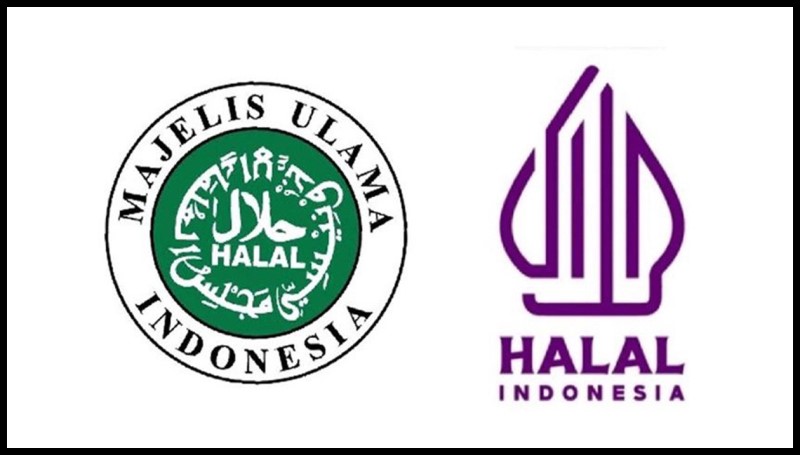 The former halal logo (left) and the new halal logo (right)
The form for including a statement indicating that products contain haram materials will be established in the future.
6. Clarifying conditions of imported products applying for halal certificate from BPJPH
Applications for halal certification of imported products must be submitted by importers or representatives based in Indonesia. Such applications are necessary when:
a. There is no foreign halal institution in the product's country of origin;
b. Foreign halal institutions in the product's country of origin have mutual recognition agreements do not cover the specific product certification;
c. There is no mutual recognition of halal certificates between the foreign halal institutions in the product's country of origin and BPJPH;
d. Business operators choose to apply voluntarily.
7. Adjusting the timeline for renewing foreign halal certificate registration
Enterprises do not need to apply for new halal certificates for imported halal products if they already hold a halal certificate issued by foreign halal institutions that have a mutual recognition agreement with BPJPH. However, the halal certificate must be registered with BPJPH before the product can be distributed in Indonesia.
The validity period of the foreign halal certificate registration aligns with the validity of the halal certificate itself.
Importers and/or representatives based in Indonesia must renew the foreign halal certificate registration by submitting a renewal application 60 working days before the registration's validity period expires.
Further Reading
Indonesia BPJPH Opens Channel of Foreign Halal Certificate Registration
Indonesia Signs the First Halal Product Assurance MRA in Europe
Unpacking Indonesian Cosmetic Halal Certification: An Expert Dialogue with LPPOM MUI
Indonesia BPJPH Emphasizes Some Materials Exempt from the Requirement to be Certified Halal
Webinar | Mastering Halal Regulations in Indonesia: From Definition to Certification
 We provide full-scale global cosmetic market entry services (including cosmetic registering & filing, regulatory consultation, customized training, market research, branding strategy). Please contact us to discuss how we can help you by