Request a Demo
Sunscreen plays a vital role in maintaining skin health, preventing photoaging, and protecting against skin cancer, making it increasingly important in the modern beauty and skincare industry. According to the Quality and Safety Research Report on Sunscreen Cosmetics published by the Development Research Center of the State Administration for Market Regulation, the global sunscreen market was valued at approximately USD 13–15 billion in 2024, and was projected to exceed USD 20 billion in 2025, with a compound annual growth rate (CAGR) of 4%–6% [1].
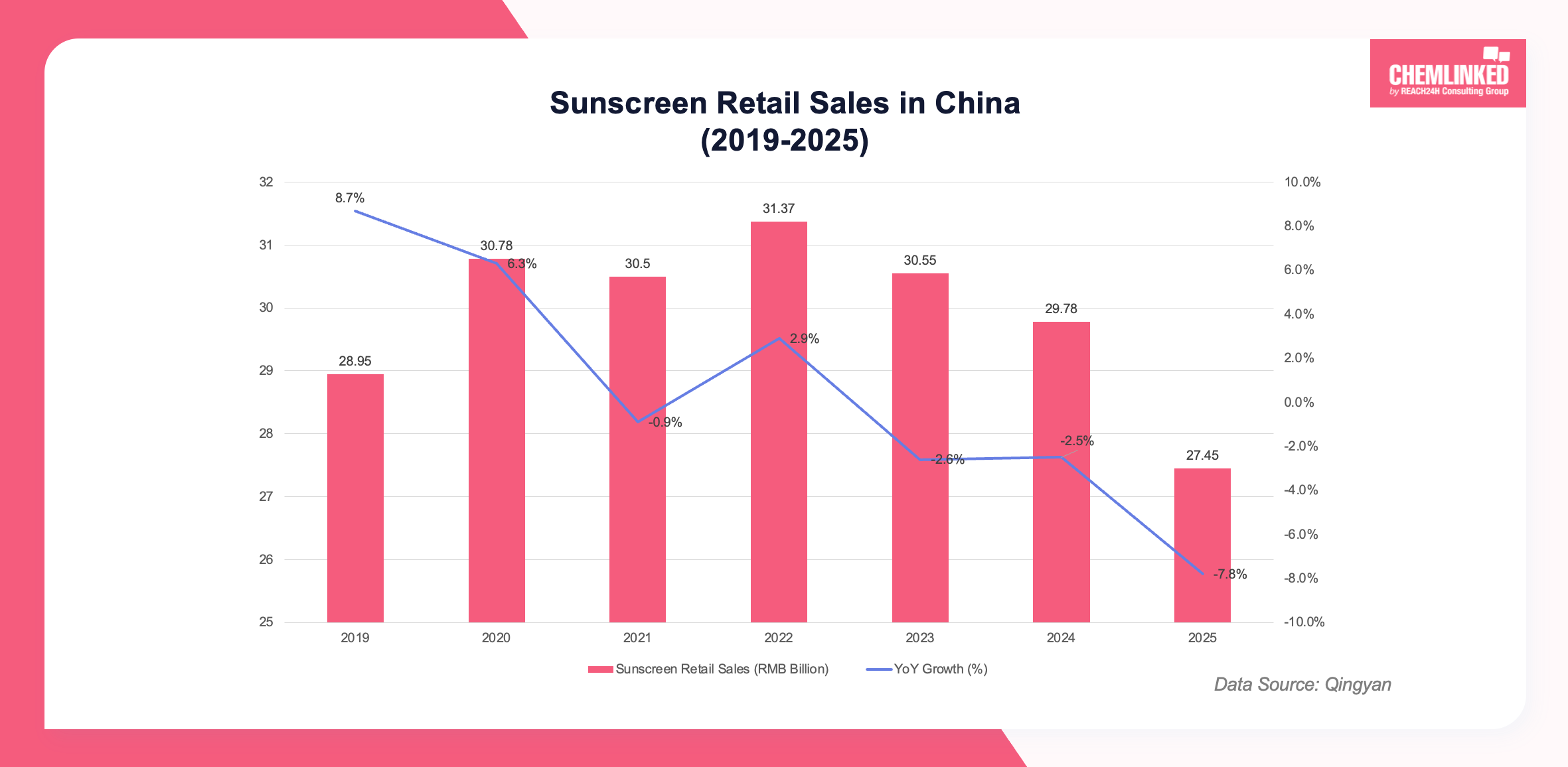
In recent years, China's sunscreen cosmetics market has maintained relatively stable growth, increasing from RMB 28.95 billion in 2019 to RMB 29.78 billion in 2024, representing a CAGR of 0.6%. Although growth has slowed, the market size is expected to exceed RMB 32 billion by 2026 [1].
The growing consumption power and consumers' enhancing awareness of sun protection are the main drivers for this fast-growing market. Sunscreen Product Market Research Report shows that 24% of consumers start to use sunscreen products before 18 years old, and 45% of consumers use 2 or 3 units of sunscreen products a year on average. Almost all consumers are satisfied with the sunscreen products they have purchased (only 0.5% aren't satisfied). 81% of consumers think that they'd like to buy the same sunscreen product multiple times [2].
As for sales channels, online shopping platforms have become one of consumers' preferred channels for purchasing sunscreen products, with online sales expected to account for more than 70% of the total market in 2025 [1]. Notably, the online performance of sunscreen products varies across different price segments. Data from major online shopping platforms, including Taobao, Tmall, Douyin, and JD.com, shows that from January to November 2025, sunscreen products priced below RMB 100 generated sales of RMB 5.59 billion, followed by RMB 4.13 billion for products priced RMB 100–200 and RMB 4.44 billion for those above RMB 200. These segments recorded year-on-year growth of 20.44%, 15.27%, and 16.02%, respectively, with sunscreen products in the mainstream price range showing the most significant growth in both sales volume and revenue, highlighting consumers' preference for value-for-money products [3].
1. New trends
Growth Slows as the Market Matures
In 2025, retail sales of sunscreen cosmetics in China reached RMB 27.45 billion, representing a year-on-year decline of 7.8%. This suggests that the sunscreen market has entered a period of adjustment. The slowdown in growth may be attributed to a combination of factors, including macroeconomic uncertainty and weaker consumer confidence, as well as intensifying market competition and a more stringent regulatory environment.
The Era of Precision Sunscreen Solutions
Sunscreens are increasingly defined by usage scenario, application area, and target consumer group. The era when a single sunscreen could meet the needs of the entire family is coming to an end. Instead, brands are developing dedicated solutions for commuting, outdoor activities, sports, the eye and lip area, the scalp, children, men, and many other specific use cases. Sunscreen has entered the era of precision customization.
Scenario-based segmentation reflects brands' deeper understanding of consumers' lifestyles. Different situations involve varying levels of UV exposure, perspiration, and makeup durability requirements, each demanding a tailored sunscreen solution. By targeting increasingly specific scenarios and consumer groups, brands are unlocking new growth opportunities while building stronger product differentiation and competitive advantages.
2. Current Sunscreens Regulations
In China, sunscreen products are classified as special cosmetics, and shall be registered with the National Medical Products Administration (NMPA) before being manufactured or imported. The registration dossier generally includes product formulation information, product testing reports, and safety assessment documentation, among other supporting materials. Upon approval, a registration certificate valid for five years is issued.
Within the regulatory framework for special cosmetics, several key compliance aspects are particularly relevant to sunscreen products, including requirements for UV filter use, claims and labeling, and testing.
UV Filter Use
China adopts a positive list system for UV filters, under which only those included in the list of permitted UV filters specified in the Safety and Technical Standards for Cosmetics (STSC) may be used in cosmetic products. Any UV filter not included in the list shall undergo new cosmetic ingredient (NCI) registration before being used in cosmetic products.
Claims and Labeling
China has established specific requirements for sunscreen efficacy labeling, covering sun protection factor (SPF) and protection factor of UVA (PFA) labeling, and related claims such as water resistance. The applicable requirements are summarized below.
Type | Measured Value | Labeling Requirement |
SPF | < 2 | No indication of sun protection effect |
2–5 (inclusive) | The measured SPF value | |
6–50 (inclusive) | 1) Upper limit: the measured SPF value; | |
> 50, with the lower limit of the 95% CI > 50 | SPF 50+ | |
> 50, with the lower limit of the 95% CI ≤ 50 | 1) Upper limit: SPF 50+ | |
PFA | < 2 | No indication of UVA protection effect |
2–3 | PA+ | |
4–7 | PA++ | |
8–15 | PA+++ | |
≥ 16 | PA++++ |
For water-resistant claims, sunscreen cosmetics must meet the applicable testing requirements. Products that have not undergone water resistance testing, or for which the SPF value after bathing decreases by more than 50% compared with the SPF value before bathing, shall not make water-resistant claims. Where water resistance is claimed, both SPF values before and after bathing may be labeled, or only the SPF value after bathing may be labeled. Labeling only the SPF value before bathing is not permitted.
Testing
Sunscreen products in China are subject to comprehensive testing requirements covering microbiological, physicochemical, toxicological, human safety, and efficacy evaluations. The main testing requirements include:
Microbiological testing: Covers microbiological testing parameters such as aerobic plate count, mold and yeast, thermotolerant coliform bacteria, Pseudomonas aeruginosa, and Staphylococcus aureus;
Physicochemical testing: Focuses on product quality and ingredient-related risks, including heavy metals, UV filters, and other risk substances, with specific items determined based on the product formulation;
Toxicological testing: Includes safety evaluations such as irritation, sensitization, and phototoxicity testing, with specific requirements depending on product characteristics, including eye contact potential and whether the product is leave-on or rinse-off;
Human safety testing: Includes tests such as patch testing to evaluate product tolerability;
Efficacy testing: Includes sunscreen efficacy evaluations to substantiate sun protection claims.
Testing required for the registration of sunscreen products shall be conducted in accordance with the methods specified in the STSC, and performed by qualified testing institutions recognized by the NMPA.
 We provide full-scale global cosmetic market entry services (including cosmetic registering & filing, regulatory consultation, customized training, market research, branding strategy). Please contact us to discuss how we can help you by