Request a Demo
Recent Updates
In a move to further streamline administration and simplify the import process, the General Administration of Customs of China issued a notice on December 17, 2021, deciding to cancel the filing of domestic consignees of imported cosmetics from January 1, 2022. 7
[Last Updated on December 20, 2021]
China Customs Inspection: Guidance on the Consignee Filing of Imported Cosmetics
China's inspection and quarantine system of imported cosmetics can be divided into three phases: 1) the customs’ filing management of imported cosmetics consignees before import; 2) the inspection and quarantine of imported cosmetics at ports, which includes inspection application, on-site inspection and quarantine, sample investigation, laboratory test and report. Unqualified products found during inspection at ports will be returned or destroyed by customs authorities depending on the situation while the qualified products will obtain the “Certificate of Entry Inspection and Quarantine of Goods”; 3) the post-market phase includes recording the product information, ensuring its quality and safety, and etc. as is generally overseen by China’s market watchdog the SAMR and its subordinate department the NMPA which is specifically tasked with oversight on cosmetics. [1]
Compared with other items in the customs declaration and inspection, the filing of imported cosmetic consignee seems to be quiet new to stakeholders. To facilitate smooth business processes, China General Administration of Customs (GAC) released guidance on the filing of domestic consignee for imported cosmetics in June [2]. Detailed requirements and compliance obligations are as follows:
What is domestic consignee?
As per the provisions specified in the Administrative Regulations on the Management of Consignee Filing, Import Records and Sale Records of Imported Cosmetics and Administrative Measures on Inspection and Quarantine of Import and Export Cosmetics, the domestic consignee of imported cosmetics refers to an importer located in mainland China and has signed the trade contract with foreigner enterprise and shoulders the responsibilities of cosmetic import inspection and quarantine as well as product tracing management.
The introduction of consignee filing system allows the authority to fully grasp the dynamic information of cosmetic consignee, marking a significant milestone in the realization of imported cosmetic traceability. When quality and safety issues arise, the substandard products can be quickly recalled to ensure consumer safety.
Domestic consignee vs. responsible person
According to China’s new filing policies of imported non-special use cosmetics [3], there are some differences and relations between the domestic consignee and the domestic responsible person of imported cosmetics:
| The domestic responsible person | The domestic consignee | |
| Authorization | Entrusted by the import enterprise | Entrusted by the domestic responsible person |
| Responsibilities | Responsible for the import and operation of cosmetics, and bear the corresponding responsibility for product quality and safety. |
|
| When applying for filing of imported non-special cosmetics | The responsible person shall submit the relevant information of the consignee. | The consignee does not need to fill in the information. |
Compliance obligations for the domestic consignee
Regarding specific obligations, the domestic consignee of imported cosmetics shall complete filing to the customs in areas where its business was registered prior to import. With the obtained filing number, the consignee of imported cosmetics can apply for inspection in line with the relevant provisions of the customs.
Additionally, the consignee shall establish scientific record systems of cosmetic import and sales and also truthfully record the flow of imported cosmetics through the supply chain. The retention period of records shall not be less than 2 years.
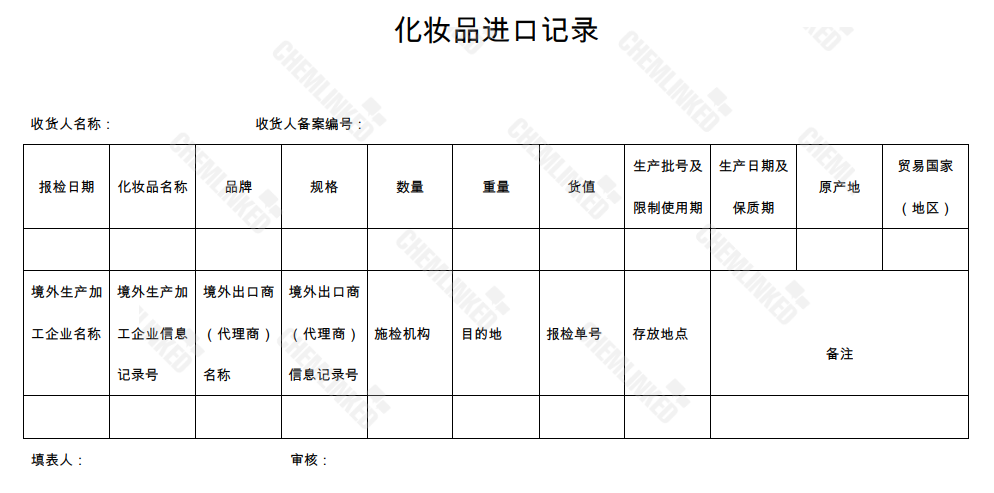
(Cosmetic import record: click here to find the English version)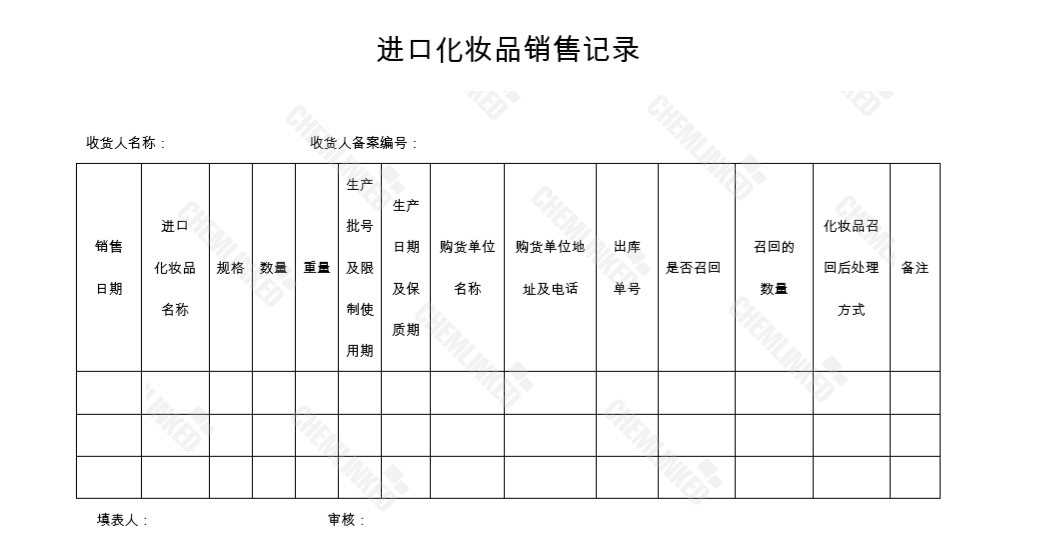
(Cosmetic sales record: click here to find the English version)
If there is a safety problem with imported cosmetics, and it may cause or have caused damage to human health and life safety, the consignee shall voluntarily recall the products and immediately report to the local customs. Meanwhile, the consignee shall disclose the relevant information to the public, inform the sellers to stop sales, inform the consumers to stop using such products, and make a recall record. If the consignee does not voluntarily recall the products, the local customs may order the recall. When necessary, the GAC will order the recall.
Significantly, for the customs inspection of cosmetic samples for import registration or filing and non-trial samples for enterprise’s R&D and publicity, the consignee shall submit the instructions on the usage and disposal of the sample and a commitment of non-sales use. When the customs conduct the review of filing, the samples can be exempted from inspection if their amount is acceptable. The consignee shall truthfully record the flow of the cosmetics and the record retention period shall not be less than 2 years.
How to conduct consignee filing?
1. Qualification of the imported cosmetic consignee
According to the Administrative Regulations on the Management of Consignee Filing, Import Records and Sale Records of Imported Cosmetics, the types of cosmetics operated by the enterprises intending to apply for consignee filing shall be confined to the following 7 categories:
Beauty cosmetics;
Oral care cosmetics;
Skin care cosmetics;
Hair care cosmetics;
Other cosmetics;
Perfume cosmetics;
Special use cosmetics
2. Required Application Materials (each material shall be stamped with the enterprise’s official seal)
An application form for filing of the consignee;
The originals (for verification purpose) and copies of the Business License, the legal representative's identity certificate and the registration form for the filing of foreign trade operators;
Enterprise quality and safety management system; cargo flow management system and defective products recall system;
Organizational settings, department functions and post responsibilities related to cosmetics safety;
The varieties and storage places of cosmetics to be operated;
The relevant information on whether the consignee has engaged in cosmetic importation, processing and sale within 2 years (if any, the varieties and quantities of cosmetics shall be specified);
In the case of declaring customs by an enterprise itself, the original (for verification purpose) and a copy of the registration certificate for the filing of the self-declared entity shall be provided.
It is important to remember that the consignee for duty-free cosmetics shall provide the company's name, address, legal representative, competent department, business scope, contact person, contact information, product list and other relevant information when applying to the local customs for filing.
3. Filing procedures
(1) Online application
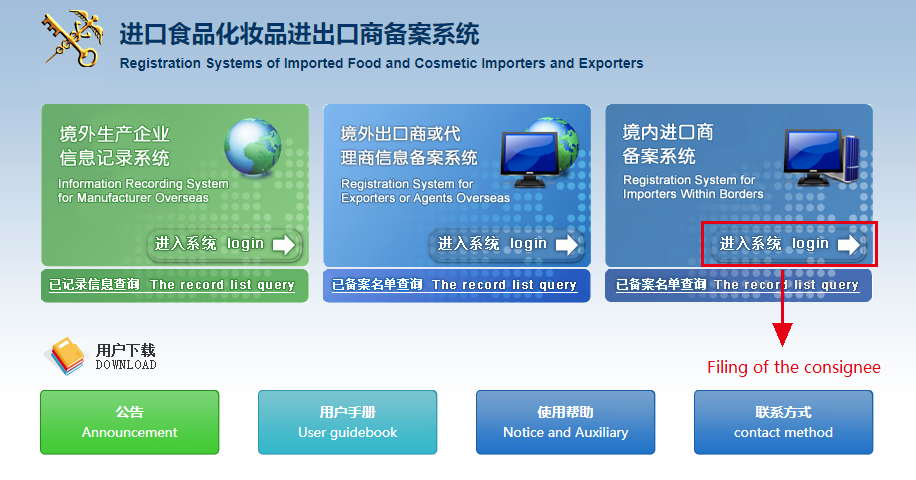
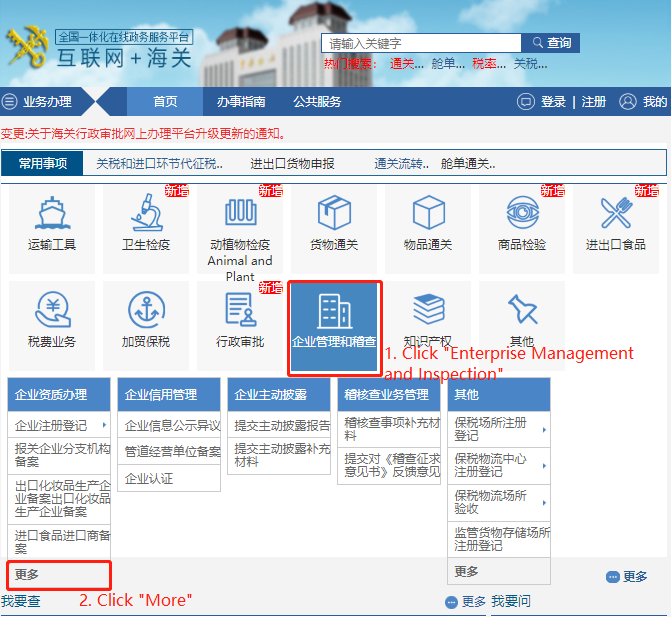
Enterprises shall accurately and truthfully fill out the filing application form online. Currently, two systems are available for online application.
File via “Registration Systems of Imported Food and Cosmetic Importers and Exporters” [4];
File via “Internet + Customs” [5].
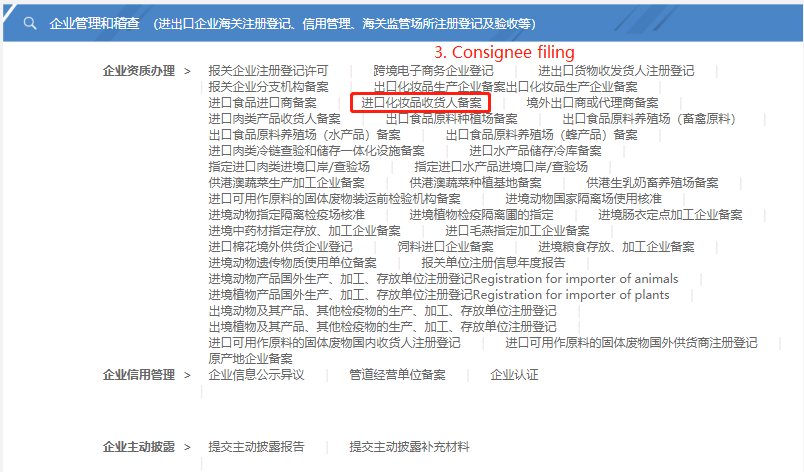
After submitting filing information, the enterprise will obtain an application number and an inquiry code, which are generated by the system to allow enterprises to log in the system, query the filing process status, filing number and modify the filing information.
(2) Paper documents submission
After online application of consignee filing, the above-mentioned paper documents shall be submitted to the acceptance windows of local customs. The applicant enterprise shall be responsible for the completeness, accuracy and efficacy of the provided materials, and shall ensure that the relevant personnel can be contacted by the submitted filing information in case of emergency.
Furthermore, enterprises need to know:
If there are any mistakes in the application materials that can be corrected on the spot, the applicant is allowed to make corrections on the spot.
If the application materials are incomplete or fail to conform to the legal form, the entire contents that need correction will be notified to the applicant at once on the spot or within 5 working days from the date of receiving the complete application materials.
If no notification is issued within the time limit, the date the application materials are received shall be considered the date of acceptance.
(3) Waiting for customs review
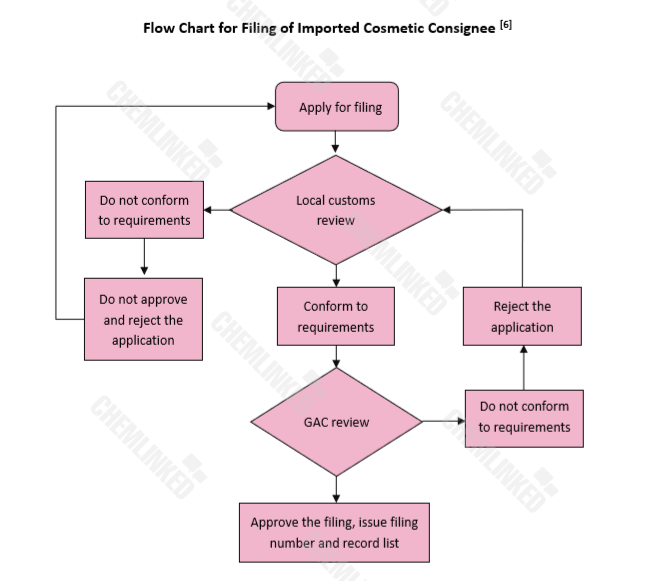
Then the local customs will conduct an administrative review of the application. Generally, the decisions whether to approve the filing or not will be made within 5 working days after acceptance, provided that all the application materials are compliant.
After verification by the local customs, the filing information will be transformed to the GAC for further review. Once the GAC has reviewed and approval is granted, a filing number coupled with the record list will be issued. The enterprise can query the filing process and the filing number through the filing system.
Here it is worth noting that differing from the application number and the query code, the filing number issued after review will be used for import customs inspection.
(4) Change information
If there are any changes to the filing information, the consignee shall promptly submit revisions and the information will be amended with approval by the customs.
1. In case of changes to the information such as name, address, telephone number of the consignee, the application for modification shall be submitted in time through the online filing management system, and the relevant paper materials shall also be submitted to inform the changed content (each material shall be stamped with the official seal of the enterprise). After administrative review and approval, the filing information will be modified.
2. In cases of changes to the type of cosmetics operated, the following paper documents shall be submitted:
The consignee's filing application form;
The varieties and storage places of cosmetics (the name, address, contact person, contact information, plan and etc. of the warehouse shall be provided. For the leasing warehouse, the copy of the lease contract and the copies of the cosmetic storage qualification certificates such as the business license for the storage enterprises shall also be provided.
3. In case of any changes to the business license, organization code certificate, legal representative's ID card and the registration form for the filing of foreign trade operators, the paper documents of the consignee's filing application, a copy and the original of the amended licenses shall be submitted. For the amended license, the originals are only used for verification purpose.
[Last Updated on July 12, 2019]
 We provide full-scale global cosmetic market entry services (including cosmetic registering & filing, regulatory consultation, customized training, market research, branding strategy). Please contact us to discuss how we can help you by