Request a Demo
Key terms:
Packaging interspace ratio: The ratio of the package volume deducting the necessary space occupied by the contents to the total package volume.
Necessary spatial coefficient of commodity: Calibration factor on the space necessary for protecting foods and cosmetics. Its value is determined by product type.
Excessive packaging, also called over-packaging, describes a product whose packaging interspace ratio, packaging layers, and packaging costs exceed the necessary function requirements, which are redundant for or unwanted by the customers. Amidst the increasing homogeneity of products, services, and channels, the purpose of excessive packaging may be to catch consumers’ attention and boost product sales among the fierce market competition. However, it can not only cause unnecessary resource waste and environmental pollution but also push product prices up, disrupt market order, and harm the consumers’ interests.
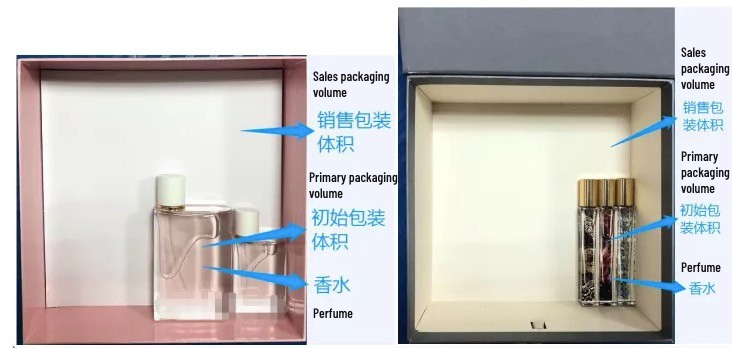 An example of excessive packaging from Shanghai AMR’s official WeChat account
1. Industry Status
Excessive packaging has been a severe and persistent problem in China’s cosmetics sector. The government has launched repeated crackdowns to rid excessive packaging. According to incomplete statistics, in the past two years, more than 60 batches of cosmetics failed relevant supervision and random inspections organized by Shanghai Administration for Market Regulation (Shanghai AMR). Among these administrative penalty cases, big international brands accounted for nearly half, involving Gucci, Chanel, Burberry, etc. As for the types of unqualified products, gift boxes and set products occupied the majority. Reasons for punishment were primarily the over-high interspace ratio.
Time | Supervision and Random Inspection Results |
September 2020 | Shanghai AMR conducted random packaging inspections on five categories of products (including biscuits, cosmetics, tea, health products and roasted coffee products) sold on five e-commerce platforms such as Tmall, Taobao, Gome, ocj.com and BLEMall. The results showed that 12 of the 50 batches of goods inspected had excessive packaging problems. Among them, cosmetics were the most problematic category, with an unqualified rate as high as 70%. Interspace ratio was the leading cause of inspection failure. Several internationally renowned cosmetic brands like Chanel, Gucci, and Lange were on the list. 1 |
June 2021 | Shanghai AMR issued a notice announcing that 23 batches of cosmetics were found substandard in the supervision and random inspection on (excessive) packaging of cosmetic products, recorded a failure rate of 32.9%. Unqualified items involved packaging interspace ratio, packaging layers, etc. Unqualified products included brands such as HOLA, Burberry, etc. 2 |
August 2021 | Shanghai AMR published the results of a new round of supervision and random inspection on the (excessive) packaging of cosmetic products produced and sold in Shanghai. A total of 60 batches of products were sampled and inspected, among which 16 batches were unqualified. Erno Laszlo, Davines, Innisfree, and some other brands were blacklisted because of the unqualified interspace ratio. 3 |
September 2021 | Shanghai Jinshan District Market Supervision Bureau conducted a supervision and random inspection on cosmetic production and sales enterprises within its jurisdiction and found that among 30 batches of goods sampled and inspected, 17 batches were over-packaged, with a failure rate of 56.7%. Brands such as Herborist, Giving, Maxam, DHC, and AFU were punished. 4 |
Some industry experts attributed this phenomenon to the lack of perfect laws and regulations as well as effective oversight. Despite the formulation and issuance of more than ten national standards such as the "GB/T 31268-2014 Restricting Excessive Packaging for Commodity - General Rule" and "GB/T 37422-2019 Method and Criteria for Green Packaging Assessment" in these years, these regulations have not been fully implemented and have not shown effective control over cosmetic excessive packaging, due to the relevant standards are too broad and need clarification in more detail.
2. More Strict Regulation Going Forward
To put an end to the excessive packaging problem, China’s State Administration of Market Supervision (SAMR) issued the revised mandatory national standard “GB 23350-2021 Requirements of Restricting Excessive Package - Food and Cosmetics” on 2 September 2021, to supersede the existing GB 23350-2009. The new standard is scheduled to be effective on 1 September 2023, allowing a two-year grace period for stakeholders.
Compared with the 2009 version, provisions in the new standard are further modified and refined to add clarity and fill in the regulatory loopholes of the current standard. The new GB standard will guide enterprises in the compliant design of sales packaging, promote industry self-regulation and ultimately standardize the market. Besides, the standard also provides reliable technical support for the regulator’s effective supervision.
Specific revisions include improving the definitions of some key terms such as contents, packaging layers, packaging interspace ratio, excessive packaging, etc.; introducing the new terms and their definitions; revising packaging interspace ratio’s limit and calculation methods; adding the outer packaging volume detection methods, judgment rules and the necessary spatial coefficient for different products.
Among them, the following points are of great significance:
(1) More definitive application scope
The new standard applies to the sales packaging of 16 categories of cosmetics, including skin care lotions, loose powders, toiletries, toothpaste, etc. Cosmetics functioned as gifts or not for sales purposes are excluded from the application scope.
Commodity Units | Commodity Categories |
General liquid | Hair care and cleaning products, skin care liquids, hair dyes, and perms, gels |
Cream and lotion | Skin care cleaning products, hair care products, hair dyes, and perms |
Powder | Loose powder, lump powder, hair dyeing, bath salts |
Aerosol and organic solvent | Aerosol, organic solvent parts |
Wax | Wax |
Toothpaste | Toothpaste |
Others | - |
(2) More stringent requirements for packaging interspace ratio
Unlike the current version, under which the packaging interspace ratio requirements varied in commodity categories, the new standard sets corresponding limits based on the net content of a single piece rather than the commodity category. For example, for foods or cosmetics with a net content greater than 50ml or 50g, the new standard requires that the interspace ratio shall not exceed 30% regardless of the category. However, the limits are significantly different under the existing standard. The maximum interspace ratio for the cosmetic category is fixed at 50% and for the pastry category is fixed at 60%.
Net Content Per Piece a (Q) mL or g | Interspace Ratio b % |
≤1 | ≤85 |
1<Q≤5 | ≤70 |
5<Q≤15 | ≤60 |
15<Q≤30 | ≤50 |
30<Q≤50 | ≤40 |
>50 | ≤30 |
Note: This table does not apply to products with only one layer of sales packaging. | |
a For cosmetics that need to be mixed before using, a single piece refers to the mixed product. b The interspace ratio of a set product shall be based on the corresponding interspace ratio of the product with the largest net content per piece. | |
(Packaging interspace ratio specified in GB 23350-2021)
In addition, there are huge differences between the current and the new standards in the calculation method of packaging interspace ratio, i.e., the spatial coefficient. The current standard adopts a uniform necessary spatial coefficient for all commodities. In contrast, the new standard stipulates different necessary spatial coefficients for different commodity categories, which means the number of necessary spatial coefficients has been greatly increased. For example, the value of the necessary spatial coefficient for skin care lotions is 9, and that for loose powder is 15 in principle.
To paraphrase the regulatory manager of COSMAX, “the necessary spatial coefficient given to 16 types of cosmetics is the biggest change for the cosmetics industry in the new standard. Previously, there was no difference in the calculation of packaging interspace ratio for different cosmetics. But going forward, the necessary spatial coefficient of makeup products is larger than that of skin care products, so it is necessary to take these differences into account in the early stage of product development and carry out packaging design.”5
(3) Relaxed requirements for packaging layers
The new standard has updated the requirements for packaging layers of cosmetics from "no more than three layers" to "no more than four layers." Although the calculation method of the existing and new standard is literally inconsistent, the existing standard sees the primary packaging as the layer 0 when calculating the number of packaging layers, while the new standard regards that as layer 1, so there is no difference in essence.
In addition, considering that some companies may use plastic packaging to ensure the safety of cosmetics, the new standard excludes layers in the form of film thinner than 0.03mm and closest to the outside of sales packaging from the calculation of packaging layers, intending to address enterprises' concerns about possible non-compliance resulted from such packaging.
(4) No substantial changes in packaging costs
The new standard stipulates that the cost of all packaging, except the packaging directly in contact with the contents, shall not exceed 20% of the product's selling price. This provision has hardly been modified since there are relatively few cases of excessive packaging in law enforcement practice owing to non-compliance with packaging cost requirements.
3. Suggestions for Stakeholders
The introduction of GB 23350-2021 is a response to China's ambitious goal of reaching carbon neutrality by 2060 and a clear signal that the regulators is tightening the regulations governing product packaging. The cosmetics industry is expected to face more stringent packaging supervision and assume more responsibilities in the future.
Therefore, cosmetic companies should make good use of the two-year transitional period to ensure compliance with the new GB standard. ChemLinked suggests that stakeholders may consider the following measures:
Learn the new standard, carry out relevant training to enable design, R&D, and production personnel to have a deeper understanding of the standard’s technical requirements, and conduct self-inspection and rectification as soon as possible;
Speed up selling the commodities that have already been in the market or in inventory, and redesign product packaging to ensure that products manufactured and sold after the transitional period conform to the new standard;
In designing new product packaging, priority should be given to environment-friendly packaging materials, such as those that are recyclable, degradable, low-carbon, produced by renewable energy production, etc.
Notably, once the transitional period ends, the production, import, and sale of cosmetics that fail to meet the new GB standard will not be allowed.
ChemLinked can help clients check whether your products are excessively packaged according to China standards. If it is of your interest, please email [email protected].

 We provide full-scale global cosmetic market entry services (including cosmetic registering & filing, regulatory consultation, customized training, market research, branding strategy). Please contact us to discuss how we can help you by