Request a Demo
China’s E-commerce Law[1]was officially implemented on Jan. 1st of 2019. News about the demise of daigou have been greatly exaggerated. Just a cursory glance at the new e-commerce law appears to clearly state that daigou would be greatly curtailed by new policies after Jan 1st 2019 best exemplified in the 2 articles shown below.
Article 11: E-commerce operators shall pay taxes…
The Impact of the E-commerce Law: Much Ado about Nothing
The birth of the e-commerce “artist”
One of the most eye-catching and hilarious things that was immediately noticeable in the post e-commerce law era was the emergence of amusing freehand sketches used to advertise products on numerous online retail platforms. The phenomenon is widely believed to have started based on the false belief that regulators were using search terms and image tags to locate Daigou sellers retailing non-compliant and illegal goods. Retailers believed that by sketching goods using basic MS paint style graphics they could avoid the watchful eyes of regulators. Some extra cautious daigou operators went as far as using foreign languages to describe their product. (see picture below)

There were also guys who described their products as self-produced or homemade goods in disguise because Article 10 of the law reads “individual who sell self-produced agri-products or homemade goods … are exempt from registration”.
All in all, these creative workarounds actually turned out to be valiant but ultimately counterproductive efforts to avoid detection by regulators due to the fact that the novelty and comedy factor actually attracted huge attention amongst bemused Chinese netizens, with many of the more bizarre advertisements going viral across Chinese social media. The state news outlet Xinhua News Agency was quick to clarify regulations and point out the issues with these deceptive practices[2].
E-commerce Operator License Registration Backlog
All operators in all e-platforms including Wechat, Taobao, JD and other online websites or apps are required to apply for a license if they did not have a license before. At TianYanCha[3] (an enterprise information server in China), we found that a total of 13,840 Taobao online shops were registered in 2019 (as of Feb. 26), and the number is still increasing.
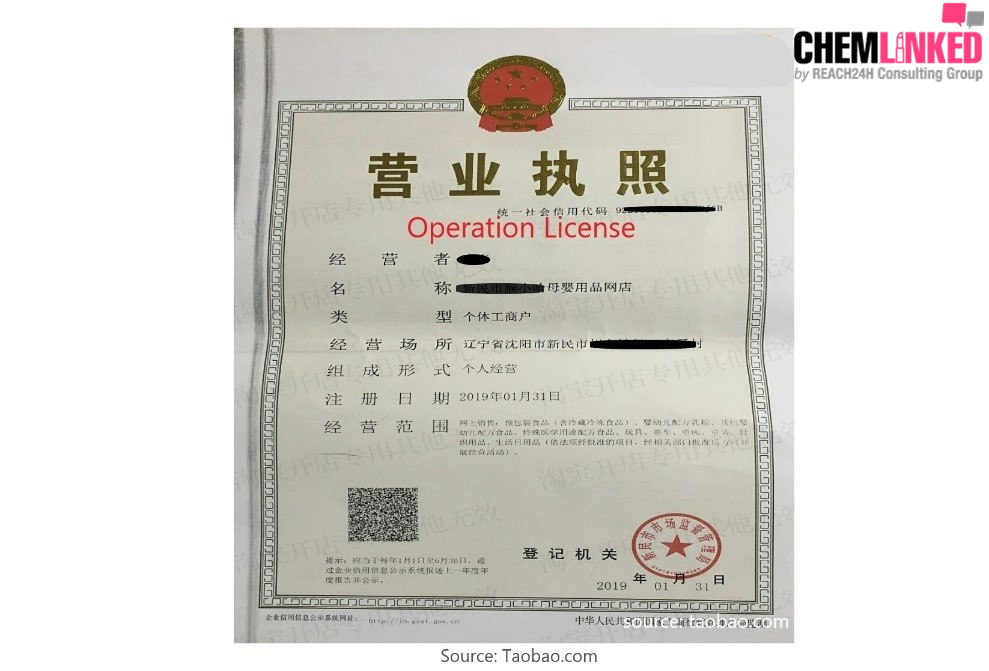
According to an insider at Alibaba’s E-commerce Industry Park, the surge in the number of applicants has exceeded the review capacity of local and national authorities and there is now a major backlog of applications. Unlike Taobao, JD has always required operators using its platforms to be fully licensed meaning there is no backlog.
Impact of E-commerce Law on Daigou has been Limited so Far
Daigou, just like any other cross-border business activity, involves shopping abroad, bringing the goods across the Chinese border and selling to customers. Although the new e-commerce law influences daigou it is by no means a “death” of daigou.
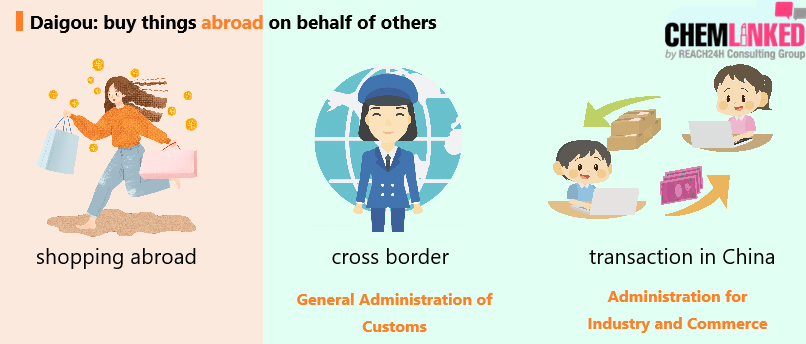
Again, in this article, I would like to clarify the working definition of daigou used in this article. Seen from its premarket stage, daigou mainly falls into two types:
daigou purchase goods abroad and carry them into China, then sell to consumers;
daigou purchase things abroad and mail in small packages to consumers.
In the past daigou businesses operating using method 1 were dominant. In the post E-Commerce Law era customs inspection on items carried into the country in suitcases etc. has been reinforced and many daigou are now more reliant on method 2. The above two types are indeed both illegal in that: a) Imported goods for trade are subject to tariff, but daigou relies on tax evasion b) Inbound passengers are allowed to carry personal use goods that are bought abroad. The legislative basis is:
GAC Announcement on Entry of Luggage Carried by Inbound Passengers[4]
If Chinese residents carry articles for personal use that purchased overseas into China, goods valued ≤¥5000 are duty-free…
Implementation Rules for Administrative Penalties of The Customs[5] article 7
Smuggling activities include concealing, disguising, dishonestly declaring import stuffs to avoid customs regulations.
Implementation Rules for Administrative Penalties of The Customs article 19
Those who transport, carry, and mail goods in excess of reasonable amount of stuffs for personal use* would be levied < 20% of stuff value. Illegal income will be confiscated.
(*for personal use: be used by the passenger/recipient or be given to friends/family members as gift , instead of being sold or rented.)
| Type 1) X | Type 2) X | |
| Registered √ | × | × No need to register |
| Not registered X | × |
Technically, regardless of whether or not an operator has obtained the operation license or not, the importation approach is also important for determining the legality of operations.
Loopholes in Administrative Practice, Lucky for Daigou
Cargo declaration (as in general trade mode) is the safest way for retailers to run their business, yet there are usually very high taxes and tariffs on imported goods, especially on luxury ones. The large markup in price required to make profits on goods imported through conventional and legal channels means that many businesses would rather take the risk and operate illegally using daigou . It allows them to pass on considerable savings to their customers while still making a healthy profit. Win for the retailer, win for the customer, but a big loss for the government.
Lucky for them, in reality it is hard for customs officers to check every piece of luggage and judge whether they are for personal use or for trade, hence many people get away with this approach. Besides, in method B, even if the customs determines that goods are destined for trade, the recipients/consumers are taxpayers, and as long as the value of goods are within their consumption limit, the goods are tariff-free.
Ever since 2018 H2, the customs redoubled its efforts to check the luggage of inbound passengers, making many travelers wait for customs review in queues at the airport. Some daigou were fined heavily, several were put into jail. It is said the customs even blacklist some daigou and increase checks and inspection of blacklisted daigou.
Daigou’s Nightmare: Smuggling Charges
Daigou traders still face the possibility of being charged with smuggling or face the prospect of huge fines.
One widely known anecdote and cautionary tale is of woman charged with smuggling charges and issued a huge fine[6] which is outlined below:
The woman was running a high-end imported clothes business on Taobao.com for four years, she purchased clothes in Hong Kong Special Administrative Zone in great quantity, and carried her goods in smaller quantity into the mainland to evade tax.
The total import value was 11.4million RMB, and her tax evasion was 3million RMB.
She ended up with 10 years in jail and a 5.5 million fine.
The legislative basis for anti-smuggling is:
Criminal Law of the People’s Republic of China[7] (excerpt and summary)
The following two premises can jointly identify certain practice as the crime of smuggling: 1) it is smuggling activity; 2) Value of tax evasion reaches 0.1 million RMB.
| Evaded tax (RMB) | Fine | Imprisonment |
| 0.1~0.5 million | 1~5 fold of evasion value | <3 years |
| 0.5~2.5 million | 3~10 years | |
2.5 million and more | 1~5 fold of evasion value or confiscation of property | >10 years |
Note: For smuggling cases, fines are based on the total of all evaded taxes.
Will This “Industry” Die?
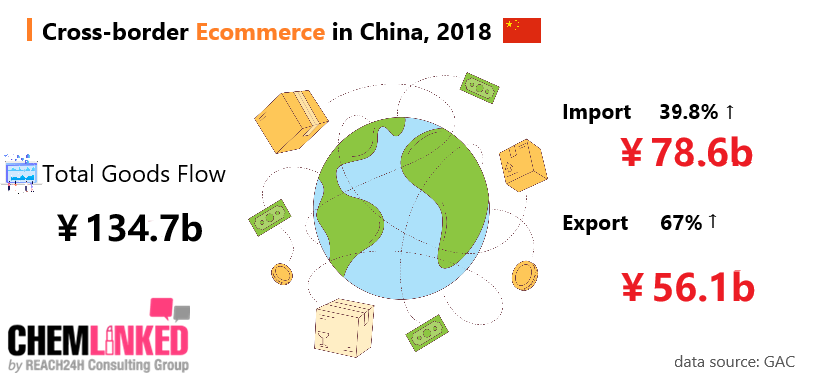
I think it won’t die in the near future, not only because laws and regulations are stymied by implementation problems but also because the market and profits are too irresistible and even today after the ecommerce law has been in place for 3 months Daigou trade is still booming. The scale of daigou is inestimable, but the massive growth in cross-border ecommerce in China is evidence of the scale of demand for imported goods in China.
Principle of survival 1: capitalize on the daigou price advantage
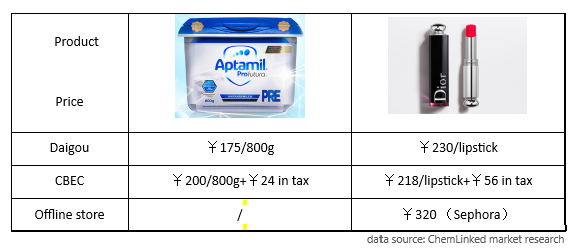
The price advantage offered by daigou businesses is a major contributor to daigou’s success. Frequently purchased imported goods such as infant formula, cosmetics, perfume, high-end watches and bags are subject to high tariffs. Daigou can avoid these tariffs and pass some of the savings on to their customers.
| Tax category | Daigou | CBEC | General trade | |
| Within limit | Beyond limit | |||
| Postal tax | √ | |||
| Tariff | √ | √ | ||
| Consumption tax | √(30% discount) | √ | √ | |
| Value added tax | √ (30% discount) | √ | √ | |
As CBEC is encouraged in China, the price gap of food products is eliminated as far as possible, however, high-end cosmetics are subject to tax as high as 50%~70%, which might be future focus of daigou.
Principle of survival 2: Familiarity breeds trust, building your brand
The profitability of China’s market has attracted many unscrupulous merchants who sell counterfeit products, damaging consumers’ faith in unofficial stores. Many mid-class consumers are now choosing online stores with a good reputation over offline stores due to the better price point of goods sold online. Daigou stores introduced by their friends or supported by many fans became their first choice.
For international stakeholders, daigou offers an interesting market access method which can allow you to increase your reach amongst Chinese consumers. However combining daigou with other trade and retail channels is tricky. Offering a consistent price point across multiple trade channels can be difficult and daigou trade can often undermine more legitimate trade and retail channels.
 We provide full-scale global cosmetic market entry services (including cosmetic registering & filing, regulatory consultation, customized training, market research, branding strategy). Please contact us to discuss how we can help you by