Request a Demo
With a population of 1.35 billion and a rapidly expanding middle class, China is the world's fastest growing market for oral care products. Continuing urbanization, as well as government and private efforts to promote good hygiene in rural areas have boosted per capita consumption on dental products in China.
Market Size and Growth
The following chart sets forth the actual and forecasted retail sales value of oral care products in China from 2011 to 2020. The retail sales of oral care products reached 30 billion RMB in 2015. It is expected to reach more than 43 billion RMB in the coming 5 years.
Retail sales value of oral care products in the PRC, RMB million, 2011-2020E
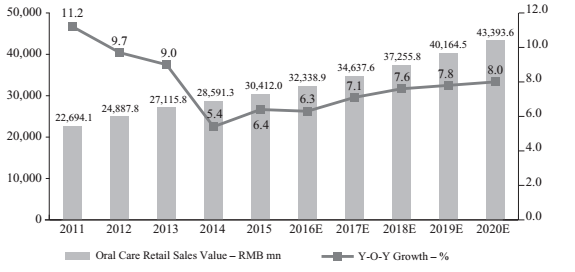
(Source: Report by China Golden Classic Group Limited)
Relevant Standards in China
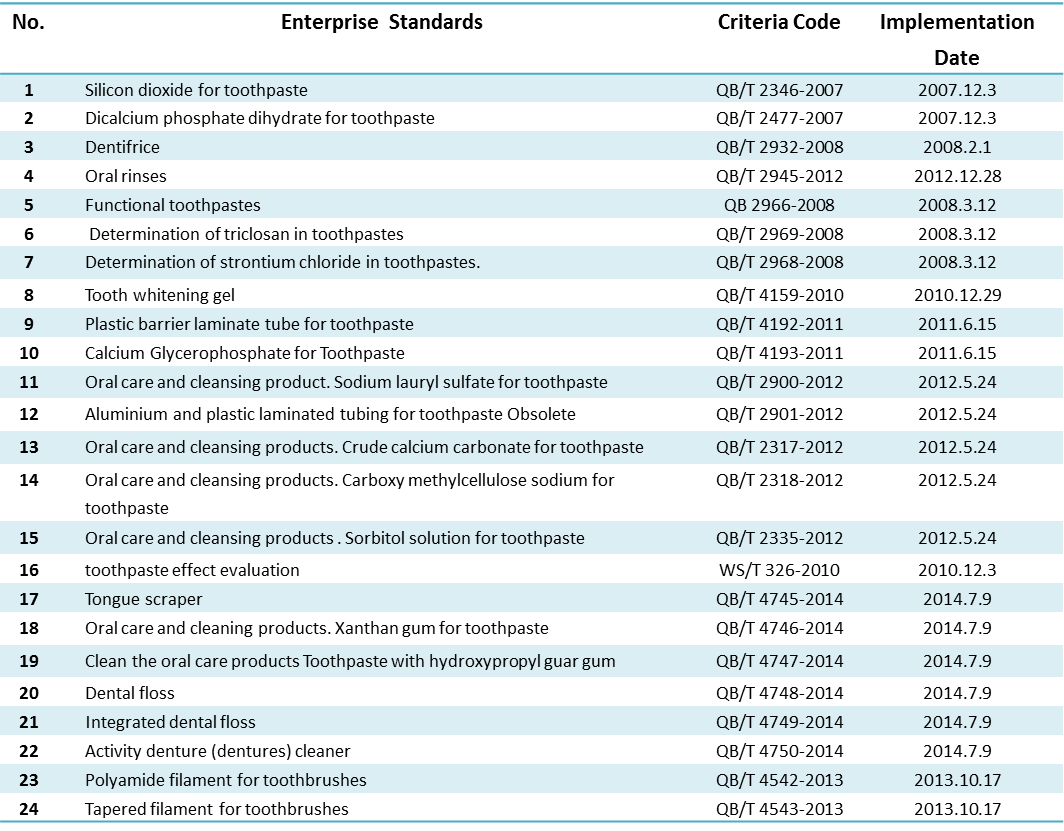
Before an oral care product reaches the market, it is evaluated by Chinese regulatory authorities and subjected to a battery of tests. All products must meet specific compliance criteria and market entry thresholds designed to protect consumers and safeguard the quality and efficacy of products. The authorities have imposed strict standards which regulate permitted ingredients, as well as packaging and the warnings. Currently, there are 33 standards for oral care products, nine of which are national standards (Table1) and 24 of which are enterprise standards (Table 2).
Table 1 Standards for oral care products - 9 National Standards
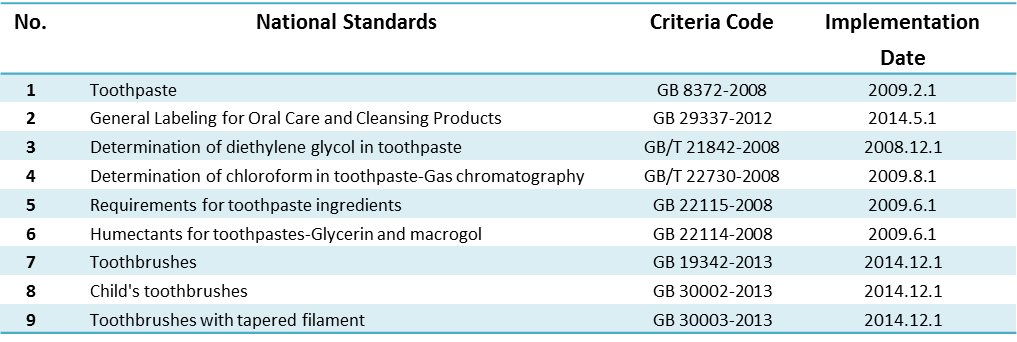
Table 2 Standards for oral care products - 24 Enterprise Standards
Safety Regulations for toothpaste products
Toothpaste product ingredients should meet the requirements in “General requirements on raw materials of toothpaste” (GB 22115-2008). This technical guidance document specifies the requirements for toothpaste raw materials including prohibited ingredients, restricted ingredients, authorized preservatives and authorized pigments.
Lists | Ingredients | Number |
Negative List | Prohibited ingredients | 1466 |
Positive List: | Restricted ingredients | 39 |
Preservatives | 48 | |
Colorants | 102 |
Regulation of Functional Toothpastes and Efficacy Claims
Functional Toothpastes (QB/T 2966-2014) defines functional toothpaste as toothpaste with added functional components, which has additional functions and can alleviate certain oral problems, or contribute to oral health in addition to the basic function of a general toothpaste.
According to the standard, the functional effects should be supported by an evaluation report. The report (including the clinical evaluation report and laboratory evaluation report) should be provided by CFDA certified hospitals or dental labs. For functions such as anti-caries, control dental plaque or gingivitis, improvement of hypersensitivity, there are already certain specific evaluation standards that should be met.
To conduct efficacy evaluation is encouraged, but not mandatory. Any company found using exaggerated or false claims without substantiation is subject to administrative sanctions, fine, ordered to pay compensation or can have their production permit canceled. For example, in 2015 Procter & Gamble Co's Crest Double-Action Whitening Toothpaste was fined by the Shanghai Bureau for Industry and Commerce for false advertising. The company was found guilty of using photo-editing software to exaggerate the teeth-whitening effect in a television commercial. The 6.03 million Yuan penalty marks the biggest fine ever in China on a charge of false advertising.
Market Entry: CIQ Inspections and Custom Clearance
For imported oral care products, before they reach the port and undergo inspection by Chinese Customs, the company should file a record with the provincial CIQ at the port. When products arrive, the on-site examination of labels and packaging and the sampling inspection and testing will be conducted by CIQ. Qualified products will obtain a CIQ certificate. Customs clearance is also a mandatory requirement. After that, the product is finally ready for sale. Normally it will take about 1 month for the whole process.

Future Trends
Chinese authorities are looking to strengthen oral care product regulations to ensure that quality and safety standards align with international best practices.
To understand the regulation of oral care product, we should first understand that the definition of "cosmetics" in China has a significant difference compared with many other countries. In China, cosmetics refers to products that are applied to the human body surfaces (lips, skin, nails, hairs, etc.) teeth and oral mucosa by smearing, spraying or using any other similar approach with the purpose of cleaning, protecting, modifying and or maintaining the integrity of these surfaces. Oral care products in contact with the teeth and oral mucosal membranes are not regarded as cosmetics in China.
Teeth and oral mucous membrane associated products appears on the draft of the Cosmetics Supervision and Administration Regulation, which was released in July, 2015. Despite the opposition of some industrial associations and enterprises, the authority in China expressly specifies that oral care products should be treated as cosmetics aligning with the U.S., European and Japanese frameworks.
The draft regulation has not been officially implemented, and it is currently uncertain how the change in the draft will affect oral care products. If they are considered cosmetics, they will be subjected to more strict regulations by the CFDA, and will require mandatory record filing or registration with CFDA or provincial FDAs according to the product category.
 We provide full-scale global cosmetic market entry services (including cosmetic registering & filing, regulatory consultation, customized training, market research, branding strategy). Please contact us to discuss how we can help you by