Request a Demo
China National Medical Products Administration (NMPA) organizes a number of national supervision and random inspections on different cosmetics across the country every year. The results of these inspection campaigns often reveals high risk market segments and often guides the development of regulation and further inspection campaigns going forward. Analyzing this data can also point to segments subject to priority inspection by authorities, thereby warranting extra care on the part of the industry to ensure the compliance of their products.
Cosmetic Inspection Results of 2019
According to data on non-compliant cosmetics publicized on NMPA’s official website over the past year, a total of 444 batches of cosmetics failed NMPA or provincial MPAs’ random inspections, including sunscreen, skin care, whitening, anti-acne, and hair dye (perm) products.
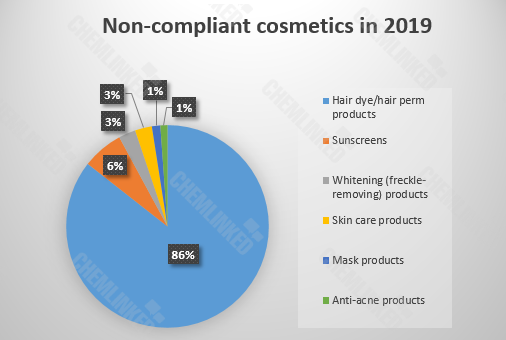 (Data: NMPA, CNPHARM)
The specifics are as follows:
Hair dye (perm) products: the prominent factors resulting in inspection failure were inconsistencies between the detected and labeled ingredients, counterfeit products, and inconsistencies between the licenses and labels. Other minor factors, such as physicochemical indicators outside of standardized parameters, detection of prohibited components, and incomplete information etc.
Sunscreens: some 15 batches of products violated regulations due to the inconsistency between the detected and labeled ingredients. The remaining violations were associated with counterfeit products.
Substandard whitening (anti-spot) products: the detection of glucocorticoids and heavy metals were the main issues found during inspections.
Substandard anti-acne products: the main problems are counterfeiting and illegal addition of antibiotics.
Substandard skincare products: counterfeit products and microbial contamination accounted for the majority, followed by excessive heavy metals, detection of antibiotics, etc.
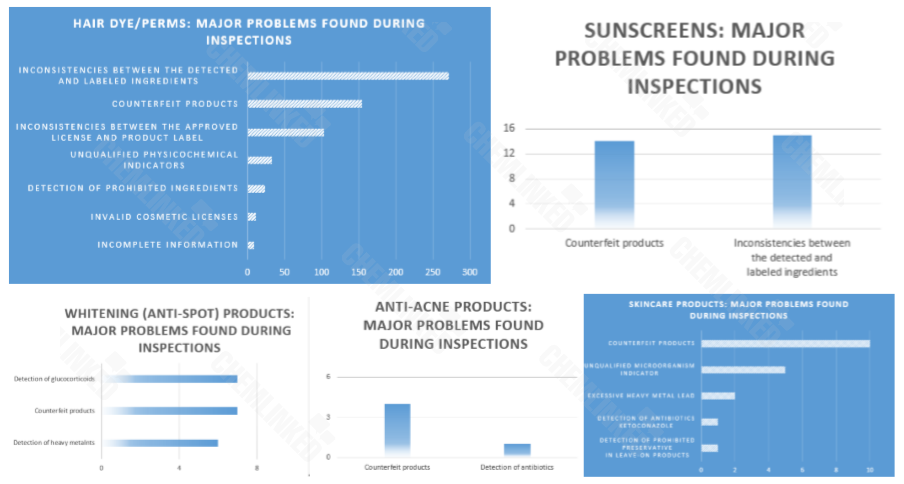 (Data: NMPA, CNPHARM)
Causes of the Problems and Compliance Requirements
Inconsistencies between the detected and labeled ingredients
The main issue with hair dye and sunscreen products is that the ingredients claimed on the label or approved certificates did not correspond to the actual merchandise.
The most common reason for the issue occurred when enterprises failed to update their registration certificate when the product formula changed. As per Provisions for Application and Acceptance of Administrative Licensing for Cosmetics, “Any change/reformulation of ingredients has the potential to impact cosmetic safety and other indexes and requires submission of a new filing/registration application as a new product." However, it takes enterprises between one and a half to two years to fully complete the reapplication, during which various documents and reports need to be submitted, and tests and reviews also conducted. The complicated and lengthy process means that some enterprise choose to market a new product using the registration certificate of a previously registered product.
Detection of banned ingredients
Notably, this problem primarily exists in hair dye (perm) cosmetics, and the main prohibited components detected are o-aminophenol and m-Phenylenediamine.
Regarding o-aminophenol, it was initially categorized as a permitted hair dye in the Hygienic Standard for Cosmetics (2007), but Safety and Technical Standards for Cosmetics 2015 adjusted requirements for some prohibited substances to directly align with international practices. Now o-aminophenol is a banned ingredient that cannot be used in cosmetics. Some companies may not be aware of this change in the standard and continue to apply the component in their products.
Detection of heavy metal
The main problem of whitening cosmetics is heavy metal contamination. Given that the whitening effect can be achieved in a short period by the use of lead and mercury, these banned substances are illegally added by some enterprises. As per the Safety and Technical Standards for Cosmetics 2015, the hazardous substances in cosmetics are subject to the concentration limits specified in the table below:
Limits of Hazardous Substances in Cosmetics | ||
Hazardous substance | Limit (mg/kg) | Remark |
Mercury | 1 | Except eye cosmetics containing organic mercury preservatives |
Lead | 10 | |
Arsenic | 2 | |
Cadmium | 5 | |
Methanol | 2000 | |
Dioxane | 30 | |
Asbestos | Not be tested out | |
Detection of glucocorticoids
Glucocorticoids are potent anti-inflammatory agents with systemic effects. Long-term use of cosmetics containing glucocorticoids interferes with collagen production and results in striae, black spots, atrophy and thinning of facial skin, as well as hormone-dependent dermatitis. Safety and Technical Standards for Cosmetics 2015 stipulates that the use of these substances such as dexamethasone, betamethasone valerate, betamethasone propionate, clobetasol propionate esters is banned in cosmetics.
Unqualified microbiological indicators
The microbiological indicator is an important index to assess the degree of contamination and sanitary conditions during the cosmetic manufacturing process. Microbial contamination is a major problem in skincare products. Excessive bacterial count and excessive mold and yeast were the most common issues. According to Safety and Technical Standards for Cosmetics 2015, the limitation of total bacterial count should be no more than 500 CFU/ml (g) for eye products, lip products, and children cosmetics; for ordinary products, it should be no more than 1000 CFU/ml (g).
Limitation of Microbiological Indicators in Cosmetics | ||
Microbiological Indicator | Limit | Remark |
Total bacterial count (CFU/g or CFU/ml) | ≤500 | Eye cosmetics, lip cosmetics and children cosmetics |
≤1000 | Other cosmetics | |
Molds and yeast count (CFU/g or CFU/ml) | ≤100 | |
Fecal Coliforms/g (or ml) | Not be tested out | |
Staphylococcus Aureus/g (or ml) | Not be tested out | |
Pseudomonas Aeruginosa/g (or ml) | Not be tested out | |
What post-market inspections mean for stakeholders?
In China, post-market sampling and inspection are a part of routine surveillance on cosmetics, and the inspection priority will be given to high-risk products, such as hair dye (perm), whitening, and sunscreen cosmetics. Noncompliant labels/certificates, detection of prohibited ingredients, and microbial contamination were cosmetic safety weak points identified during the 2019 sampling inspection campaign.
Cosmetics stakeholders should strictly abide by relevant cosmetic laws, regulations, and standards, pay close attention to regulatory updates, and fully understand the requirements for cosmetic quality and safety.
Cosmetic Safety and Technical Standards 2015 is the most significant cosmetic legislation in China, serving as the gold-standard reference for cosmetic safety supervision and inspection. It encompasses explanations of technical terms, requirements of cosmetic prohibited/restricted/permitted ingredients, specifications of cosmetic testing methods, etc. Cosmetic manufacturers shall refer to these technical standards for production.
 We provide full-scale global cosmetic market entry services (including cosmetic registering & filing, regulatory consultation, customized training, market research, branding strategy). Please contact us to discuss how we can help you by