Request a Demo
During the COVID-19 crisis, the demand for essential hygiene products such as disinfectants and hand sanitizers has shot up across Australia. In response to the attendant supply shortage, Australia’s Health Minister Greg Hunt announced on March 30 that the Therapeutic Goods Administration (TGA) would introduce an urgent legislative instrument to relax regulations on hand sanitizer [1].
On March 27, Australia released the Therapeutic Goods (Excluded Goods—Hand Sanitisers) Determination 2020 (Compilation No. 1), which temporarily exempted the usual TGA licensing requirements for specified hand sanitizers during the pandemic. On May 6, the Exclusion Determination was superseded by an amended version—Therapeutic Goods Amendment (Excluded Goods—Hand Sanitisers) Determination 2020 (Compilation No. 2) to further clarify the ingredient, labeling and presentation requirements.
Under the updated regulation, the Exclusion Determination still applies until June 30 this year. The TGA has developed three classes of hand sanitizers, and the corresponding obligations for each category are as follows [2]:
1. Specified Hand Sanitizers
The specified hand sanitizers are eligible for the exemption of TGA approval or notification during the COVID-19 pandemic, provided those products satisfy the specified formulation, manufacturing, advertising, and labeling criteria.
Regarding formulation and manufacturing
The products shall be prepared strictly in line with one of the two specific formulas advised by the WHO.
(1) Ethanol hand sanitizers:
| (2) Isopropyl alcohol hand sanitizers:
|
Notably, manufacturers shall ensure that both of these hand sanitizers are manufactured under sanitary conditions, retain the manufacturing records, and test samples of each batch of the final products to verify the concentration of the active ingredients conforming to the exemption threshold.
Regarding the labeling
The front and back labels can be combined into a single label, or co-located on the goods, and can be printed in color. The following information can be included in the label:
a business name or logo of the manufacturer or supplier, and a trade name for the product provided that neither suggests the product has been approved or recommended by a government or government authority;
a batch number and expiry date (no more than three years from the date of manufacture);
a statement that the product is “based on the hand rub formulation of the WHO";
any other caution, warning, or other marking that relates to the safe use, transportation or storage of the goods.
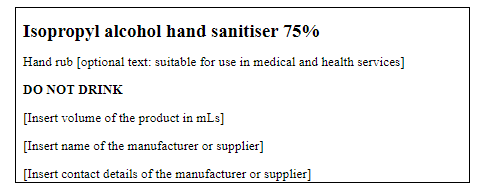 (TGA: Front label of isopropyl alcohol hand sanitizers)
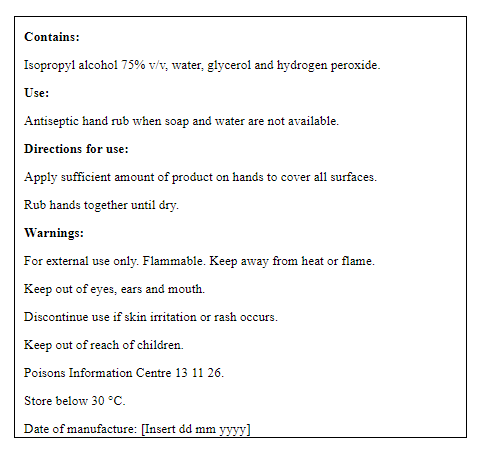 (TGA: Back label of isopropyl alcohol hand sanitizers)
2. Therapeutic Goods
Hand sanitizers with therapeutic use claims, such as “effective against E. coli/viruses” or “help quell the spread of COVID-19”, or hand sanitizers to be used in clinics or hospitals are categorized as therapeutic goods.
The products must be manufactured by TGA-licensed manufacturers in Australia or at overseas sites with certified GMP clearance, and require the evaluation from the TGA and inclusion in the Australian Register of Therapeutic Goods (ARTG) before import. Besides, sufficient data is necessary to support the claims marked on the label.
3. General Consumer Products (Cosmetics)
It refers to products for personal or domestic use, with no claims of effectiveness against viruses and uses low-risk ingredients (not contain a substance included in the Poisons Standard).
These products are regulated by the National Industrial Chemicals Notification and Assessment Scheme (NICNAS) and the labeling duties of which shall comply with the Australian Competition and Consumer Commission (ACCC) rules.
For more information about global hand sanitizer regulations, please refer to ChemLinked’s Hot Topic.
 We provide full-scale global cosmetic market entry services (including cosmetic registering & filing, regulatory consultation, customized training, market research, branding strategy). Please contact us to discuss how we can help you by