Request a Demo
BackgroundAccording to the Technical Guidelines for Cosmetic Safety Assessment, until May 1, 2024, cosmetics registrants and notifiers have the option to submit a simplified product safety assessment report during the registration or notification process. However, starting from May 1, 2024, the full version of the assessment report must be submitted. This transition presents challenges for the industry due to factors like the lack of toxicological data for various ingredients and limited safety assessment personnel.
National Medical Products Administration (NMPA) may introduce a six-month transition period for the submission of the full assessment report, as reported in the official industry newspaper on March 15, 2024. Additionally, NMPA will implement measures to optimize the management of safety assessment.
To support enterprises in submitting the full assessment reports, in March and April 2024, China released 5 draft guidelines related to safety assessment: |
On April 10, 2024, the China National Institutes for Food and Drug Control (NIFDC) unveiled six draft guidance documents concerning cosmetics safety assessment. 1 These documents specifically address stability testing, preservative challenge testing, packaging compatibility testing, skin sensitization testing, and ingredient safety data, aiming to enhance the overall safety assessment process for cosmetics. These documents are:
1. Technical Guidelines for Stability Evaluation of Cosmetics
2. Technical Guidelines for Cosmetic Preservative Challenge Testing
3. Technical Guidelines for Compatibility Evaluation of Cosmetics with Packaging Materials
5. Index of Cosmetics Safety Assessment Data from Authoritative Organizations
6. Information on Cosmetic Ingredient Usage
These draft documents are open for public feedback until April 17, 2024. Interested parties are encouraged to provide their comments and relevant documents to [email protected] before the deadline.
1. Technical Guidelines for Cosmetic Stability Testing, Preservative Challenge Testing, Packaging Compatibility Testing, and Integrated Approaches to Testing and Assessment (IATA) of Skin Sensitization
In the full version of the safety assessment report, it is essential to include stability testing, preservative challenge testing, and packaging compatibility testing. Previously, there was a lack of unified standards for these tests issued by cosmetic regulatory authorities. As a result, most enterprises conducted these tests based on their own methods or by referring to standards from other product categories, such as drugs.
The introduction of these Guidelines brought about a unification of testing methods for stability, preservative challenge, and packaging compatibility. This development is beneficial for enterprises, as it provides standardized procedures for conducting these tests.
Technical Guidelines | Main Contents | Drafting Background |
Technical Guidelines for Stability Evaluation of Cosmetics (Draft for Comments) | The Guidelines specifies the test requirements, test methods and result evaluation for cosmetic stability testing.
The design of cosmetic stability testing should be combined with the physical and chemical properties of ingredients, product form, formula, production process, and packaging materials. The cosmetic stability testing can include influencing factor test, accelerated test and long-term test. | Previously, two regulations in China touched upon cosmetic stability testing. Article 30 of the Provisions for Management of Cosmetic Registration and Notification Dossiers emphasizes the need to set storage conditions and durability based on the characteristics of the product packaging and product's stability or relevant experimental results. Additionally, Technical Guidelines for Cosmetic Safety Assessment highlighted the assessment of physical and chemical indicators of cosmetics based on their specific conditions to determine product stability.
However, neither of the two regulations provided explicit instructions for conducting stability testing. To address this gap, NIFDC newly introduced this Guidelines. The test requirements and test methods outlined in the Guidelines are consistent with current general principles of stability testing used in the industry. Besides, practical and feasible test conditions are selected to ensure the test's operability while maintaining appropriate standards. |
Technical Guidelines for Cosmetic Preservative Challenge Testing (Draft for Comments) | The Guidelines specifies the evaluation method for the preservative efficacy of cosmetics. It is specifically designed for the performance evaluation of preservative systems in common cosmetics, such as lotions and creams that contain water (AW ≥ 0.7). | The current standards utilized in China for assessing cosmetics' preservative efficacy include the group standards T/SHRH 017-2019 Antimicrobial Effectiveness Testing of Cosmetics, T/GDCDC 010-2019 Test Method for the Preservative Challenges of Cosmetics, and the General Principles 1121 “Bacterial Efficacy Test Method” of the Pharmacopoeia of the People's Republic of China (2020 Edition).
The preservative efficacy evaluation method outlined in the newly introduced Guidelines incorporates relevant Chinese domestic and foreign standards while innovatively introducing two key elements: the T1 time point and Staphylococcus epidermidis. These additions aim to limit the excessive use of preservative ingredients. After thorough methodological verification, the methods prescribed in the Guidelines can meet the requirements for evaluating the preservative efficacy of cosmetics. |
Technical Guidelines for Compatibility Evaluation of Cosmetics with Packaging Materials (Draft for Comments) | The Guidelines provides instructions on the requirements, test methods, and result evaluation for conducting compatibility evaluation between cosmetic contents and the containers/carriers that directly come into contact with them. The testing scope excludes secondary packaging and accessories that do not have prolonged contact with cosmetics.
Compatibility research should commence during the early stages of cosmetics R&D, or during the selection of packaging materials, and should be conducted consistently throughout the entire cosmetics development process.
During the compatibility research, it is crucial to consider the specific types of cosmetic products and packaging materials involved, as well as the contact methods employed. The targeted research plans are designed and implemented to ensure the quality and safety of cosmetics. | Packaging materials that directly come into contact with cosmetics should be safe enough to prevent chemical reactions with the cosmetics, as well as avoid migration or release of harmful substances that could potentially pose risks to human health. However, there has been very few research conducted on compatibility in the cosmetics industry. In addition, testing standards and regulations specifically tailored to packaging materials in the cosmetics field can rarely be seen both domestically and internationally.
To address this research gap, the Guidelines has been developed. It provides a convenient and effective framework for conducting compatibility research, in consideration of the diverse materials and shapes of packaging materials, as well as the wide variety of cosmetics being packaged. |
Technical Guidelines for Integrated Approaches to Testing and Assessment (IATA) of Skin Sensitization (Draft for Comments) | The Guidelines is applicable to the skin sensitization assessment of cosmetic ingredients. The assessment employs toxicological tests capable of detecting the key events (KE1-KE3) within the skin sensitization Adverse Outcome Pathway (AOP), forming a "2 out of 3" integrated testing strategy (ITS). The scope of this strategy should be consistent with the suitability of all selected test methods. | Safety and Technical Standards for Cosmetics (STSC) includes several existing alternative methods for testing skin sensitization, namely: 1) Skin Sensitization: Local Lymph Node Assay: DA (LLNA:DA) 2) Skin Sensitization: Local Lymph Node Assay: BrdU-ELISA (LLNA:BrdU-ELISA) 3) In Chemico Skin Sensitization: Direct Peptide Reactivity Assay (DPRA) 4) In Chemico Skin Sensitization: Amino acid Derivative Reactivity Assay (ADRA) 5) In Vitro Skin Sensitization: Human Cell Line Activation Test (h-CLAT) 6) U937 Cell Line Activation Test (U-SENS) 7) Keratinocyte Based ARE Reporter Gene Assay (LuSens)
To address the limitations of individual testing methods, the Guidelines has systematically integrated the existing alternative methods into a "2 out of 3" ITS based on the mechanism and process of skin sensitization AOP. This approach aims to enhance the reliability and application level of alternative testing methods, and provide alternative toxicological data for the safety assessment of cosmetic ingredients.
In addition to the alternative methods specified in STSC, enterprises can refer to methods validated by internationally recognized alternative method validation agencies and the OECD. However, it is essential to provide clear explanations of the data interpretation procedures and uncertainty analysis, such as the threshold boundary ranges. |
2. Cosmetic Ingredient Safety Data Catalogs
1) Index of Cosmetics Safety Assessment Data from Authoritative Organizations
This Index is an objective collection of ingredients that meet the following three criteria:
They have been used in cosmetics available in China;
They are not included in STSC;
Assessment conclusions for these ingredients have been published by authoritative agencies such as Scientific Committee on Consumer Safety (SCCS), Cosmetic Ingredient Review (CIR), and the German Federal Institute for Risk Assessment (BfR).
The Index comprises 3,572 ingredients and includes their corresponding serial number in IECIC, Chinese name, INCI name/English name, and previous/current name.
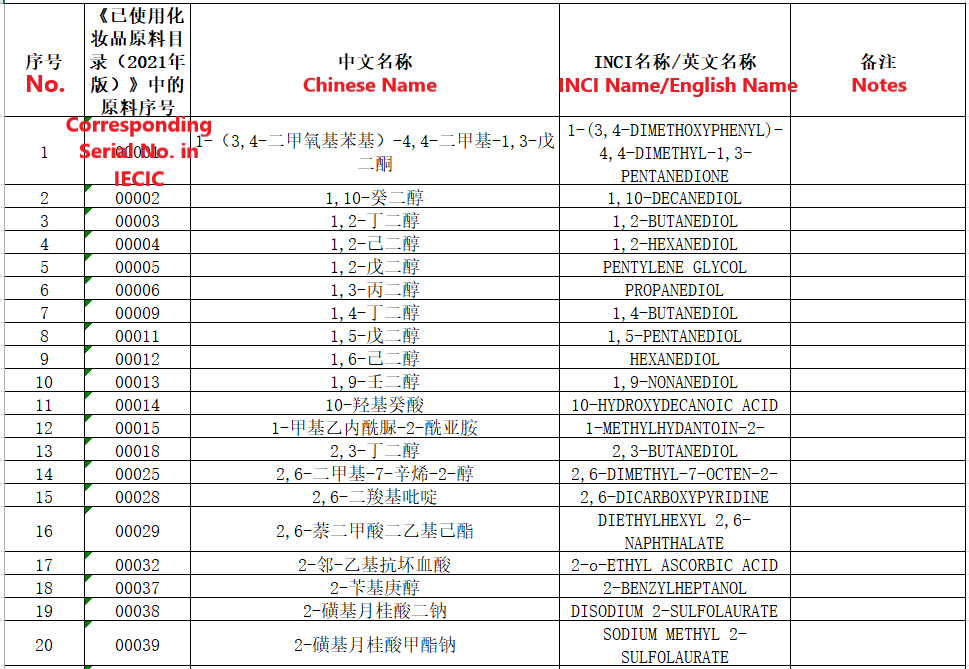 Excerpt of Index of Cosmetics Safety Assessment Data from Authoritative Organizations
The Index serves as a reference for enterprises conducting cosmetics safety assessments. Registrants and notifiers can utilize the assessment conclusions provided by authoritative agencies, including but not limited to SCCS, CIR, and BfR, for these ingredients. When adopting assessment conclusions, the following requirements should be met:
1) Analysis of assessment conclusions: Conclusions that comply with China's cosmetic regulations and usage conditions can be adopted;
2) Staying updated: Given advancements in science and technology and evolving knowledge, the types of ingredients assessed and their assessment conclusions may change. Enterprises should prioritize the latest assessment conclusions;
3) Handling diverging conclusions: In cases where different authoritative agencies offer different assessment conclusions, enterprises should scientifically and reasonably adopt relevant conclusions. The reliability and relevance of the data should be the principle of selection.
2) Information on Cosmetic Ingredient Usage
Information on Cosmetic Ingredient Usage is an objective collection of ingredients that meet the following three criteria:
They have been used in special cosmetics available in China, and the special cosmetics registration certificate is still valid;
They are not included in STSC;
No assessment conclusions from authoritative agencies are available.
It includes 2,250 ingredients with their serial number in IECIC, Chinese name, INCI name/English name, previous name, application sites and application methods of the products containing the ingredient, and the concentration of ingredients used in the product. Notably, it encompasses a significant number of plant ingredients with Chinese characteristics, which greatly facilitates the access of safety data for these plant ingredients.
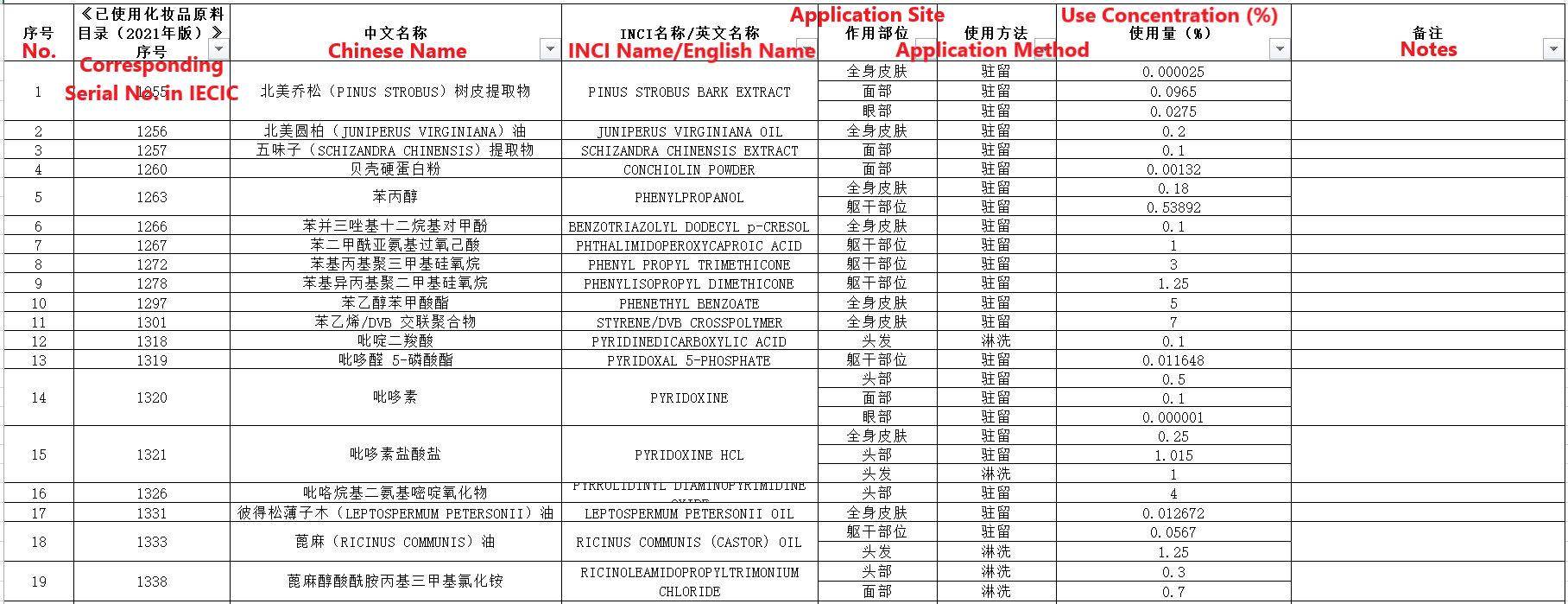
Excerpt of Information on Cosmetic Ingredient Usage
Data Adoption Requirements
The specified ingredient concentrations in Information on Cosmetic Ingredient Usage serve as a reference for enterprises conducting cosmetics safety assessments. Cosmetic registrants and notifiers should appropriately utilize the ingredient concentration based on the product's application method and site, following the following principles:
For the same ingredient with the same application site, if only the ingredient concentration of leave-on products is available, the concentration of this ingredient in leave-on products can be referred to in the safety assessment of this ingredient in rinse-off products. However, if only the ingredient concentration of rinse-off products is available, the concentration of this ingredient in rinse-off products cannot be referred to in the safety assessment of this ingredient in leave-on products;
For the same ingredient with the same application method, the safety assessment can be conducted in the order of 1) whole body skin, trunk area, face, lips, and eyes, or 2) whole body skin, trunk area, hands, feet, head, and hair. The ingredient concentration of product with a former-ranked application site can be referred to in the safety assessment of products with a later-ranked application site. However, when the product's application site is the eye and the ingredient concentration of products applied to other sites is referred to, the eye irritation of the ingredient should be separately assessed.
It's important to note that the cosmetics regulatory authorities have not conducted a systematic evaluation of the safety of the 2,250 ingredients listed in Information on Cosmetic Ingredient Usage. When utilizing the use concentration provided in Information on Cosmetic Ingredient Usage, registrants and notifiers should comply with relevant national laws, regulations, standards, and technical specifications, and bear responsibility for product quality and safety.
For ingredients not listed in Information on Cosmetic Ingredient Usage, the NIFDC will make improvements based on the inclusion principles of the Inventory and feedback from enterprises.
Industry Comments
The release of Information on Cosmetic Ingredient Usage provides significant relief to companies which are tackling the challenge of compiling full safety assessment reports, particularly due to the limited available data for many ingredients. Upon finalization, Information on Cosmetic Ingredient Usage may replace the existing ingredient safety data used in safety assessments, i.e. the "highest historical usage concentration" in IECIC. This transition will grant enterprises access to a broader array of ingredient safety data, effectively streamlining their product safety assessments.
With extensive experience in cosmetic registration and notification, ChemLinked’s parent company REACH24H Consulting Group offers compliance solutions to assist overseas cosmetic enterprises entering into China. Welcome to contact us at [email protected] for more advice.

 We provide full-scale global cosmetic market entry services (including cosmetic registering & filing, regulatory consultation, customized training, market research, branding strategy). Please contact us to discuss how we can help you by