Request a Demo
On November 15, 2024, the National Institutes for Food and Drug Control (NIFDC) issued a notice to solicit public opinion on the draft of Ingredient Usage Information of Marketed Products1.
Background information In April 2024, NIFDC released 11 technical documents related to cosmetic safety assessment, three of which pertain to the usage of ingredient data: Guidelines for the Use of Cosmetic Ingredient Data, Ingredient Usage Information of Marketed Products, and Index of Cosmetic Safety Assessments by International Authorities. These documents aim to guide companies in collecting and utilizing the existing safety data of ingredients. To further enhance the implementation of cosmetic safety assessment, NIFDC has organized the formulation ingredients and their usage information from over 1.4 million registered cosmetics with valid permits. This effort has contributed to the Ingredient Usage Information of Marketed Products (Revised Draft for Public Consultation). |
The ingredient inventory in the draft is expanded from 2,234 to 3,578 ingredients. At the same time, ingredient usage information is enlarged to 5240 items. Looking into the details, a total of a total of 1,675 extract ingredients (提取物) were found in the exposure draft, reflecting a significant increase of 463 extracts compared to the previous version. This development is particularly promising for cosmetic companies that use plant materials.
Apart from the rise in the ingredient number, the permissible usage concentrations for several substances are to be elevated, enabling broader applications of these ingredients in cosmetic manufacturing. For instance, the concentration of "Pinus Strobus Bark Extract (北美乔松树皮提取物)" is increased from 0.000025% to 0.4% when applied on body skin.
According to the draft, the scope of marketed cosmetics in the regulation is re-defined as "the ingredient usage information for filed and registered cosmetics with valid permits in China that are not included in the Safety and Technical Standards for Cosmetics2 or the Index of Cosmetic Safety Assessments by International Authorities". This update incorporates validly filed cosmetics (general cosmetics), which is a significant reason for the substantial increase in ingredient information in the new edition.
Additionally, the priorities for determining the use concentrations for each application site are clarified as below.
For the same ingredient and usage methods, the information can be organized in the following order: whole body, torso, face (including neck), hands and feet, head, hair, lips, eyes, and fingernails (toenails). The recommended use concentrations for subsequent application sites should be based on those for prior sites. However, if the product is intended for the eye area and its use concentration is established based on that for other sites, an additional eye irritation assessment is necessary. Importantly, the use concentrations for lips and eyes should not be based on those for the hands, head, or hair. The use concentration for body hair should only be determined based on those for the whole body or torso. If the application site includes both the head and hair, the usage amount for the head should be used as a reference. If the application site includes the face (including neck), eyes, and/or lips, the use concentration for the face (including neck) should serve as a reference to establish the relevant use concentration, with an additional eye irritation assessment required if the eye area is included. For ingredients used in products targeting multiple application sites, the usage amount from the higher-level application site with the same usage method should be followed. |
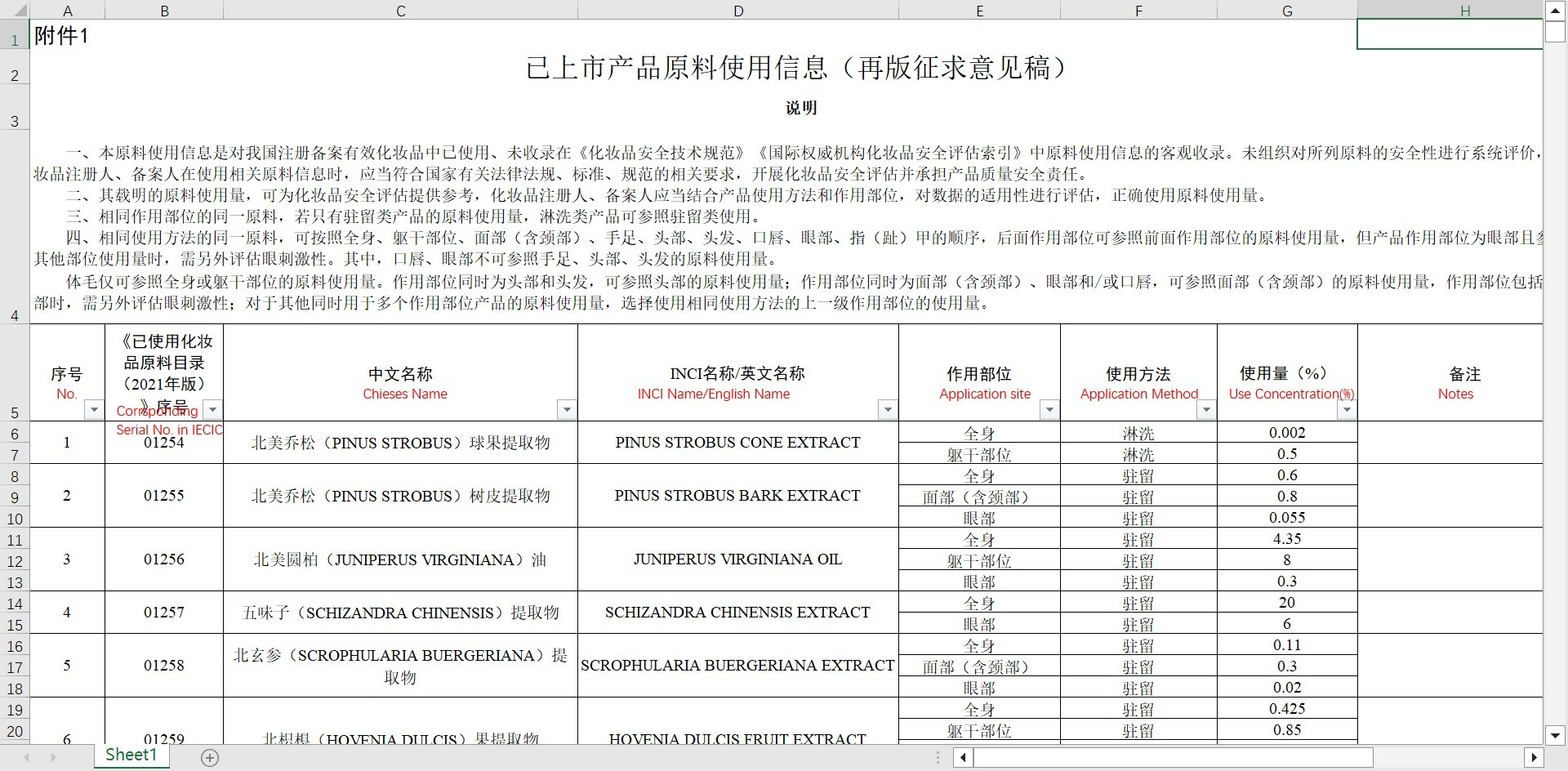 Excerpt of Ingredient Usage Information of Marketed Products
Stakeholders can send suggestions to [email protected] prior to November 30, 2024. According to the NIFDC, if the ingredient’s types or usage amounts exceed the scope outlined in this draft, but have been conducted with assessments following Safety and Technical Standards for Cosmetics2, the registrants can provide suggestions to the authority with relevant materials.
 We provide full-scale global cosmetic market entry services (including cosmetic registering & filing, regulatory consultation, customized training, market research, branding strategy). Please contact us to discuss how we can help you by