Request a Demo
Editor's Note: This article was originally published on Oct. 14, 2022, and was updated on Nov. 18, 2022, as per the latest developments.
Latest Updates
On October 28, 2022, the Department of General Operation within China General Administration of Customs released an announcement to further clarify the requirements for exporting cosmetics containing TEA to China.
In accordance with the announcement, for TEA added as a pH adjuster in cosmetics, it will generally react with the acidic substances contained in products. If the product's testing report shows that TEA monomers are not detected, it proves that TEA has undergone a complete reaction and there is no free TEA in the product. In this case, according to Regulation of the People's Republic of China on the Administration of Controlled Chemicals, it is not required to provide the Import License for Dual-use Items and Technologies.
Safety and Technical Standards for Cosmetics 2015 includes the testing method of TEA in Chapter 4 Physical and Chemical Testing Methods for Cosmetics. Stakeholders can refer to this method to conduct the testing for cosmetics that fulfil above conditions.
Recently, when exporting cosmetics containing Triethanolamine to China, some cosmetic enterprises were required to provide the Import License for Dual-use Items and Technologies (import license) by China General Administration of Customs. To help stakeholders better comply with this requirement, this article explains why the import license is required for cosmetics containing TEA, and introduces the application process of the license.
Triethanolamine (CAS No 102-71-6), or TEA, is an organic compound commonly serving as a pH adjuster, moisturizing agent, and/or emulsifying agent in various kinds of cosmetic products, such as cleansing creams, skin lotions, eye gels, shampoos, and shaving foams. In addition to its application in cosmetics, TEA is used as the main material in the manufacturing of chemical weapons. Bearing these features, TEA is regulated as a dual-use item, and subject to particular import and export requirements.
Requirements for Exporting Cosmetics Containing TEA to China
Dual-use items refer to goods that can be used for both civilian and military purposes, including nuclear-related items, biological agents, missiles, precursor chemicals, controlled chemicals, etc. To ensure the safe use of dual-use items, as stipulated by Administrative Measures for the Import and Export License of Dual-use Items and Technologies, the import and export of dual-use items are subject to licensing. To help stakeholders understand whether they need to apply for the license, Ministry of Commerce has compiled the Catalogue of Dual-use Items and Technologies Subject to Import & Export License Administration (Catalogue) to specify all the regulated dual-use items.
TEA is included in the Catalogue as a controlled chemical. According to Regulation of the People's Republic of China on the Administration of Controlled Chemicals (Regulation), the licensing system for dual-use items applies to the import and export of TEA, as well as products containing TEA. The Implementation Rules of Regulation of the People's Republic of China on Administration of Controlled Chemicals prescribes that, when the controlled chemical's concentration in the product is below a certain threshold, the import and export can be exempted from applying for the license. However, the Ministry of Industry and Information Technology has not published the exemption threshold of TEA yet. Therefore, for exporting cosmetics containing TEA to China, regardless of the concentration, it is mandatory to apply for the import license.
 Practical Guide to Apply for the Import License
The Regulation requires that, the application for the import license of TEA and products containing TEA shall be conducted by two designated companies, Sinochem Group and China Haohua. Before exporting cosmetics containing TEA to China, the exporter needs to contact one of the designated companies, and prepares the application materials as instructed. The designated company will then submit the materials for approval to Beijing Municipal Bureau of Economy and Information Technology, Ministry of Industry and Information Technology and Ministry of Commerce in sequence. The whole application process roughly takes one and a half months.
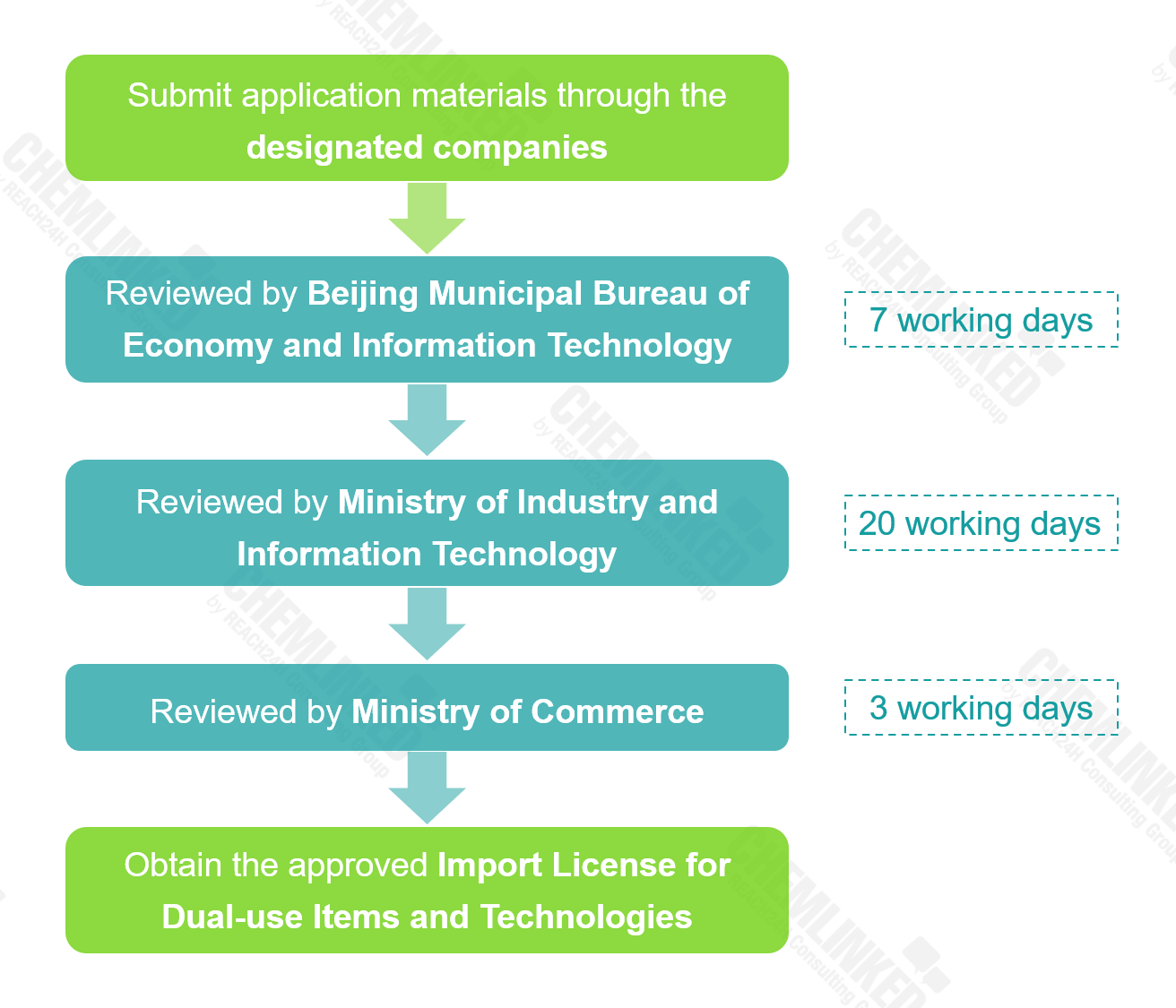
With the obtained import license, the exporter can then export cosmetics containing TEA to China. Generally, the valid period of the import license is not more than one year. The license can be used across the calendar year, but can be used only until March 31 of the next year even if the expire date is later than March 31. After this due date, the exporter needs to apply to the license-issuing department for renewing the license.
 We provide full-scale global cosmetic market entry services (including cosmetic registering & filing, regulatory consultation, customized training, market research, branding strategy). Please contact us to discuss how we can help you by