Request a Demo
On March 21, 2025, Japan Ministry of Health, Labour and Welfare (MHLW) issued notification announcing significant amendments to the Japanese Standards of Quasi-drug Ingredients 2021 (JSQI 2021). JSQI 2021 is the foundational technical standard for quasi-drug ingredients, outlining the basic specifications and testing methods required for regulatory compliance.
This revision introduces several updates to both general testing methods and ingredient specifications, aiming to enhance quality control and regulatory consistency. The changes came into effect immediately upon publication, but a transition period will be in place until September 30, 2026, allowing companies to continue applying the previous standards during this time.
Key Revisions to JSQI 2021
1. Updates to General Testing Methods
A major update includes the addition of the 2,2'-bipyridyl colorimetric method to "48 Iron Test Method". Additionally, 14 other general testing methods have been revised to align with the Japanese Pharmacopoeia and other official regulatory standards.
No. | Revised Testing Method | No. | Revised Testing Method |
1 | 2. Acrylonitrile test method | 2 | 6. Anionic surfactants quantitative method |
3 | 9. Ester value determination method | 4 | 27. Perfume test method |
5 | 40. Water-soluble collagen test method | 6 | 47. Qualitative reaction |
7 | 48. Iron test method | 8 | 61. Non-saponifiable matter assay method |
9 | 69. Methanol test method | 10 | 75. Lipase titer test method |
11 | 76. Sulfate test method | 12 | 80. Standards |
13 | 81. Reagents and test solutions | 14 | 82. Standard solutions for volumetric analysis |
15 | 83. Standard solutions |
2. Revised Specifications for 222 Ingredients
No. | Examples of the Revised Ingredients |
1 | Acrylamide•Acrylate•Methoxypolyethylene Glycol Methacrylate Copolymer |
2 | 2-Acrylamido-2-methylpropanesulfonic Acid•Methacryl Acid N,NDimethylaminoethyl Copolymer |
3 | Acrylic Acid•Alkyl Methacrylate Copolymer |
4 | Astaxanthin Solution |
5 | Potassium L-Aspartate |
6 | Magnesium L-Aspartate |
7 | N-Acetyl Glucosamine |
8 | N-Acetyl-L-Cysteine |
9 | 5-Amino-o-cresol |
10 | 2-Amino-4-nitrophenol |
11 | 2-Amino-5-nitrophenol |
12 | 1-Amino-4-methylaminoanthraquinone |
13 | 2-Amino-2-Methyl-1-Propanol |
14 | Sodium Bisulfite |
15 | Alcaligenes Polysaccharides |
16 | Sodium Alkanesulfonate |
17 | Ammonium Alkyl (12,14,16) Sulfate |
18 | Propyleneglycol Alginate |
19 | Aluminium Powder |
20 | Alkyl (C12–C15) Benzoate |
21 | Benzyl Benzoate |
22 | Umber |
23 | Propylene Glycol Isostearate |
24 | Isostearoyl Hydrolyzed Collagen (1) |
25 | Inositol |
26 | 3,3′-Iminodiphenol |
27 | Bovine Plasma Extract |
28 | Undecylenic Acid Monoethanolamide |
29 | Titanated Mica |
30 | Estradiol |
Notes: For the complete list of the 222 revised ingredients, please refer to the MHLW notification issued on March 21, 2025. 1 | |
Changes to Manufacturing and Sales License Application Requirements
Along with the revisions to JSQI 2021, the MHLW has also updated the regulatory requirements for quasi-drug manufacturing and sales license applications.
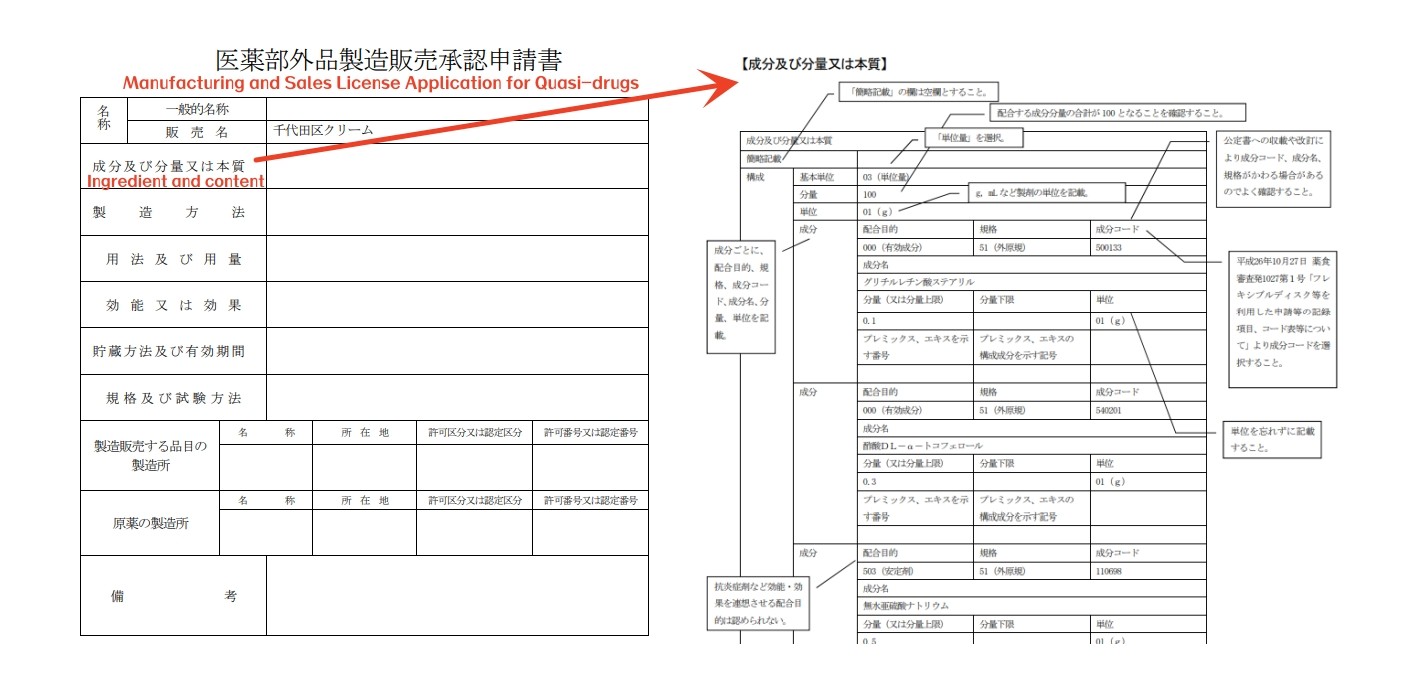 An example of the application formFrom March 21, 2025, all new quasi-drug approval applications shall comply with the updated standards if they contain the revised ingredients. Applicants can simply cite "Revised Japanese Standards of Quasi-Drug Ingredients" (“改正外原規” in Japanese)" in the "Ingredient and Content" column of the application form, without needing to provide detailed specifications. However, companies have the option to continue using the pre-revised standards until September 30, 2026.
For existing products that have already been approved and contain the revised ingredients, companies may still use the previous standards until September 30, 2026, but must adhere to the updated standards starting October 1, 2026. If they wish to continue with the old standards beyond this date, they must submit a minor change notice by the end of September 2026. This notice should specify that the application is based on Notification 0321 No. 1, issued by the MHLW, regarding the partial amendments to JSQI 2021.
In addition, for products that include revised JSQI testing methods in the "Specifications and Testing Methods" section, the previous JSQI 2021 testing methods will remain valid until September 30, 2026. From October 1, 2026, the revised JSQI 2021 testing methods must be used.
The MHLW also clarified that if there are changes to reagent or solution names due to the recent JSQI revision, companies will not need to submit a separate change application. These name changes can be incorporated into the next minor change notice or partial change application for other reasons, streamlining the regulatory process.
 We provide full-scale global cosmetic market entry services (including cosmetic registering & filing, regulatory consultation, customized training, market research, branding strategy). Please contact us to discuss how we can help you by