Request a Demo
On July 9, 2025, the National Pharmaceutical Regulatory Agency (NPRA) of Malaysia released its 2024 Surveillance and Complaints Section Highlights, presenting key data and regulatory actions across several areas, including drug and cosmetic sampling, product recalls, complaint handling, and advertisement monitoring. 1 Enforcement measures—ranging from warning letters to product recalls and notification cancellations—were implemented to protect public health and ensure regulatory compliance within the industry.
The following summarizes the key findings and enforcement activities in the cosmetics sector.
1. High-risk Cosmetics Targeted in Sampling and Lab Tests
In 2024, the NPRA conducted targeted sampling of notified cosmetics under a risk-based strategy, prioritizing products such as whitening creams and baby-use cosmetics due to their higher likelihood of containing prohibited ingredients.
Out of 1,577 notified cosmetic samples tested, 39 were found to be out-of-specification (OOS) or had failed results. In response, the NPRA imposed a range of regulatory actions, including:
Warning letters
Product recalls
Cancellation of product notifications
22 notified cosmetics were recalled, among which:
64% were Degree III, Level B recalls
36% were Degree II, Level B recalls
These recalls involved cosmetics that tested positive for prohibited substances listed in the Scheduled Poisons List under the Poisons Act 1952. Public advisories were also issued urging consumers to immediately cease use of the affected products.
2. Labelling Violations: 80% of Notified Cosmetics Non-Compliant
The NPRA reviewed the labels of 1,943 notified cosmetics and found a staggering 80% (1,510 products) in violation of Malaysia’s labelling requirements. Common non-compliance issues included:
Missing country of manufacture
Absence of batch numbers
Product name differing from the name notified
Labels presented only in foreign languages
Missing name and address of the notification holder
All violators received formal warning letters, and the NPRA flagged the need for stricter enforcement moving forward. Officials noted that the notification-based control system for cosmetics, compared to the registration process for other products, may contribute to the high violation rate.
3. Consumer Complaints Highlight Safety Concerns
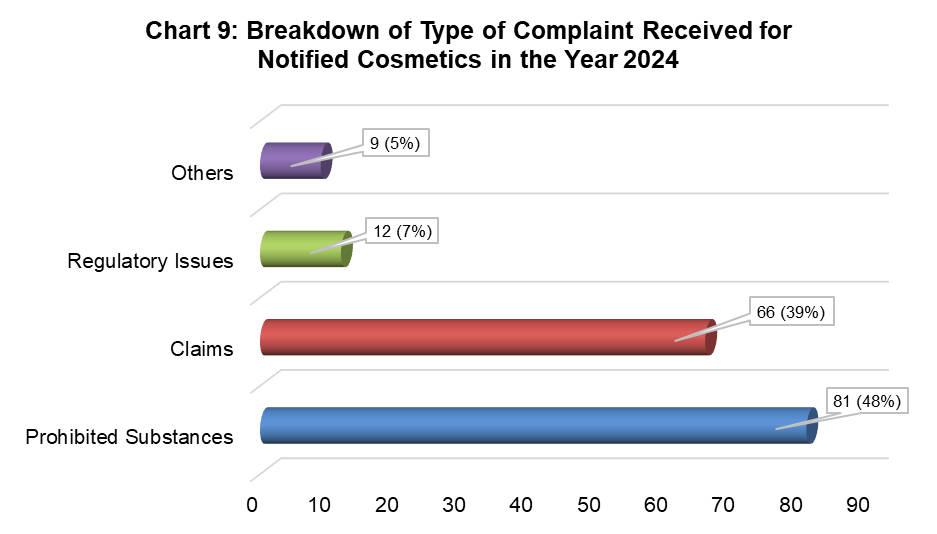
The NPRA’s Surveillance and Complaints Section handled 1,112 reports in 2024, of which 168 related to notified cosmetics. The primary issues reported include:
Adverse side effects and suspected presence of prohibited ingredients, including mercury, hydroquinone, and tretinoin (81 complaints)
Exaggerated or misleading claims, such as making medical claims or claims beyond the scope of cosmetics (66 complaints)
Regulatory issues (12 cases)
Other miscellaneous issues (9 cases)
 Source: NPRAAn example of a regulatory complaint includes a report alleging that a cosmetic was manufactured at a facility lacking Good Manufacturing Practice (GMP) certification, with additional concerns such as fungal contamination, black spots, or visible dirt on the cosmetics.
4. Handling of ASEAN Post Marketing Alert System (PMAS) and Rapid Alerts
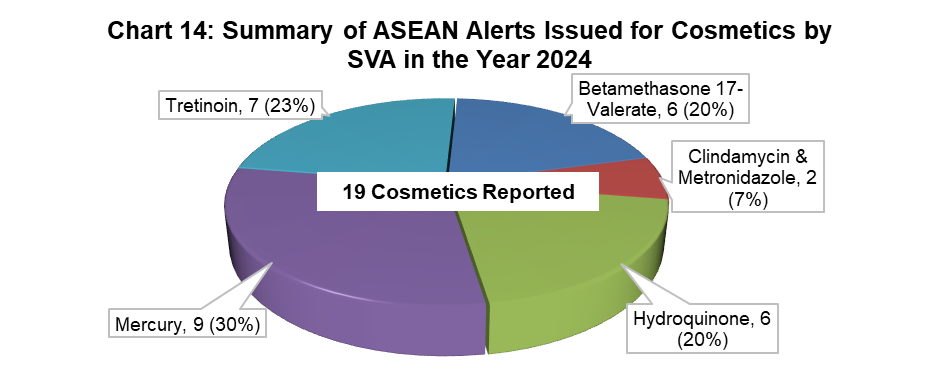
Malaysia assessed 17 rapid alerts involving 240 cosmetics under the ASEAN PMAS, four of which were notified in Malaysia and triggered further regulatory actions. Additionally, Malaysia issued seven PMAS alerts to other ASEAN countries, covering 19 cosmetics found to contain prohibited ingredients.
Mercury topped the list of prohibited ingredients, followed by tretinoin, hydroquinone, betamethasone 17-valerate, clindamycin, and metronidazole. Several products contained multiple prohibited ingredients, intensifying the public health threat.
5. Advertisement Violations: Medical Claims Trigger Cancellations
Of 1,226 cosmetic advertisements reviewed, 384 (31%) were found non-compliant. Among the non-compliant cases as below:
291 products (76%) had notifications cancelled due to prohibited medical claims (e.g., treatment of asthma, eczema, joint pain, slimming, and sexual enhancement)
89 cases (23%) led to advertisement warning letters for making claims not aligned with cosmetic guidelines
4 cases (1%) involved other breaches
 Source: NPRAThe NPRA also investigated 101 complaints related to misleading cosmetic ads, confirming all as valid. Regulatory measures included:
32 notification cancellations
32 warning letters
In several cases, Cosmetic Notification Holders (CNHs) were required to submit supporting data for advertisements that included suspicious or exaggerated claims, such as “fading acne scars” or “skin whitening in 5 minutes”, which may fall outside the permitted scope for cosmetic.
Further Reading
Malaysia Amends Cosmetic Ingredient Use Requirements: 1 New Addition and 2 Revisions
Updates to ASEAN Cosmetic Directive (ACD)’s Ingredient Annexes: 2 Additions and 4 Revisions

 We provide full-scale global cosmetic market entry services (including cosmetic registering & filing, regulatory consultation, customized training, market research, branding strategy). Please contact us to discuss how we can help you by