Request a Demo
The following are some of the highlights of his speech.
NMPA Supervision Scope Extends to Ingredient Manufacturer – Introduction of Ingredient Submission Code
According to Mr. Jiang, a considerable improvement of the CSAR is that the NMPA has extended the supervision scope to the cosmetic ingredient manufacturers. Instructions for Cosmetic Registration and Notification Dossiers stipulated that when notifying or registering cosmetics, the ingredient sources, quality specifications, quality and safety documents, etc., should be submitted. But the ingredient quality and safety documents are so many that the uploading of each registrant and notifier will cause great waste of social resources.
To solve these problems, the NMPA came up with a method of ingredient submission code. Ingredient manufacturers are encouraged to submit ingredient quality and safety documents on the NMPA designated website. The ingredient submission code will be automatically generated after submission. The cosmetics registrants and notifiers can choose the ingredient submission codes when filling in the formula information during registration or notification.
The ingredient submission code brings considerable advantages. It will:
Encourage ingredient manufacturers to conduct sufficient research on ingredients before submitting quality and safety documents;
Eliminate the need for registrants and notifiers to spend a lot of time preparing and submitting quality and safety documents every time registering or notifying product;
Reduce the difficulty for small and micro enterprises to obtain quality and safety documents from ingredient manufacturers;
More convenient risk assessment of cosmetics, because the lack of basic data on ingredients is currently the biggest challenge in product risk assessment;
Facilitate ingredient traceability. If there is any problem with the ingredients, the NMPA only needs to retrospectively review the ingredients in the database to know which products on the market use such ingredients which helps with vigilance.
For convenience and safety, in the future, enterprises will prefer to use ingredients with submission code. Ingredient manufacturers that are unwilling to apply for a submission code will gradually be phased out or outright eliminated [2].
NCI Classified Management - What Impact Will it Have?
The classified management of new cosmetic ingredients (NCI) in CSAR is also an amendment that enterprises are very interested in. In the past, for the pre-market approval, all NCI are subject to a uniformed registration scheme with strict application requirements, unclear review time, and low pass rate, which has resulted in impassivity to export NCI to China. But under the CSAR, China will adopt classified management on the pre-market approval of NCI from Jan 1, 2021. Only high-risk NCI require registration with NMPA and a maximum review duration of 128 working days, while low-risk NCI requires only a simple notification, which is deemed to be completed just after submitting notification documents. In such a case, cosmetic ingredient enterprises looking to export NCI would enjoy greatly expedited market access to China.
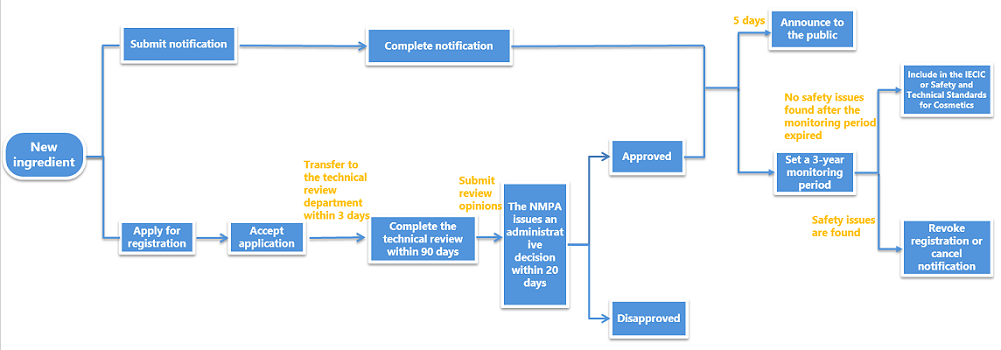 New Ingredient Registration and Notification Flowchart, Source: CRAC-HCFMr. Jiang believes that a large number of ingredient innovations will emerge as a result of this change. In the past, NCI registration was too tricky, but now the NMPA has lowered the threshold through notification management. As long as the ingredient is not high-risk and the documentation is complete, enterprises are encouraged to do notification. The ingredient innovation will hopefully lead to overall innovation in the cosmetics industry.
"The relationship between ingredient and product is just like fish and water. Without innovation made by cosmetic ingredient enterprises, it will be hard for cosmetic product enterprises to innovate. Cosmetic ingredients are to products what bricks are to buildings, only with which can we build magnificent houses," said Mr. Jiang.
ChemLinked also compiled a free report on how to export NCI into China under the new regulations, including the classification of NCI, determination of domestic responsible person, testing arrangements, documents preparation, safety monitoring system establishment, future trends, etc. You can download the free report here.
 Hotly Discussed Issues in the Industry – Trace Ingredients Labeling
Mr. Jiang also mentions a noteworthy point in Administrative Measures on Cosmetics Labeling is the labeling of full ingredients, which stipulates that ingredients with contents of no more than 0.1% (w/w) in a cosmetic formula shall be labeled separately with "Other Trace Ingredients" as the guiding word.
The labeling of "Other Trace Ingredients" will help crack down on cosmetics with conceptual ingredients. But the industry worries that "Other Trace Ingredients" will deliver a perception to consumers that the ingredient is meaningless or ineffective even though they are not, such as the preservatives are completely effective at 0.1%, and some of the peptide substances are also effective at 0.1%. To a certain extent, it will affect the competitiveness of some products that still have corresponding efficacies even with trace functional ingredients.
Currently, the provision of "Other Trace Ingredients" labeling is still under discussion and is subject to the final version of Administrative Measures on Cosmetics Labeling.
Recommendations on Ingredient Management – Enterprises should Strengthen Self-construction
Finally, Mr. Jiang gives his recommendations on ingredient management from an enterprise perspective.
Identify key control points for product safety, and determine the responsibility system of relevant personnel;
Self-build or entrust scientific team; strengthen hardware investment, improve capabilities including physical and chemical analysis, efficacy evaluation, safety risk assessment, and comprehensive quality management;
Establish information systems, including ERP systems (including planning, production, quality control, warehouse management, records, etc.), R&D management systems (including regulatory compliance), etc., to meet new regulatory requirements;
Enterprises should strictly control the ingredient market entry. Ingredient manufacturers should provide documents consistent with those submitted to the NMPA for the product enterprises to keep, and the enterprise itself or a third party entrusted should have the ability to identify ingredients in compliance with regulatory and corporate requirements; priority is given to the ingredients with submission code;
The ingredients that have been registered or notified by the ingredient manufacturers should minimize changes;
The use of new ingredients in the formula should be fully demonstrated, the meaningless addition of conceptual ingredients should be reduced, and the formula should be streamlined;
Preliminary research on formula should be adequate. In addition to safety, efficacy, and use feeling, when developing formulas, supply and alternative ingredients issues should also be considered to ensure that the formula can be produced stably over a long life cycle;
Products claiming functional ingredients, the ingredient manufacturer is required to provide sufficient evidence in advance;
In the future, the direct supply of ingredients will increase, and new regulations will have a certain impact on ingredient agents.
*The materials (video and PPT) of the presentation are available now. You can click here to register for CRAC-HCF Forum and then go to the Live Conference Hall's download section to get them if there is a need.
 We provide full-scale global cosmetic market entry services (including cosmetic registering & filing, regulatory consultation, customized training, market research, branding strategy). Please contact us to discuss how we can help you by