Request a Demo
Beauty Market Condition in 2024
Overall performance
In 2024, the Chinese cosmetics market is becoming increasingly saturated amidst the broader economic slowdown and intensifying market competition. According to data released by the National Bureau of Statistics, cosmetics retail sales from January to December 2024 totaled 435.7 billion yuan, marking a year-on-year (YoY) decrease of 1.1%. The total retail sales of consumer goods in 2024 amounted to 48,789.5 billion yuan, reflecting a 3.5% increase from the previous year, which means that cosmetics retail sales lagged behind the overall market performance throughout the year.
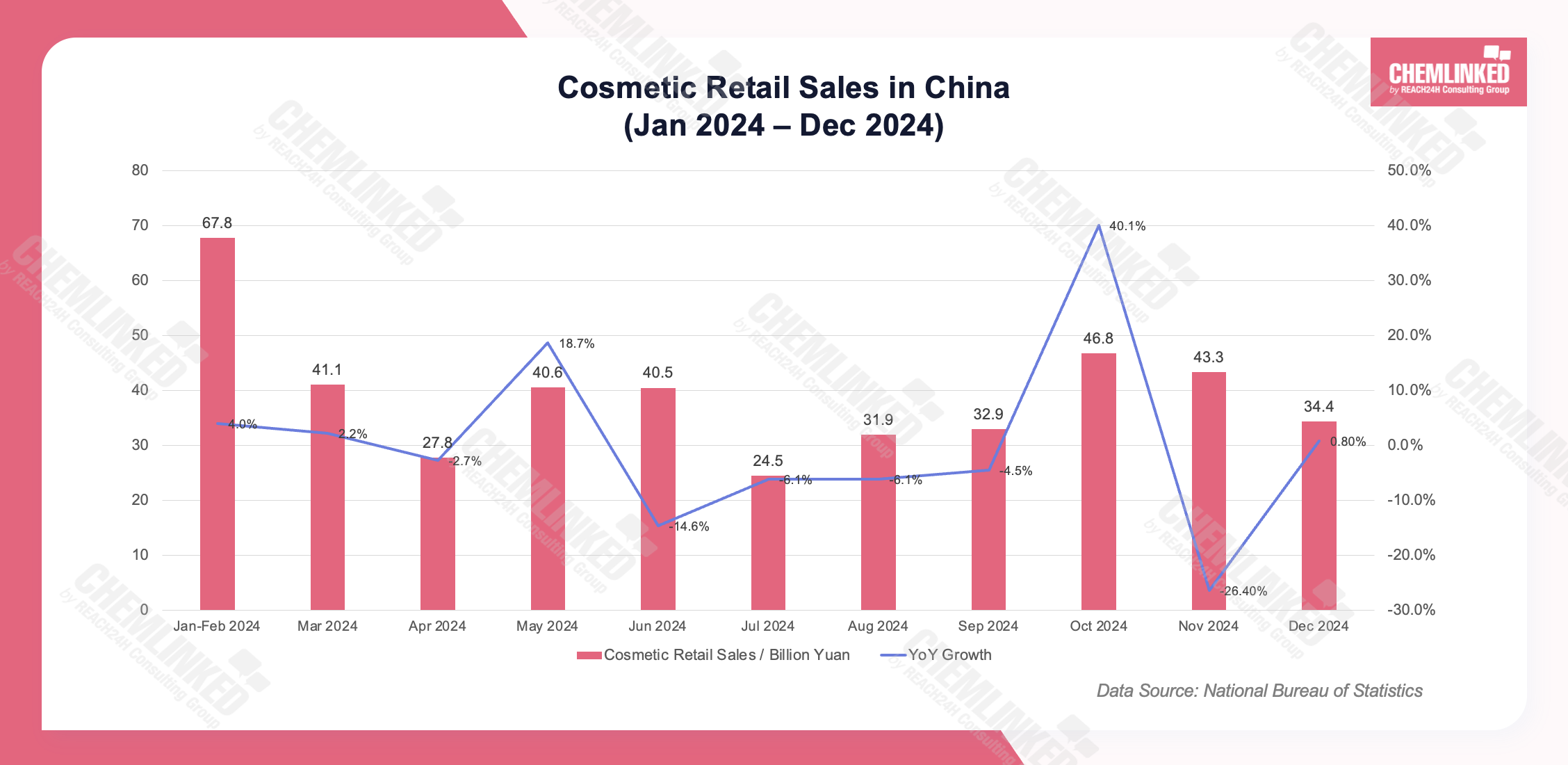
According to the data of 2024, cosmetics consumption is largely driven by big promotions. The monthly retail sales performance shows growth during or before major promotions, such as January-February (New Year’s Goods Festival), March (38 Big Promotion), May (618 Big Promotion), and October (Double 11). However, once the promotions end, retail sales experience significant declines. Specifically, cosmetics retail sales experienced negative growth in April, June to September and November, with declines ranging from 2.7% to 26.4%. The most notable drop occurred in November, with a steep 26.4% decrease following the pre-sale of the Double 11 in October.
Online Performance
The rapid growth of e-commerce has made online channels crucial for cosmetics sales. In 2024, online cosmetic sales continued to rise while offline channels faced increasing pressure. In response to this trend, beauty brands have strengthened their presence in online channels and are exploring new sales models, such as live streaming and social e-commerce.
According to statistics from Cosmetics Observer, the combined Gross Merchandise Volume (GMV) of cosmetics across four major platforms—Taotian (Taobao and Tmall), JD, Douyin, and Kuaishou—reached nearly 540 billion yuan in 2024. Among these platforms:
Taotian remains the largest channel in terms of cosmetics sales, with a GMV of 243.1 billion yuan, though it experienced a YoY decline of 10%.
Douyin, as a rising star, is catching up to Taotian, with its GMV surging to 210.3 billion yuan, reflecting a growth rate of 24.83%.
JD achieved a GMV of 53.8 billion yuan, with a growth rate of 9%.
Kuaishou’s GMV stood at 31.368 billion yuan, remaining largely stable compared to 2023.
In terms of product categories, taking Douyin as an example, in 2024, skincare products accounted for 68.78% of the market share, with 12,000 skincare brands offering a total of 1.16 million products. Compared to skincare, the market shares of makeup/perfumes and beauty tools are relatively smaller, standing at 24.6% and 6.62%, respectively.
In terms of market share, within the subcategories of skincare products, facial skincare, eye care, and sun protection are the top three in terms of market share, with shares of 87.36%, 5.89%, and 3.68%, respectively. Notably, men’s skincare sales saw a 57.87% YoY increase in 2024. Other categories, such as lip care, T-zone care, lip balms, and travel/experience packs, also showed growth compared to 2023.
In the subcategories of makeup and perfume, facial makeup, lip makeup, and eye makeup hold the largest market shares. Additionally, men’s perfumes and balms saw a 208.45% YoY increase, indicating significant growth potential.
Import & Export Performance
China’s cosmetic exports have demonstrated resilience against the national economic slowdown and the sluggish cosmetics market. According to the data from the General Administration of Customs, in 2024, China’s cosmetics exports reached 5,120.397 billion yuan in 2024, marking an 11.9 YoY increase. The primary export destinations for Chinese cosmetics include the United States, the United Kingdom, the Netherlands, Mexico, South Korea, and Japan. Positive growth has been recorded in these major markets, underscoring the ongoing internationalization of Chinese cosmetics.
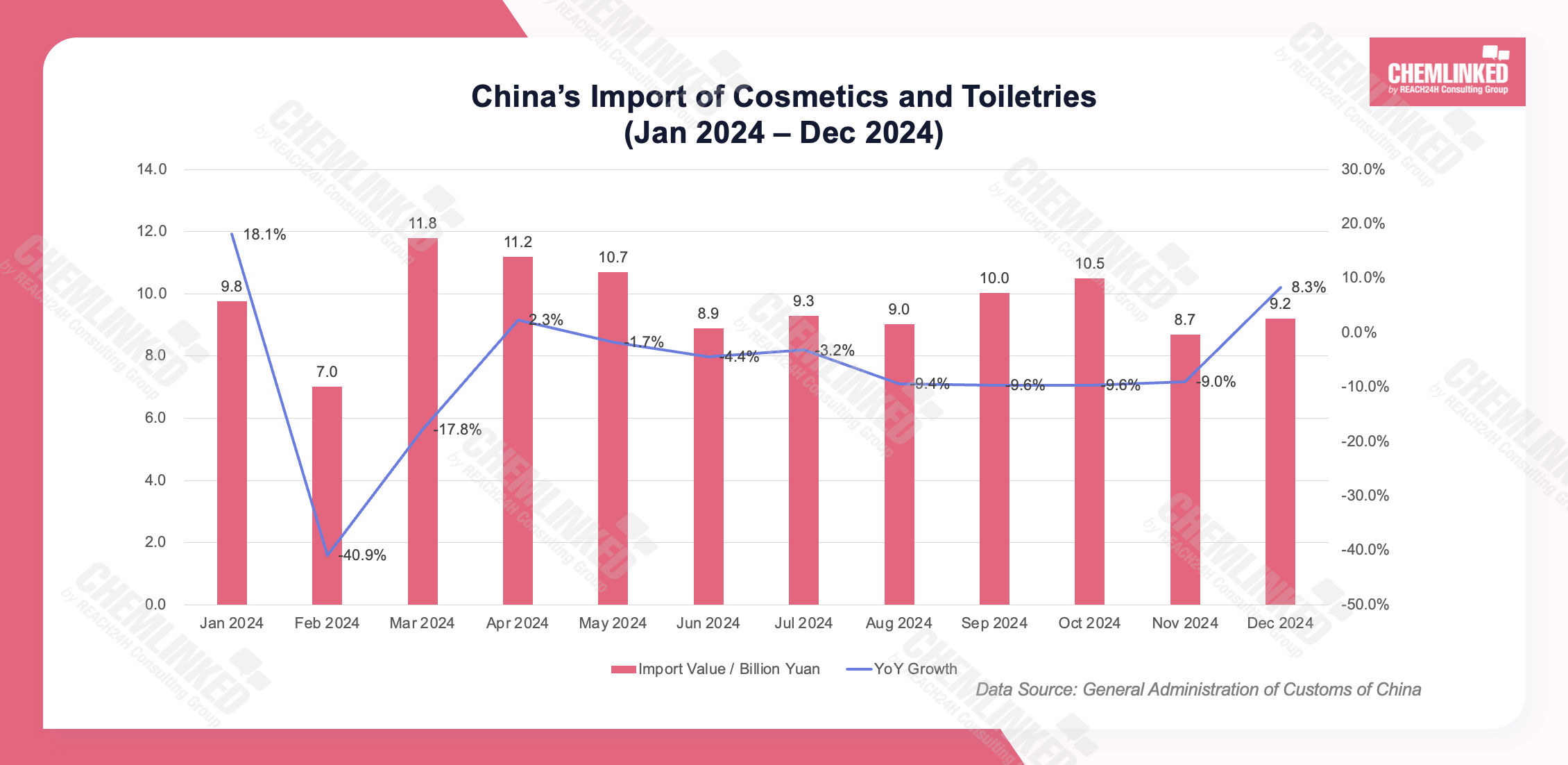
In contrast, the growth rate of China’s cosmetics imports has continued to decelerate in recent years. In 2024, the total volume of cosmetics imports stood at 324,800 tons, with a total value of 116.08 billion yuan, reflecting YoY declines of 9.4% and 7.9%, respectively. These figures represent the lowest import levels recorded over the past five years, highlighting a persistent downward trend of cosmetics imports.

Highlights of the Beauty Market
The Rise of Chinese Domestic Brands
Despite the overall downturn in cosmetics retail sales, the rise of Chinese domestic beauty brands has emerged as a significant trend. In the TOP 20 skincare products list on Douyin, 11 Chinese domestic brands made themselves into the TOP 20. Notably, Kans ranked first, with a GMV of 6.749 billion. Proya, surpassing international giants like L’Oreal, Estee Lauder, and Helena Rubinstein, ranked second.
Guyu and Chando also performed well, ranking 8th and 9th, respectively. This marks the first time in four years that Guyu has entered the TOP 10. Comfy, OSM, JOYRUQO, and Florasis followed closely, securing positions from 11th to 14th. At the lower end of the list, HBN, MARUBI, and DCEXPORT ranked 18th to 20th, respectively.
(See more detailed analysis on the rise of Chinese beauty brands: Top Chinese Beauty Brands Reveal A New Industry Landscape).
TOP 20 Skincare Brands on Douyin in 2024
No. | Brand | GMV (CNY Billion) | YoY (%) |
1 | Kans | 6.7.49 | 102.0 |
2 | Proya | 3.703 | 62.8 |
3 | L’Oreal | 3.002 | 24.5 |
4 | Estee Lauder | 2.746 | 34.5 |
5 | Helena Rubinstein | 2.210 | 32.9 |
6 | Lancôme | 2.139 | 23.9 |
7 | La Mer | 2.092 | 15.4 |
8 | GuYu | 1.975 | 64.6 |
9 | CHANDO | 1.936 | 107.4 |
10 | The History of Whoo | 1.883 | 44.8 |
11 | Comfy | 1.800 | 99.9 |
12 | OSM | 1.764 | 48.8 |
13 | JOYRUQO | 1.547 | 28.5 |
14 | Florasis | 1.374 | -9.7% |
15 | YSL | 1.332 | 34.8% |
16 | Olay | 1.322 | 56.9% |
17 | SK-II | 1.314 | -1.6% |
18 | HBN | 1.307 | 28.7% |
19 | MARUBI | 1.302 | 66.6% |
20 | DCEXPORT | 1.266 | 139.1% |
Data source: Feigua Data
Decline of International Beauty Brands
The rise of Chinese domestic beauty brands has coincided with the decline of international brands. International beauty giants, such as L’Oreal, Estee Lauder, and LVMH, are facing setbacks in their performance in China and under increasing growth pressure.
In addition to the decline in imports mentioned above, in 2024, at least 15 beauty companies publicly announced layoffs, impacting over 30,000 people. This represents the largest wave of layoffs in nearly a decade. Additionally, many international beauty brands have exited the Chinese market. According to incomplete statistics from Qingyan, 26 overseas beauty brands have closed their Tmall overseas flagship stores or withdrawn from China in 2024, including high-end skincare brand TULA of P&G, BAUM of Shiseido, and NYX of L’Oréal.
The withdrawal of these once-glorious international beauty brands from China highlights the challenges they are facing in the market. For example, traditional offline channels have underperformed, while emerging e-commerce sectors such as interest-based e-commerce and live streaming have been dominated by Chinese domestic brands, prompting international brands to withdraw. Additionally, the declining consumer spending power and higher price of international beauty brands acceletrate the decrease in sales. In contrast, many Chinese domestic brands offer more moderate pricing and cater to the preferences of younger consumers, which has contributed to overseas brands' lost of market share.
Technology-Driven Innovation in the Beauty Industry
In 2024, beauty companies are increasingly investing in technology to gain a competitive edge, not only by upgrading core ingredients and formulas but also by exploring new categories such as scalp care and oral beauty agents.
According to iMedia Research, the market size of hair care products in China grew to 62.09 billion yuan in 2023 and is expected to reach 81.78 billion yuan by 2029. Feigua data reveals that from January to November 2024, sales of shampoo and hair care products on Douyin reached 14.715 billion yuan, a 39.2% year-on-year increase. Beyond basic anti-dandruff and anti-hair loss treatments, consumers are now seeking more specialized solutions like oil control and smoothness. The fastest-growing subcategories include no-rinse shampoo sprays (up 241.5%) and functional scalp care products (up 136.1%), underscoring their market potential.
As competition intensifies, beauty brands are focusing on niche market segments. They are continuously refining product ingredients and efficacy to offer more advanced, efficient, and user-friendly products to solidify their market presence.
Outlook for the Cosmetics Industry in 2025
The decline in cosmetics retail sales in 2024 reflects the immense challenges amidst the economic downturn. Insights from industry professionals reveal a cautious outlook for the coming year. Mao Jianlin, founder and chairman of Kangboli Technology (Suzhou) Co., Ltd., believes that “2025 does not appear promising. Our industry needs to work together to overcome challenges.” Zhang Ningjun, vice president of France Terraké, China, emphasized that the overall environment in 2025 would likely be more difficult, requiring more refined operations, with a focus on depth rather than expansion.
On the other hand, some brand founders and executives are more optimistic about the beauty market in 2025. Zhang Jianhua, general manager of Simpcare R&D, said, “2025 will certainly be more competitive, but the opportunity lies in providing consumers with the best products and technologies, developing solutions tailored to their needs, and executing strategies effectively” Besides, according to a survey by Qingyan indicates widespread agreement within the cosmetics industry that “technological anti-aging will continue to trend, the whitening market will experience significant growth and new opportunities will arise in the outdoor sunscreen and hair care markets.”
ChemLinked Comments
As China strengthens its supervision of the cosmetics industry and further refines policies and regulations, coupled with consumers’ increasing demand for high-quality, diverse beauty products, the industry is undergoing restructuring and integration. This is accelerating the elimination of inferior brands while fostering the rise of high-quality ones. In the face of an increasingly competitive market, companies must continuously improve product quality, enhance innovation and R&D, and ensure compliance with tightening regulatory standards. At the same time, they must stay attuned to the evolving needs of consumers and offer personalized, high-quality products to capture the market share.
 We provide full-scale global cosmetic market entry services (including cosmetic registering & filing, regulatory consultation, customized training, market research, branding strategy). Please contact us to discuss how we can help you by