Request a Demo
On March 14, 2019, South Korea officially implemented a series of cosmetic regulations, including 1. No. 15947 Cosmetics Act, 2. Enforcement Rule of the Cosmetics Act, 3. Enforcement Decree of the Cosmetics Act, 4. Operational Rules of Consumer Cosmetic Safety Management Supervisor, 5. Requirements on Certification Authority Designation and Certification of Natural and Organic Cosmetics, 6. Regulation on Track Records of Manufacture or Importation and List of Cosmetics Raw Material.
The main amendments of South Korean latest cosmetic regulations focus on 5 key areas. All of them came into force on Mar. 14, 2019, except for the provisions related to customized cosmetics.
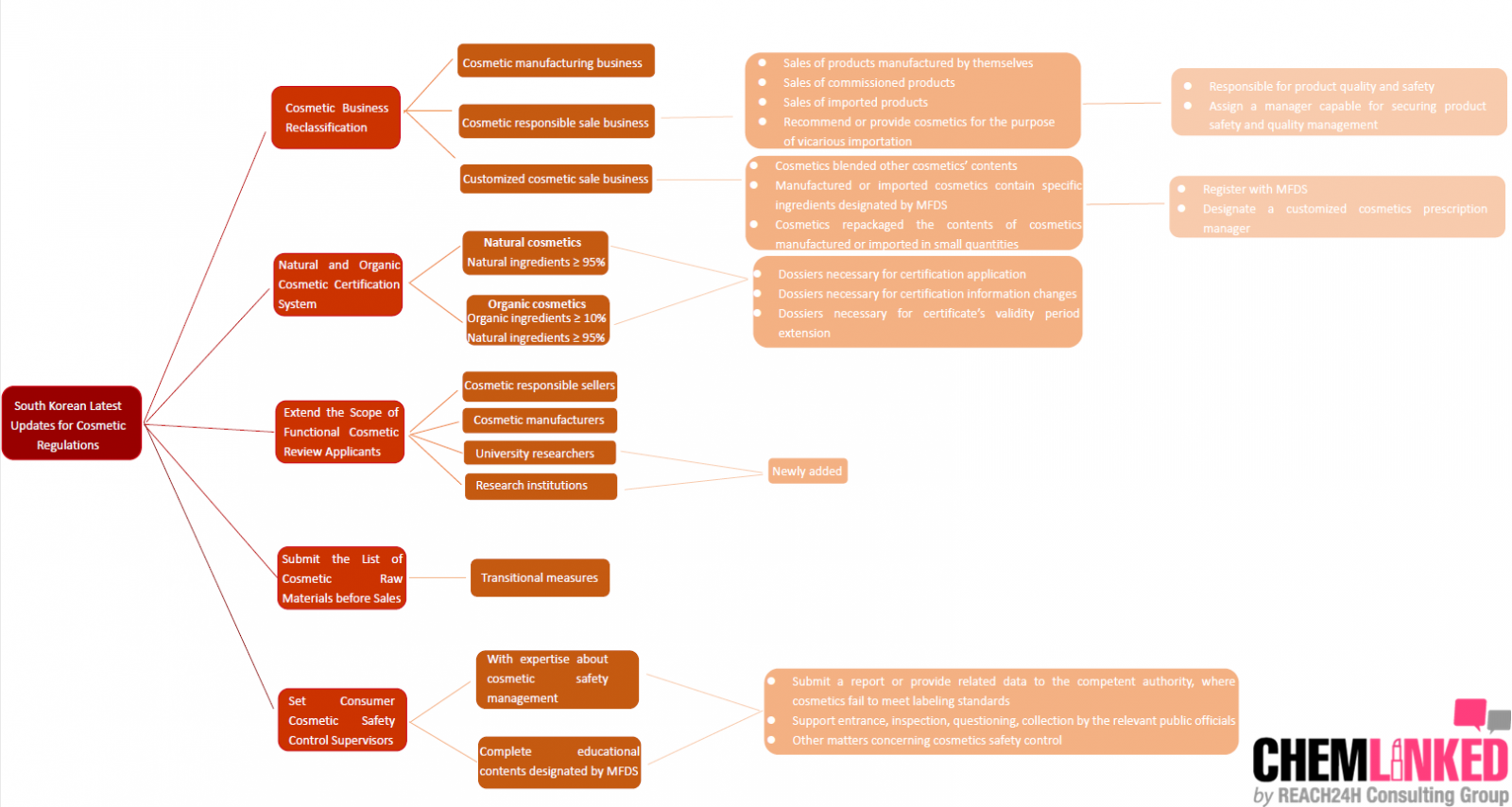
1. Re-classify cosmetic business into 3 types [1]
a) Cosmetic manufacturing business, which refers to business manufactures of finished cosmetics or constituents (excluding secondary packaging or labeling process only).
b) Cosmetic responsible sale business. “Cosmetic sale business” was changed to “Cosmetic responsible sale business”, which means cosmetic responsible sellers should take the responsibility of product quality and safety and shall assign a manager capable for securing product safety and quality management. The cosmetic responsible sale manager shall be registered with MFDS.
Cosmetic responsible sale business scopes include 1) sales of products manufactured by themselves 2) sales of commissioned products 3) sales of imported products 4) recommending or providing cosmetics for the purpose of vicarious importation.
c) Customized cosmetic sale business. Customized Cosmetics refer to 3 kinds of cosmetics which are:
Cosmetics blended other cosmetics' contents;
Manufactured or imported cosmetics contain specific ingredients designated by MFDS;
Cosmetics repackaged the contents of cosmetics manufactured or imported in small quantities.
Anyone who intends to sell customized cosmetics shall register with MFDS.
2. Implement natural and organic cosmetics certification system
Natural and organic cosmetics certification system was introduced in South Korean No.15488 Cosmetics Act released on Mar. 13, 2018. The system stipulates the standards of natural and organic cosmetics and relevant regulations about cosmetics certification application and certification body assignment.
Natural and organic cosmetics definitions:
According to the draft Standard of Natural and Organic Cosmetics [2] released on Mar. 20, 2019, natural cosmetics refer to cosmetics that contain animal and plant ingredients and their derivative materials, in which natural ingredient concentration must exceed 95%.
Organic cosmetics refer to cosmetics that contain organic ingredients and ingredients derived from animals and plants. Organic ingredient concentration shall exceed 10% and natural ingredients (including organic ingredients) shall exceed 95%. (Please refer to CL News for specific standards for natural and organic cosmetics in South Korea).
Dossiers necessary for certification:
If enterprises want to certify natural cosmetics or organic cosmetics, they need to prepare relevant documents and submit a certification application to the certification body designated by the head of MFDS. The certification body that receives the application will check whether the product meets the standard and inform the applicant of the result after the review. The certification body will continue monitoring whether the certified products in circulation meet the certification standards or not.
According to South Korean Requirements on Certification Authority Designation and Certification of Natural and Organic Cosmetics [3] implemented on Mar. 14, 2019, a) documents necessary for certification application include:
| 1. Product ingredient information 2. Product manufacturing technique, container, packaging and storage |
b) Documents necessary when applying for certification information changes include:
| Items to be changed | Documents necessary |
| Product name | The original certificate, reasons for name change |
| Responsible sellers | The original certificate, evidence that proves responsible sellers change |
| Certification service providers’ name and address | The original certificate, evidence that proves service providers’ name and address change |
c) Documents necessary for certificate’s validity period extension:
| 1. The original certificate 2. Evidence that proves the product meets the latest certification standard |
Implementation purpose of certification system:
There was no natural or organic cosmetics certification system in South Korea before, enterprises can only rely on overseas natural and organic cosmetics certification without specific standards and accurate information. With the introduction of the natural and organic cosmetics certification system, it is expected to institutionalize the natural and organic cosmetics market and provide consumers with accurate certification standards and information. Inspection standards for natural and organic cosmetics are currently being formulated.
3. Extend the scope of functional cosmetics review applicants
In order to protect the intellectual property rights of developers and promote cosmetics R&D in South Korea, the scope of applicants for functional cosmetics review has been expanded to cosmetic responsible sellers, cosmetic manufacturers, university researchers and research institutions.
4. Submit the report of the list of raw materials before distribution and sales [4]
A cosmetics seller shall report data, such as a track record of manufacturing or importing cosmetics and a list of raw material used in the process of manufacturing cosmetics, to the Minister of Food and Drug Safety (MFDS). The report detailing the list of raw materials shall be submitted to authorities before distribution and sales of cosmetics. The report should also detail if the cosmetics are to be sold in South Korea or exported to other countries.
Transitional measures for this amendment are: Cosmetics which have been distributed or sold on the market before Mar.13, 2019, but have not submitted the report on a list of raw materials, shall submit the report retroactively before Mar. 14, 2020.
5. Set consumer cosmetic safety control supervisors
Consumer Cosmetic Safety Control Supervisors are newly set in No.15488 Cosmetics Act. MFDS or local FDA can assign a person recommended by the cosmetic association or consumer group with expertise about cosmetic safety management or has completed the educational content designated by MFDS as supervisor, serving for 2 years. Their main duties include supporting safety control management of cosmetics on the market and promotion of cosmetics safe usage, etc.
Operational Rules of Consumer Cosmetic Safety Management Supervisor stipulates the appointment procedures, extension of term, educational content, main duties, subsidy assistance, etc. of consumer cosmetics safety supervisors. The set of consumer cosmetic safety control supervisors is to strengthen the safety management of products in circulation, as well to enhance consumer participation and trust in government policy implementation.
For more detailed analysis, please refer to the webinar presented by South Korean cosmetic regulatory expert Tiger Kim on April 17, 2019.
 We provide full-scale global cosmetic market entry services (including cosmetic registering & filing, regulatory consultation, customized training, market research, branding strategy). Please contact us to discuss how we can help you by