Request a Demo
Editor's note: This article was originally published on March 11, 2026, and was updated on May 18, 2026, as per the latest developments. The updated contents are marked in red below.
Safety and Technical Standards for Cosmetics (STSC) is the overarching technical standard governing cosmetic safety supervision and testing in China. It establishes comprehensive technical requirements covering ingredient management and testing methods for cosmetic products. The standard mainly includes the following contents:
Chapter 1: Explanations of technical terms and general safety requirements;
Chapters 2–3: Lists of prohibited, restricted, and permitted ingredients used in cosmetics;
Chapters 4–8: Testing methods covering physicochemical testing, microbiological testing, toxicological testing, human safety testing, and efficacy evaluation.
Since its promulgation on Dec. 23, 2015, and implementation on Dec. 1, 2016, the STSC has undergone multiple revisions to keep pace with regulatory and industry developments. This article summarizes all revisions related to ingredient limits introduced in the STSC since its publication. For a summary of the testing methods revisions, please visit the ChemLinked article "An Overview of Historical Revisions to Testing Methods in China’s STSC".
#English Translations
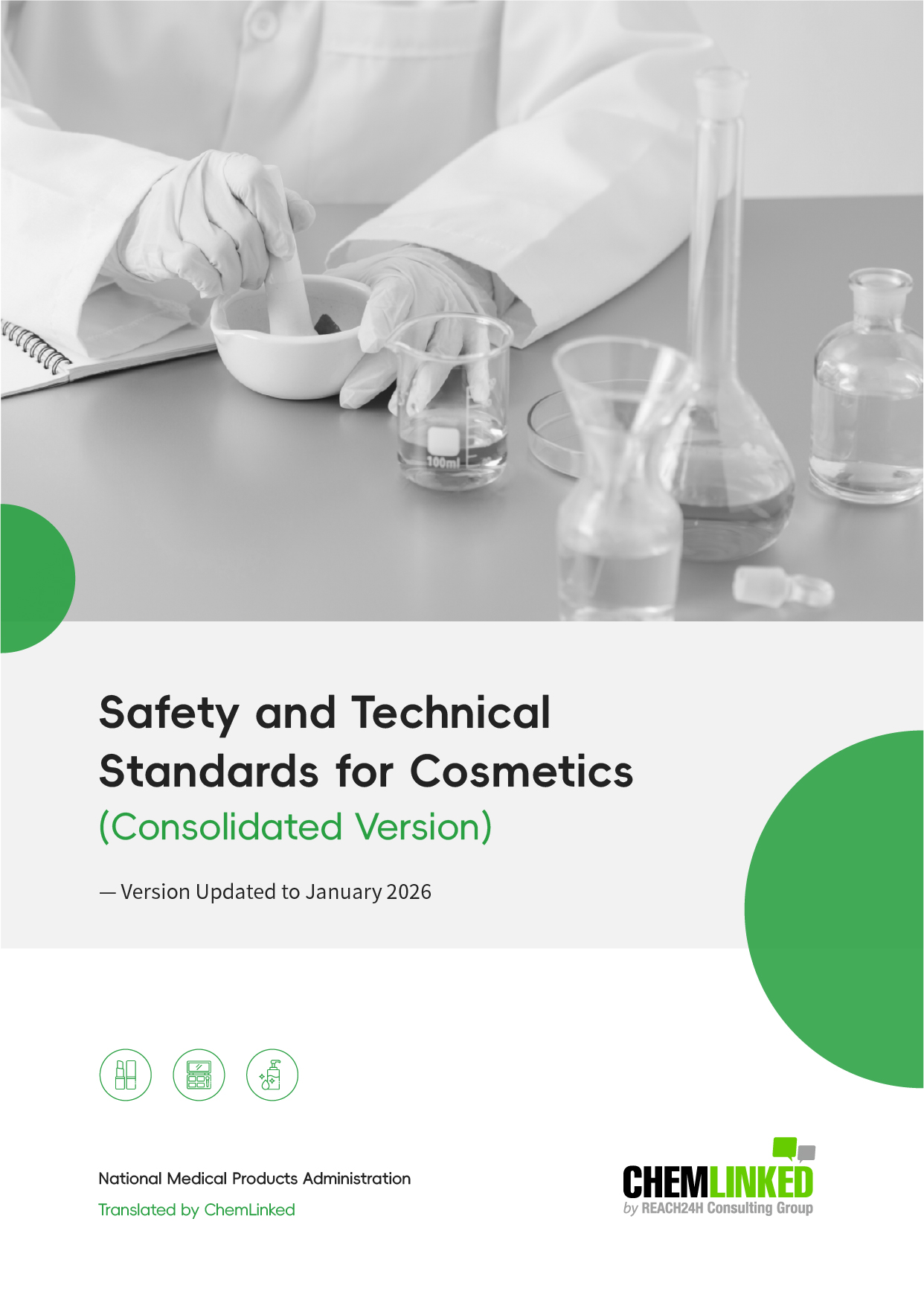
Safety and Technical Standards for Cosmetics (Consolidated Version)ChemLinked has compiled a consolidated English translation of the STSC, bringing together all official revisions issued between 2016 and 2026 into one complete, easy-to-reference document. The full English translation spans over 1,800 pages and is priced at USD 1,580. *Please note that this translation, provided by our affiliated company, is not included in ChemLinked paid membership benefits.1. Prohibited Ingredients
The prohibited ingredients list has seen the most frequent updates to phase out substances with potential health risks:
1) Detailed Amendments
2021 (NMPA Announcement No. 74 of 2021): The NMPA completely updated and replaced the lists for prohibited chemical and plant/animal ingredients.
2023 (NMPA Announcement No. 41 of 2023): Added Benvimod as a prohibited ingredient and established a limit for Benzene as an impurity at 2mg/kg.
2024 (NMPA Announcement No. 12 of 2024): Added five prostaglandin analogues to the prohibited list, including Bimatoprost, Latanoprost, Tafluprost, Tafluprost ethyl amide, and Travoprost.
2026 (NMPA Announcement No. 6 of 2026):
○ Effective Jan. 1, 2027: 4-Methylbenzylidene Camphor and 6-Amino-m-cresol are transitioned to the prohibited list. PFOS (and its salts) and PFOA (and its salts) are newly added;
○ Effective Jan. 1, 2028: Zinc Pyrithione is transitioned to the prohibited list. Butylphenyl Methylpropional and Cyclotetrasiloxane are newly added;
2026 (NMPA Announcement No. 48 of 2026) :
○ Mercury and its compounds are prohibited for use in cosmetics, except for certain preservatives permitted in cosmetic products, including Thimerosal and Phenylmercuric salts (including borate). The revision removes this exemption, and reclassifies Thimerosal and Phenylmercuric salts (including borate) as prohibited ingredients.
2) Current Status: The lists currently contain a total of 1,406 prohibited ingredients (1,297 chemicals and 109 plant/animal ingredients).
2. Restricted Ingredients
1) Detailed Amendments
Historical Updates: In 2021 and 2026, several previously restricted ingredients were removed from this list and transitioned to entirely prohibited status due to safety concerns.
Ingredient Reference Number in the Prohibited List (After Revision) | Ingredient | Ingredient Reference Number in the Restricted List (Before Revision) |
|---|---|---|
1267 | Borates and tetraborates | 3 |
1268 | Boric acid | 3 |
1271 | Dichloromethane; methylene chloride | 41 |
1272 | Formaldehyde | 31 |
1274 | Nitromethane | 33 |
1297 | Zinc pyrithione (Effective Jan. 1, 2028) | 21 |
2026 (NMPA Announcement No. 6 of 2026): Adjusted the specific restriction requirements for Salicylic Acid (Effective Jan. 1, 2028).
2) Current Status: The list currently contains 42 restricted ingredients.
3. Permitted Preservatives
1) Detailed Amendments
2020 (NMPA Announcement No. 141 of 2020): Ethyl Lauroyl Arginate HCl was approved and added as a permitted preservative.
2021 (NMPA Announcement No. 74 of 2021): Clorofene, Formaldehyde, and Paraformaldehyde were removed and transitioned to the prohibited list.
2026 (NMPA Announcement No. 6 of 2026): Zinc Pyrithione is removed and transitioned to the prohibited list (Effective Jan 1, 2028). Furthermore, the usage restrictions and limits for Climbazole, Methylisothiazolinone (MIT), and Polyaminopropyl Biguanide have been revised and tightened (Effective Jan 1, 2028).
2026 (NMPA Announcement No. 48 of 2026): Biphenyl-2-ol and its salts are currently regulated as permitted preservatives in cosmetics, with a maximum concentration of 0.2% (as phenol), without defined product category restrictions. The revision introduces category-specific concentration limits for rinse-off and leave-on products, as well as restrictions on use in applications with inhalation exposure risk and labeling requirements. The revised requirements will apply as of June 1, 2028.
2) Current Status: The list currently contains 49 permitted preservatives.
4. Permitted UV Filters
1) Detailed Amendments
2021 (NMPA Announcement No. 74 of 2021): 3-Benzylidene Camphor was removed and transitioned to the prohibited list.
2026 (NMPA Announcement No. 6 of 2026): 4-Methylbenzylidene Camphor is removed and transitioned to the prohibited list (Effective Jan 1, 2027). Additionally, the specific restriction requirements for Benzophenone-3, Homosalate, and Octocrylene have been revised (Effective Jan 1, 2028).
2) Current Status: The list currently contains 25 permitted UV filters.
5. Permitted Colorants
With no recent deletions mentioned in the latest update, STSC currently maintain a stable list of 157 permitted colorants.
6. Permitted Hair Dyes
1) Detailed Amendments
2021 (NMPA Announcement No. 74 of 2021): 2-Chloro-p-phenylenediamine and its sulfate salts were removed and transitioned to the prohibited list.
2026 (NMPA Announcement No. 6 of 2026): 6-Amino-m-cresol is removed and transitioned to the prohibited list (Effective Jan 1, 2027). The restriction requirements for Toluene-2,5-diamine and Toluene-2,5-diamine sulfate have also been revised (Effective Jan 1, 2028).
2026 (NMPA Announcement No. 48 of 2026): Acid Violet 43 is permitted for use as a hair dye in cosmetics. The revision amends the maximum use level for non-oxidative hair dye products and updates the substance's purity specifications, with effect from June 1, 2028.
2) Current Status: The list currently contains 72 permitted hair dyes.
7. Other Amendments
In addition, revisions have been made to the total bacterial count limits for eye cosmetics, lip cosmetics, and children's cosmetics, as well as the limit for dioxane, and remarks for mercury.
Indicator | Limit | Remark |
|---|---|---|
Total bacterial count (CFU/g or CFU/ml) | ≤500 (Current requirements: to be repealed on January 1, 2027) | Eye-applicable cosmetics, lip care and lip make-up and children's cosmetics |
≤100 (New requirements: to take effect on Jan. 1, 2027) | ||
≤1000 | Other cosmetics | |
Dioxane (mg/kg) | 30 (Current requirements: to be repealed on Jan. 1, 2027) | / |
10 (New requirements: to take effect on Jan. 1, 2027) | / | |
| Mercury (mg/kg) | 1 | / |
ChemLinked has compiled a consolidated English translation of the STSC, integrating all official revisions issued between 2016 and 2026 into a single, comprehensive document for easy reference. The full translation contains over 1,800 pages and is available for USD 1,580. For companies interested in translations of specific chapters only, please contact ChemLinked for customized pricing.

 We provide full-scale global cosmetic market entry services (including cosmetic registering & filing, regulatory consultation, customized training, market research, branding strategy). Please contact us to discuss how we can help you by