Request a Demo
China imposes stringent supervision over new cosmetic ingredients (NCI) and their pre-market approval. According to the Article 9 of the overriding Regulations concerning the Hygiene Supervision over Cosmetics 1989, before a new ingredient is used to make cosmetics, an application must be made to the relevant health department for approval. As a matter of fact, it is tough and time-consuming to apply for the approval of a NCI in China though the tests conducted on new ingredients are one-third of those for new chemicals required under "MEP Order 7" although there is no need to perform environmental exposure assessment.
The expensive testing fees and the extended approval period are prohibitive for many companies. What makes filing for the application even unattractive is that there is no protection period for a NCI so it can be used by any other cosmetic manufacturers upon the release of the approval notice by SFDA. These could all be the reasons that make producers so reluctant to make the first move.
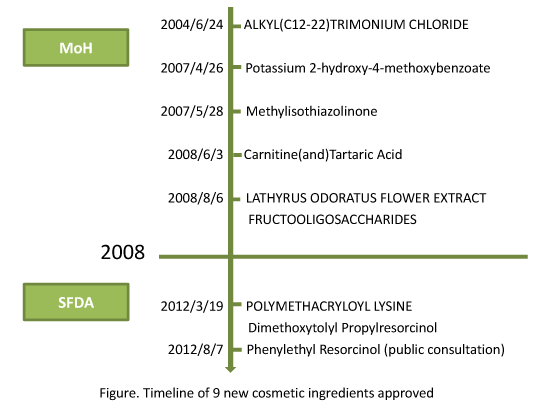
Since 2004, only eight ingredients are approved through dossier supplementation and one is now under public consultation. (Note: since September 1, 2008, SFDA took over the responsibility of cosmetic supervision from Ministry of health)
Despite difficulties ahead, the number of NCI applications is growing year after year. However, challenges exist ahead of successful approval of the NCI.
Technically speaking, submission of non-standard dossiers, lack of testing data and unreasonable design of tests are main factors that result in the sluggish approval process. Furthermore, the development of alternative animal testing methods in China lags far behind developed countries and SFDA will not accept the results drawn from animal alternative tests. "At present, no alternatives to animal testing are valid except 3T3 NRU Phototoxicity Test Method (still in its draft proposal stage), which is likely to become China's first in vitro alternative test," said Dr. He Zhengming from National Institutes for Food and Drug Control. Before the validation of alternative testing a NCI needs to go through toxicological tests step by step, which last three months to two years long. Therefore, you'd better start application and preparation of dossiers at least one year before it gets approval. Generally, it takes 5 days for SFDA to perform a format check on all submitted documents and issue an acceptance notice, 90 days for SFDA to conduct the technical review of the new ingredient and 20 days to issue an approval notice or an opinion letter to the applicant to request more documents, which will definitely prolong the approval process.
Specifically, technical review by SFDA will be concentrated on the source, physic-chemical properties, intended use and scope, use limit, production process and quality and safety control, all information of which shall be complete, consistent and normative.
During the whole process of dossiers preparation, the safety evaluation of the ingredient, risk substances and impurities is crucial and the toxicological safety evaluation data is the most difficult part, which consists of the summary of the evaluation, toxicological testing data and safe evaluation information of risk substances that may be contained in the raw materials. In principle, the following toxicological test should be performed:
Acute oral and acute dermal toxicity test;
Skin and acute eye irritation / corrosion test;
Skin sensitization test;
Skin phototoxicity and photosensitivity test (must be performed if has UV filters);
Mutagenicity test (should at least include a gene mutation test and a chromosome aberration test);
Sub‐chronic oral and dermal toxicity test;
Teratogenicity study;
Chronic toxicity/carcinogenicity;
Toxicokinetics and dynamics;
However, in real cases, according to the characteristics and properties of ingredients, several tests may be exempt.
Exemption Cases | Exempt Tests |
1. The NCI does not function as preservatives, sunscreen agents and colorants and needn’t to be included in the "List of Restricted Substances" in the "Hygiene Standards for Cosmetics 2007" | 7,8,9, Sub-chronic oral and dermal toxicity test depending on exposure route |
2. On the basis of Case 1, the NCI has been recorded in the inventory of existing ingredient by overseas authoritative organizations for more than four years and no relevant literature shows potential hazard to human | 6,7,8,9 |
3. With a history of safe use, the NCI is a food ingredient and extract that has been published by domestic or foreign authoritative organizations or passed the safety evaluation; or the department under the State Council has announced its use as both food and medicine. | 1,5,6,7,8,9 |
4. Polymer with average molecular weight above 1000 Daltons | 1,3,5,6,7,8,9 and photosensitivity test |
5. A foreign authoritative organization has approved it as a safe ingredient in cosmetics | All but relevant evidential documents (Chinese version is a must) |
6. If the structure and properties of the NCI are similar to an existing ingredient | Depends |
Nevertheless, the whole regulatory and supervisory systems of new cosmetic ingredients in China will become more and more mature. SFDA has been committed to improve the administrative licensing of new cosmetic ingredients by the following aspects: 1) promulgating more related regulations/specific technical requirements, including Guide for Risk Assessment of Possible Substances with Safety Risks in Cosmetics 2010 and Guidance on Application and Review of New Cosmetic Raw Materials 2011; 2) revising the Inventory of Existing Cosmetic Ingredient (3667 ingredients has been published in three batches for public consultation till now); 3) strengthening international cooperation to promote the research of alternative methods -SFDA is now selecting laboratories to conduct research on alternatives to toxicological methods for cosmetics.
In conclusion, a successful registration needs not only prudent preparation of toxicity data, thorough examination of dossiers before submission to avoid supplementation, but also close tracking of updated or newly-released cosmetic regulations.
In the case that the new cosmetic ingredient is not listed on the Inventory of Existing Chemical Substances in China (IECSC), you are obliged to notify it with CRC of MEP.
Reference Links
Regulations concerning the Hygiene Supervision over Cosmetics 1989
Guide for Risk Assessment of Possible Substances with Safety Risks in Cosmetics 2010
Guidance on Application and Review of New Cosmetic Raw Materials 2011
 We provide full-scale global cosmetic market entry services (including cosmetic registering & filing, regulatory consultation, customized training, market research, branding strategy). Please contact us to discuss how we can help you by