Request a Demo
The EU Safety Gate, which succeeded RAPEX, plays a crucial role in quickly sharing details on dangerous non-food products among 30 national authorities (including EU countries, Iceland, Liechtenstein, and Norway). This system aids in efficient market supervision, and allows member countries to take necessary steps when the same product is found on their market.
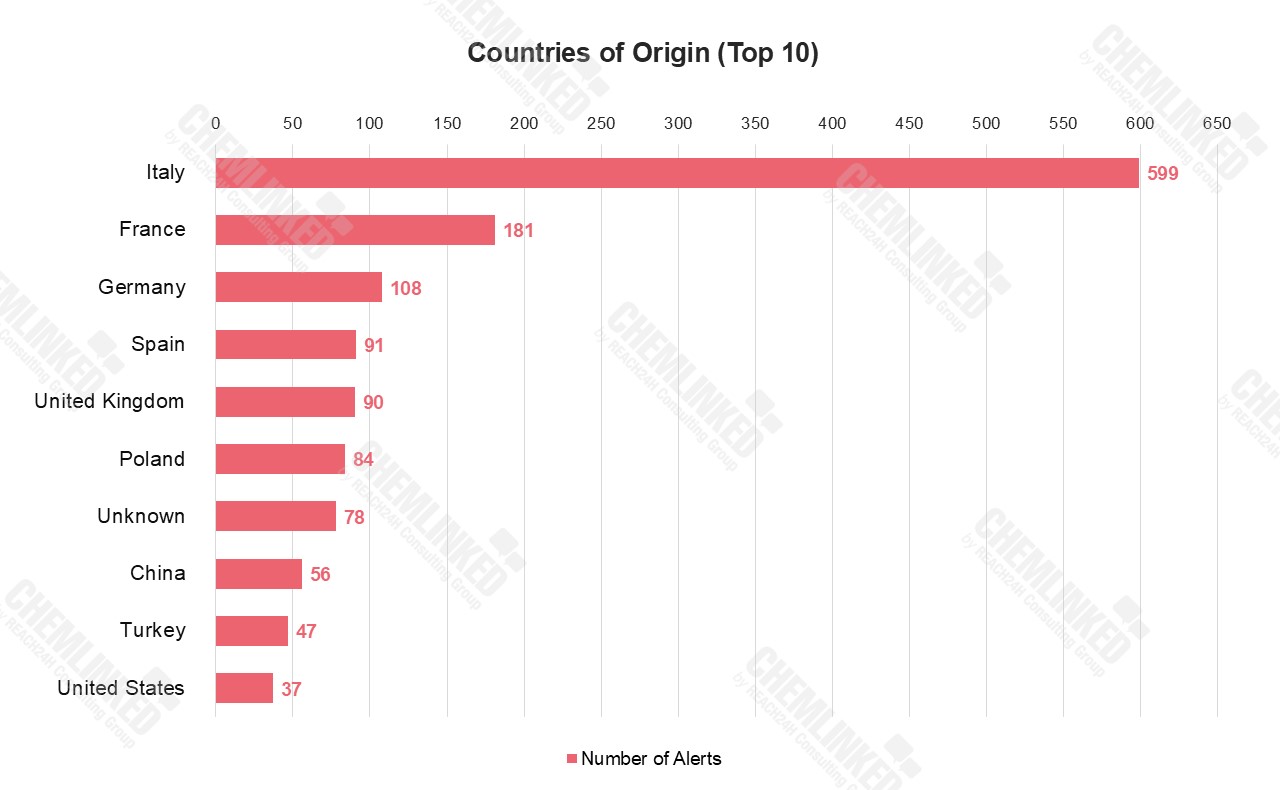
In 2024, the Safety Gate flagged 1,491 batches of non-compliant cosmetics. Of these, 1,413 batches had known origins, with Italy leading the list with 599 batches, followed by France and Germany with 181 and 108 batches, respectively. The remaining 78 batches had no identified origin.
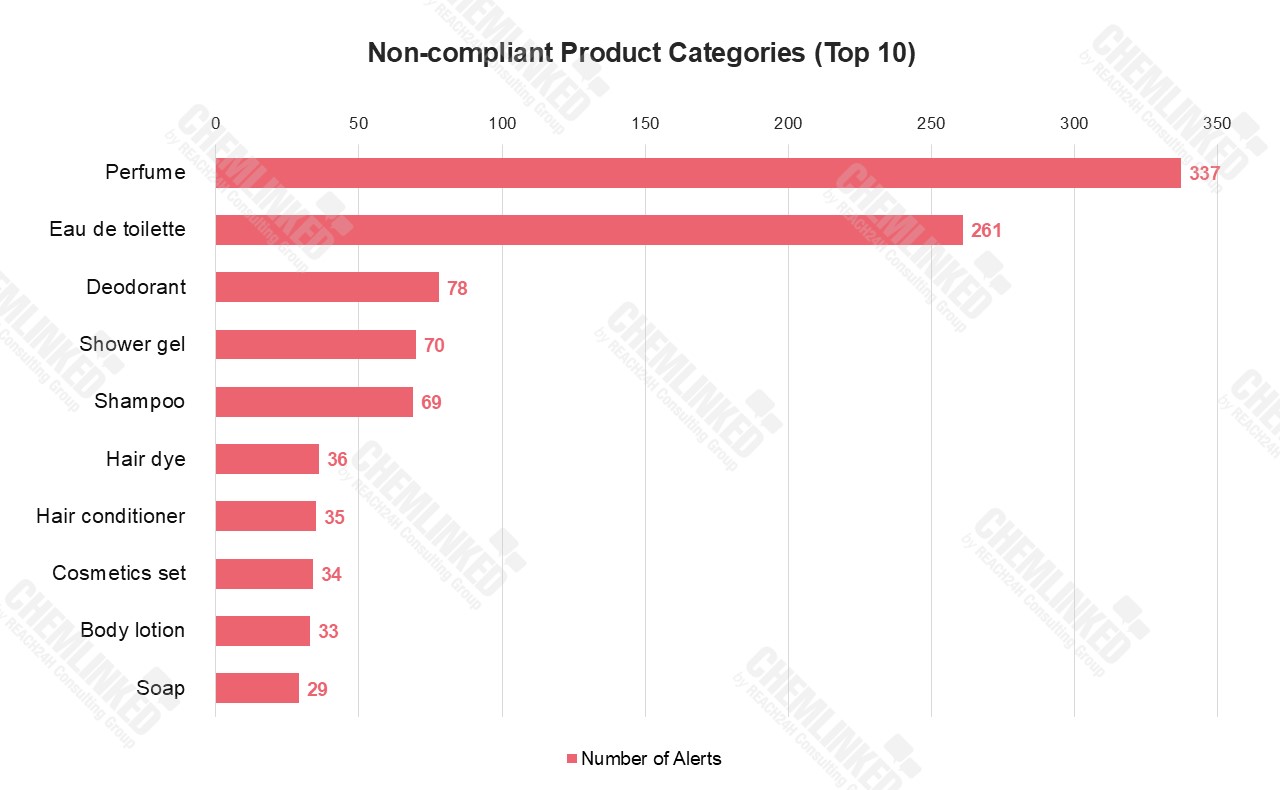
In terms of product categories, perfume topped the list once again, in line with 2022 and 2023, with 22.6% of alerts. Eau de toilette was in second place at 17.5%, followed by deodorant at 5.2%, shower gel at 4.7%, and shampoo at 4.6%.
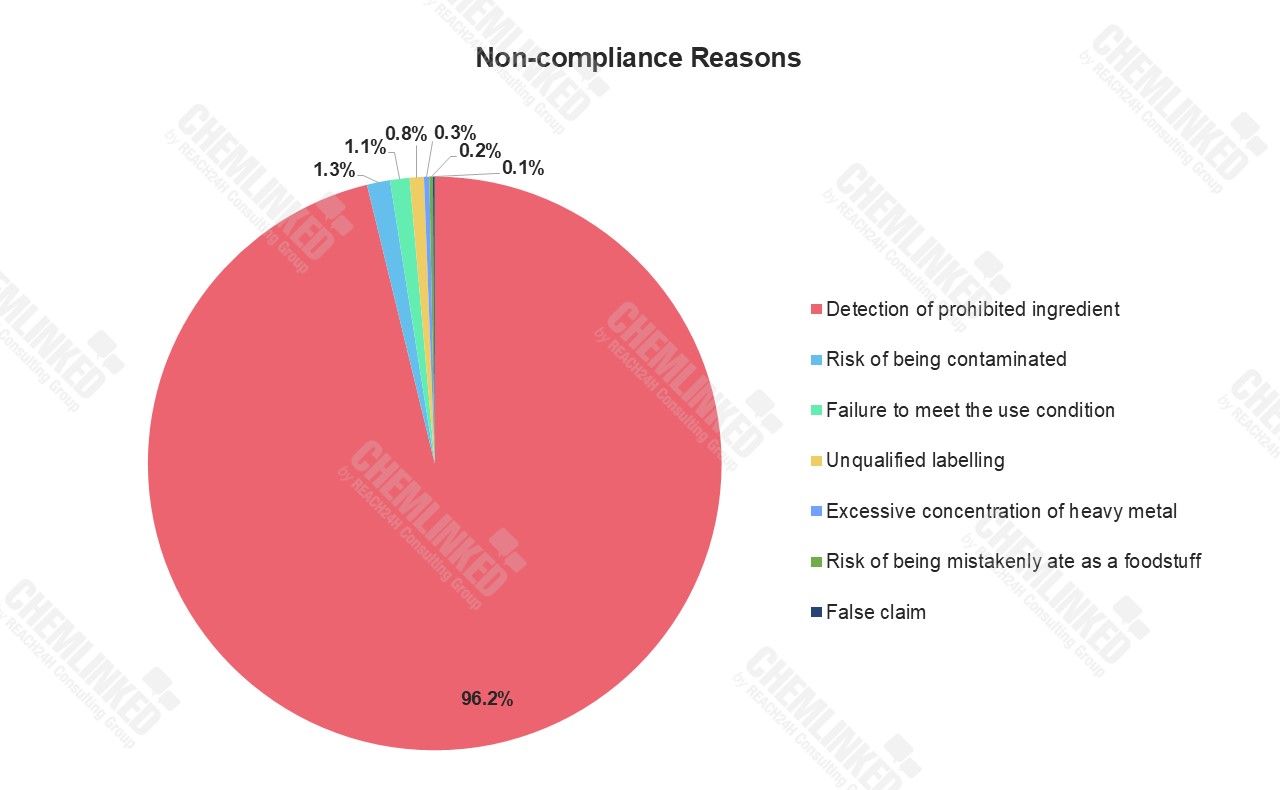
Of the reported cosmetics, the predominant reason for non-compliance is the detection of prohibited ingredients, accounting for a substantial 96.2%. Other contributing reasons include risk of being contaminated (1.3%), failure to meet the use condition (1.1%), unqualified labelling (0.8%), excessive concentration of heavy metal (0.3%), risk of being mistakenly ate as a foodstuff (0.2%), and false claim (0.1%).
Compliance Guidance for Major Non-compliance Reasons
1. Detection of prohibited ingredient
Among the non-compliant cosmetics reported, 1,439 batches were identified to contain 11 prohibited ingredients listed in Regulation (EC) No 1223/2009 (Cosmetics Regulation). The details of the prohibited ingredients are as follows. Notably, compared to those identified in 2022 and 2023, the ingredients numbered 4, 6, 7, 8, and 11 are detected for the first time in 2024.
No. | Detected Prohibited Ingredient | CAS No. | Risk |
1 | 2-(4-tert-butylbenzyl) propionaldehyde / Butylphenyl Methylpropional (BMHCA) | 80-54-6 | BMHCA may harm the reproductive system and the health of unborn child. It may also cause skin sensitization. |
2 | Hydroxyisohexyl 3-cyclohexene carboxaldehyde (HICC or Lyral) | 51414-25-6 / 31906-04-4 | HICC is a skin sensitiser that triggers allergic reactions or contact dermatitis. |
3 | Hydroquinone | 123-31-9 | Hydroquinone can cause skin irritation and dermatitis. Notes: Hydroquinone is prohibited in cosmetics with the exception of its professional use in artificial nail systems. |
4 | Perfluorononyl dimethicone | 259725-95-6 | Perfluorononyl dimethicone is a perfluorooctanoic acid (PFOA) related compound, which poses a risk to human health and the environment. |
5 | Octamethylcyclotetrasiloxane (D4) | 556-67-2 | D4 is highly persistent and bioaccumulative. It can pose risk to aquatic life and the environment, and is suspected of being toxic to reproduction. |
6 | Dioxane | 123-91-1 | Dioxane poses a potential cancer risk, causes serious eye irritation, and may lead to respiratory discomfort. |
7 | Trisodium nitrilotriacetate | 5064-31-3 | Trisodium nitrilotriacetate is harmful if swallowed. It also poses risks of serious eye irritation and potential carcinogenicity. |
8 | Versalide | 88-29-9 | Versalide is recognized as a persistent and bioaccumulative substance with potential neurotoxic effects that may impact the nervous system. |
9 | Isobutylparaben | 4247-02-3 | Isobutylparaben might be toxic for reproduction and development, especially for the male reproductive system. |
10 | Pyrithione zinc | 13463-41-7 | Pyrithione zinc is toxic if swallowed, and causes damage to organs through prolonged or repeated exposure. |
11 | CI 45170 | 81-88-9 | CI 45170 may be carcinogenic, and can cause irritation when in contact with the skin and eyes. |
2. Risk of being contaminated
In 2024, 20 batches of non-compliant cosmetics were found to be at risk of being contaminated. Exposure to microbiologically contaminated products may pose a risk of skin infection, in particular for sensitive consumers. As per The SCCS Notes of Guidance for the Testing of Cosmetic Ingredients and Their Safety Evaluation, finished cosmetic products shall meet the following specifications:
Types of Microorganism | Products Specifically Intended for Children Under Three Years of Age, the Eye Area or the Mucous Membranes | Other Products |
Total Aerobic Mesophilic Microorganisms (Bacteria plus yeast and mould) | ≤ 1 x 10² CFU per g or ml a | ≤ 1 x 10³ CFU per g or ml b |
Escherichia coli | Absence in 1g or 1ml | Absence in 1g or 1ml |
Pseudomonas aeruginosa | Absence in 1g or 1ml | Absence in 1g or 1ml |
Staphyloccocus aureus | Absence in 1g or 1ml | Absence in 1g or 1ml |
Candida albicans | Absence in 1g or 1ml | Absence in 1g or 1ml |
Notes: | ||
3. Failure to meet the use condition
In 2024, 17 batches of non-compliant cosmetics were found to violate the use conditions outlined in the Cosmetics Regulation. ChemLinked has compiled the involved ingredients and their corresponding use conditions in the table below:
No. | Ingredients | CAS No. | Use Conditions |
1 | Methylchloroisothiazolinone (MCI) and Methylisothiazolinone (MI) | 26172-55-4, 2682-20-4 | MCI and MI can be used only in rinse-off products. |
2 | Acid red 33 | 3567-66-6 | When acid red 33 is used as a hair dye substance in non-oxidative hair dye products, its maximum concentration shall not exceed 0.5%. |
3 | Acid blue 9 | 3844-45-9 | When acid blue 9 is used as a hair dye substance in non-oxidative hair dye products, its maximum concentration shall not exceed 0.5%. |
4 | 2-Phenoxyethanol | 122-99-6 | When 2-phenoxyethanol is used in cosmetics, its maximum concentration shall not exceed 1%. |
5 | Methyl-4-hydroxybenzoate | 99-76-3 | The maximum concentration of methyl-4-hydroxybenzoate in cosmetics is: |
6 | Hydrogen peroxide | 7722-84-1 | The maximum concentration of hydrogen peroxide in cosmetics is: |
7 | Kojic acid | 501-30-4 | When kojic acid is used in face and hand products, its maximum concentration shall not exceed 1%. |
8 | Selenium disulphide | 7488-56-4 | When selenium disulphide is used in antidandruff shampoos, its maximum concentration shall not exceed 1%. |
9 | 2-Hydroxyethyl methacrylate (HEMA) | 868-77-9 | The application of HEMA in nail products is limited to professional use. |
10 | Hydroquinone methylether (Mequinol) | 150-76-5 | The application of mequinol in artificial nail systems is limited to professional use. |
11 | p-Phenylenediamine (PPD) | 106-50-3 | When p-phenylenediamine is used as a hair dye substance in oxidative hair dye products, after mixed under oxidative conditions, its maximum concentration applied to hair must not exceed 2% calculated as free base. |
12 | Salicylic acid | 69-72-7 | The maximum concentration of salicylic acid in cosmetics, as a restricted ingredient, is: |
4. Unqualified labelling
To protect consumers sensitive to fragrances, EU mandates that identified fragrance allergens shall be specified individually on the labels when their concentration exceeds 0.001% in leave-on products or 0.01% in rinse-off products. Currently, 81 entries in the restricted ingredients list under the Cosmetics Regulation fall under this requirement.
In 2024, 13 fragrance allergens were found in cosmetics that were not in compliance with the above labelling requirement. These allergens include:
No. | Ingredient Name | CAS No. | No. | Ingredient Name | CAS No. |
1 | Benzyl alcohol | 100-51-6 | 8 | Geraniol | 106-24-1 |
2 | Benzyl benzoate | 120-51-4 | 9 | Hexyl cinnamal | 101-86-0 |
3 | Benzyl salicylate | 118-58-1 | 10 | Hydroxycitronellal | 107-75-5 |
4 | Cinnamyl alcohol | 104-54-1 | 11 | Isoeugenol | 97-54-1 |
5 | Citral | 5392-40-5 | 12 | Limonene | 138-86-3 / 7705-14-8 / 5989-27-5 / 5989-54-8 |
6 | Citronellol | 106-22-9 / 26489-01-0 / 1117-61-9 / 7540-51-4 | 13 | Linalool | 78-70-6 |
7 | Coumarin | 91-64-5 |
 We provide full-scale global cosmetic market entry services (including cosmetic registering & filing, regulatory consultation, customized training, market research, branding strategy). Please contact us to discuss how we can help you by