Request a Demo
The EU Safety Gate, previously known as RAPEX, facilitates the rapid dissemination of information on measures against dangerous non-food products among 30 national authorities (EU countries plus Iceland, Liechtenstein, and Norway). This helps member countries effectively monitor their markets, and take necessary measures if the same product is found in their territory.
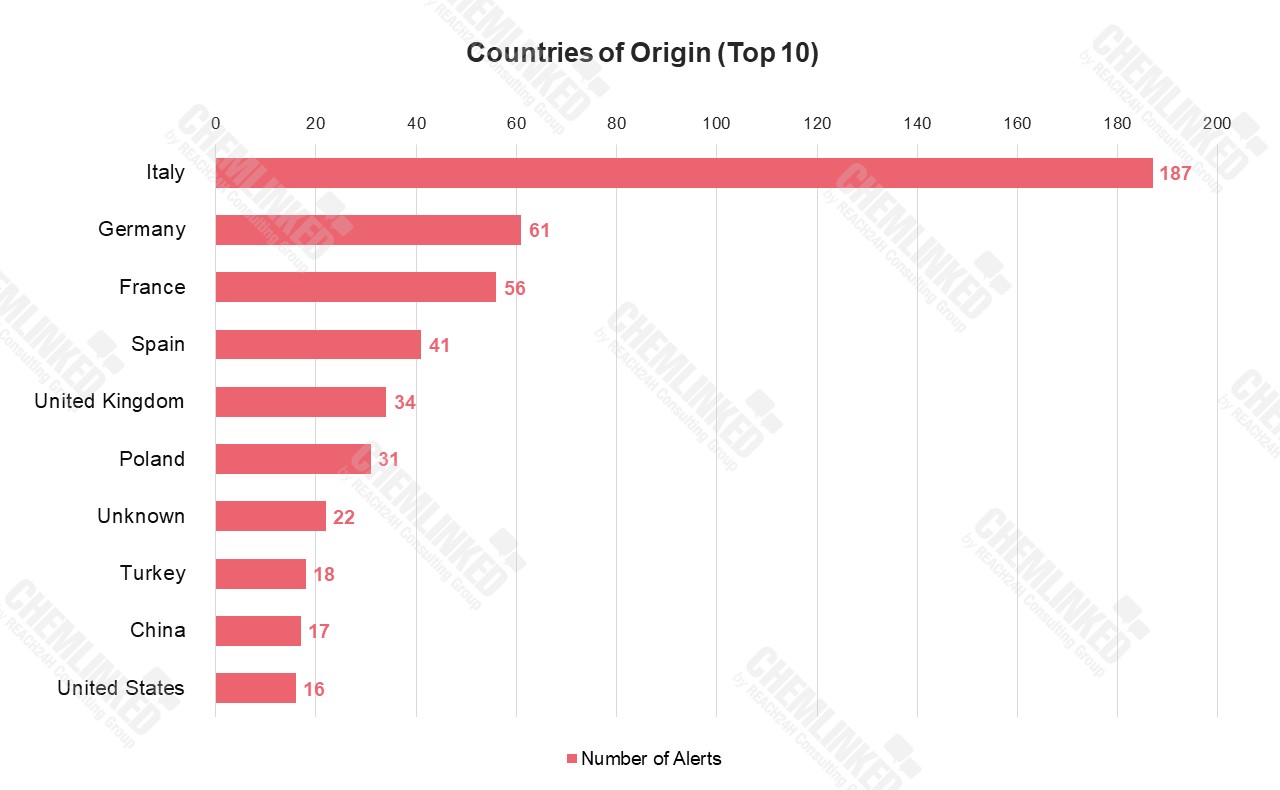
In the first half of 2024, the Safety Gate circulated alerts on 521 batches of non-compliant cosmetics. Of these, 499 batches had known origins. Among the 25 identified countries of origin, Italy led with 187 batches, with Germany and France coming next with 61 and 56 batches, respectively. The rest 22 batches had unknown origins.
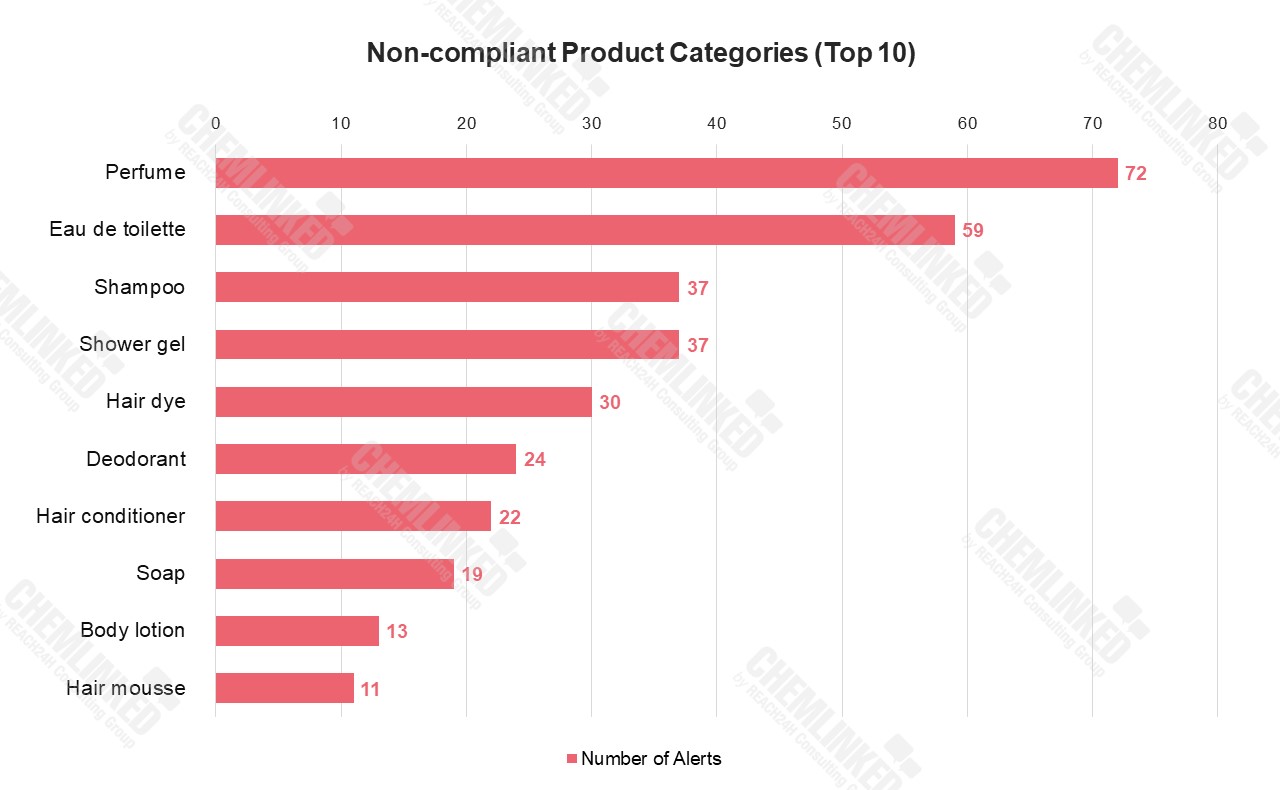
Regarding product categories, consistent with 2022 and 2023, perfume appeared most, accounting for 13.8% of alerts. Eau de toilette ranked second at 11.3%, followed by shampoo and shower gel at 7.1% each, and hair dye at 5.8%.
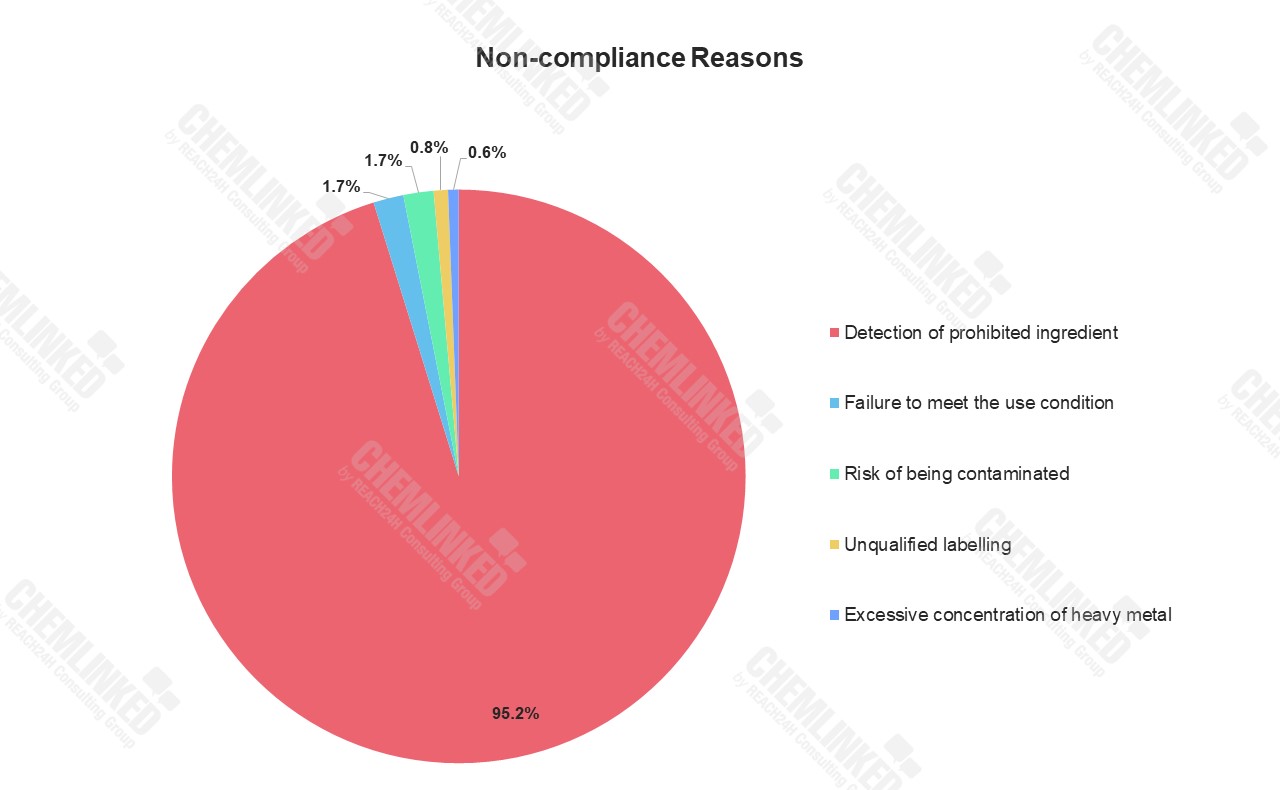
For the reported cosmetics, the primary reason for non-compliance is the detection of prohibited ingredient, which constitutes a significant 95.2%. Other reasons include failure to meet the use condition (1.7%), risk of being contaminated (1.7%), unqualified labelling (0.8%), and excessive concentration of heavy metal (0.6%).

Non-compliance Reasons and Corresponding Regulatory Requirements
1. Detection of prohibited ingredient
Of the reported non-compliant cosmetics, 499 batches were found to contain prohibited ingredients listed in Regulation (EC) No 1223/2009 (Cosmetics Regulation). Notably, 484 batches contained 2-(4-tert-butylbenzyl) propionaldehyde (BMHCA), a fragrance ingredient banned for its reproductive toxicity since March 1, 2022. The details of detected prohibited ingredients, including BMHCA, in the reported cosmetics include:
No. | Detected Prohibited Ingredient | CAS No. | Risk |
1 | 2-(4-tert-butylbenzyl) propionaldehyde / Butylphenyl Methylpropional (BMHCA) | 80-54-6 | BMHCA may harm the reproductive system and the health of unborn child. It may also cause skin sensitization. |
2 | Hydroxyisohexyl 3-cyclohexene carboxaldehyde (HICC or Lyral) | 51414-25-6 / 31906-04-4 | HICC is a skin sensitiser that triggers allergic reactions or contact dermatitis. |
3 | Hydroquinone | 123-31-9 | Hydroquinone can cause skin irritation and dermatitis. Notes: Hydroquinone is prohibited in cosmetics with the exception of its professional use in artificial nail systems. |
4 | Perfluorononyl dimethicone | 259725-95-6 | Perfluorononyl dimethicone is a perfluorooctanoic acid (PFOA) related compound, which poses a risk to human health and the environment. |
5 | Octamethylcyclotetrasiloxane (D4) | 556-67-2 | D4 is highly persistent and bioaccumulative. It can pose risk to aquatic life and the environment, and is suspected of being toxic to reproduction. |
2. Failure to meet the use condition
In H1 2024, nine batches of non-compliant cosmetics were identified as a violation to the use conditions specified in the Cosmetics Regulation. ChemLinked sorts out the involved ingredients, and details their respective use conditions in the table below:
No. | Ingredients | CAS No. | Use Conditions |
1 | Methylchloroisothiazolinone (MCI) and Methylisothiazolinone (MI) | 26172-55-4, 2682-20-4 | MCI and MI can be used only in rinse-off products. |
2 | Acid red 33 | 3567-66-6 | When acid red 33 is used as a hair dye substance in non-oxidative hair dye products, its maximum concentration shall not exceed 0.5%. |
3 | Acid blue 9 | 3844-45-9 | When acid blue 9 is used as a hair dye substance in non-oxidative hair dye products, its maximum concentration shall not exceed 0.5%. |
4 | 2-Phenoxyethanol | 122-99-6 | When 2-phenoxyethanol is used in cosmetics, its maximum concentration shall not exceed 1%. |
5 | Methyl-4-hydroxybenzoate | 99-76-3 | The maximum concentration of methyl-4-hydroxybenzoate in cosmetics is: |
6 | Hydrogen peroxide | 7722-84-1 | The maximum concentration of hydrogen peroxide in cosmetics is: |
7 | Kojic acid | 501-30-4 | When kojic acid is used in face and hand products, its maximum concentration shall not exceed 1%. |
3. Risk of being contaminated
During the first half of 2024, nine batches of non-compliant cosmetics were found to be at risk of contamination by aerobic mesophilic microorganisms. Exposure to such products may lead to skin infections, especially among sensitive users. As per The SCCS Notes of Guidance for the Testing of Cosmetic Ingredients and Their Safety Evaluation, finished cosmetic products shall meet the following specifications for aerobic mesophilic microorganisms:
Products specifically intended for children under three years of age, the eye area or the mucous membranes: 1 x 10² CFU/g or CFU/ml
Other products: 1 x 10³ CFU/g or CFU/ml
4. Unqualified labelling
Under the Cosmetics Regulation, identified fragrance allergens shall be individually labelled on the package of cosmetics when their concentration exceeds 0.001% in leave-on products or 0.01% in rinse-off products. At present, 81 entries in the restricted ingredients list annexed to the Cosmetics Regulation are subject to this individual labelling requirement.
In H1 2024, five fragrance allergens were detected in cosmetics that failed to comply with the above labelling requirement. These allergens are benzyl salicylate (CAS No. 118-58-1), geraniol (CAS No. 106-24-1), isoeugenol (CAS No. 97-54-1), limonene (CAS No. 138-86-3 / 7705-14-8 / 5989-27-5 / 5989-54-8), and linalool (CAS No. 78-70-6).
5. Excessive concentration of heavy metal
Heavy metals are prohibited in cosmetics under the Cosmetics Regulation, while traces are allowed as long as they do not endanger human health. Yet, there are no specific limits set for these traces at the EU level. For reference, the member state Germany has established the following limits (mg/kg) for unavoidable metal content in cosmetics:
Cadmium: 0.1;
Mercury: 0.1;
Antimony: 0.5;
Arsenic: 0.5 (or 2.5 for theatre make-up); and
Lead: 2.0 (or 5.0 for certain make-up products, or 0.5 for toothpaste).
 We provide full-scale global cosmetic market entry services (including cosmetic registering & filing, regulatory consultation, customized training, market research, branding strategy). Please contact us to discuss how we can help you by