Request a Demo
Under the Food, Drug, and Cosmetic Act (FD&C Act), the U.S. Food and Drug Administration (FDA) has the authority to detain and refuse entry to any product found to be non-compliant with the Act. When a product is detained, the FDA issues a "Notice of FDA Action" to the product’s owner or consignee, detailing the violation nature. The recipient is then given an opportunity for an informal hearing to present evidence regarding the admissibility of the product. If the product owner fails to prove compliance or submit a corrective plan, the FDA will issue another “Notice of FDA Action,” formally refusing the product’s entry. The product must then be either exported or destroyed within 90 days.
2024 Rejection Statistics
In 2024, the FDA rejected a total of 1,300 batches of imported cosmetics from 42 countries. Côte d'Ivoire accounted for the highest number of rejections, with 417 batches denied entry. Other leading sources of rejected products included India, South Korea, China, and Germany.
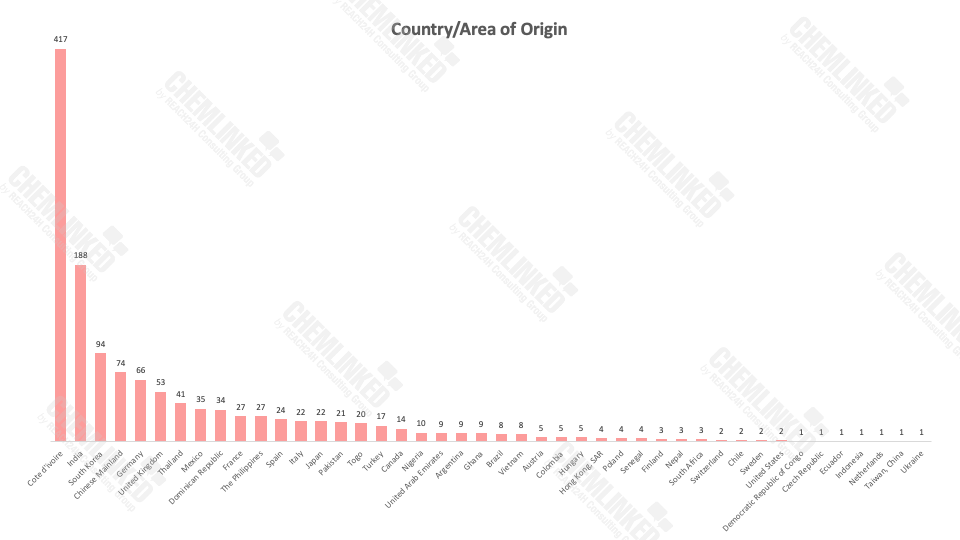 Country/Area of Origin (2024)The rejected products covered nine cosmetic categories. Skin care preparations were the most frequently rejected, with 547 batches, representing 42.08% of the rejected products. Personal cleanliness preparations ranked second, accounting for 23.92%, followed by hair preparations at 12.08% and makeup preparations at 7.85%.
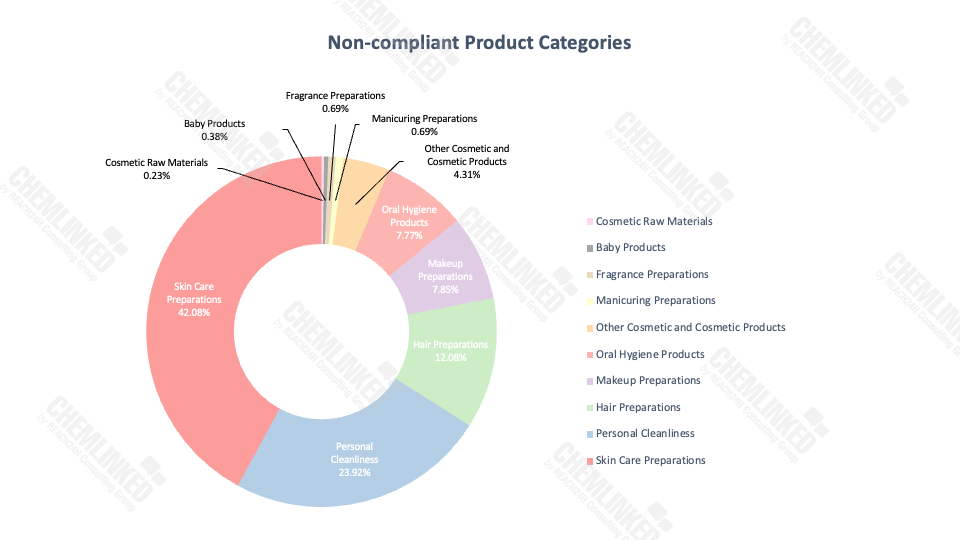 Non-compliant Product Categories (2024)The primary cause of rejection was the misclassification of drugs as cosmetics. Many cosmetic-type products were marketed with therapeutic claims, which inevitably marked them as unapproved new drugs based on legal definition. This issue accounted for the highest proportion of rejections of 723 batches. Other reasons for rejection included the improper use of color additives and labeling deficiencies.
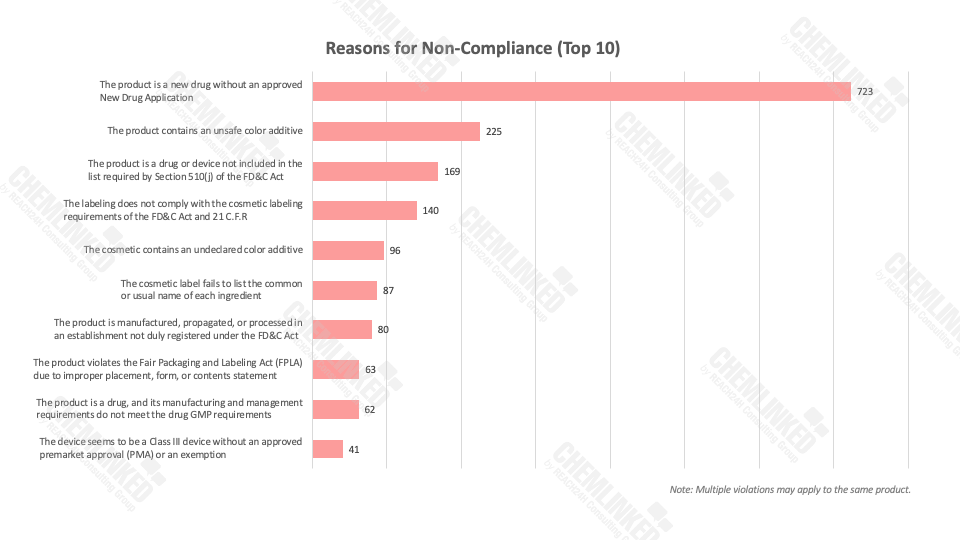 Top 10 Reasons for Non-compliance (2024)
Key Compliance Requirements
To reduce the risk of import rejections and successfully enter the U.S. cosmetics market, cosmetic companies must ensure that their products meet the following key regulatory requirements:
1. Proper Classification: Cosmetic, Drug, or Both
A significant cause of product rejection stems from the distinction between cosmetics and drugs. In the United States, whether a product is classified as a cosmetic or a drug is determined by its intended use, with distinct regulations applying to each category.
Under the FD&C Act, a cosmetic is defined as an “article intended to be rubbed, poured, sprinkled, or sprayed on, introduced into, or otherwise applied to the human body… for cleansing, beautifying, promoting attractiveness, or altering the appearance.” This definition encompasses any substance used as a component of a cosmetic, excluding soap. With the exception of color additives, cosmetic products and ingredients do not require FDA approval before they are marketed.
In contrast, drugs are subject to more rigorous oversight. They must either receive premarket approval through the New Drug Application (NDA) process or comply with a specific monograph established by the FDA’s Over-the-Counter (OTC) Drug Review.
Some products fall into both categories, such as anti-dandruff shampoos, fluoride toothpastes, antiperspirant deodorants, as well as moisturizers and makeup marketed with sunscreen claims. Under the Modernization of Cosmetics Regulation Act of 2022 (MoCRA), these dual-purpose products are subject to the drug requirements outlined in Chapter V: Drugs and Devices of the FD&C Act, as well as cosmetic requirements for fragrance allergen disclosure and professional use labeling. However, they are exempt from other cosmetic requirements listed in the MoCRA, such as adverse event reporting, GMP compliance, facility registration, product listing, safety substantiation, general labeling, records inspection, and mandatory recall authority.
2. Color Additive Regulations
Another frequent cause of rejection was the improper use of color additives. As per the FD&C Act, all color additives used in cosmetics, except for coal tar hair dyes, must be approved by the FDA. Furthermore, certain color additives require batch certification by the FDA in order to be legally used in cosmetics marketed in the U.S.
The FDA classifies approved color additives into two categories: those that require certification and those that are exempt. The FDA maintains a comprehensive list of approved color additives, which includes both those subject to certification and those exempt from it, available on its official website. It is illegal to market cosmetics containing uncertified color additives. The FDA can take enforcement action against adulterated or misbranded products.
To avoid rejection due to color additive violations, companies must ensure that they source FDA-certified color additives from qualified suppliers and verify that the certification details, such as the legal name, the FDA lot number, and the use limitations, are included the color's label. The FDA provides a list of companies that have requested color certification within the past two years, which can serve as a reference for verifying supplier compliance. If a supplier is not on this list, companies can contact the FDA at [email protected] to confirm.
3. Labeling Compliance
Labeling is another critical compliance area. Cosmetics sold in the U.S. must meet the requirements set forth by the FD&C Act and the Fair Packaging and Labeling Act (FPLA). The cosmetic labels must provide essential information such as identity statement, net quantity of contents, name and place of business, distributor statement, material facts, warning and caution statements, ingredients, etc.
Additionally, there are specific guidelines regarding the label’s presentation, including the location, font size, and format of the information. For example, the identity statement must be in bold and prominently displayed, typically aligned parallel to the base of the container when sold at retail. All labeling information must be in English, unless the product is distributed exclusively in Puerto Rico or a territory where another language predominates, in which case the label can be presented in the predominant language.
The FDA does not have the authority or resources for pre-market approval of cosmetic labeling, which means cosmetic labeling is not subject to pre-market approval. Instead, it is the responsibility of the manufacturer and/or distributor to ensure that products are properly labeled. Failure to meet labeling requirements, such as providing false or misleading information, omitting required details, or improperly displaying information, can result in the product being deemed “misbranded” and subject to detention or rejection.

 We provide full-scale global cosmetic market entry services (including cosmetic registering & filing, regulatory consultation, customized training, market research, branding strategy). Please contact us to discuss how we can help you by