Request a Demo
On May 2, 2026, the Canadian government published the Canada Gazette, Part I, Volume 160, Number 18, adopting two Significant New Activity (SNAc) Notices under the Canadian Environmental Protection Act, 1999. 1 The notices mandate that companies must submit a Significant New Activity Notification (SNAN) before undertaking specific manufacturing or distribution activities involving two specific ester substances in consumer products and cosmetics. The notices came into force immediately upon publication on May 2, 2026.
Key Cosmetic-related Requirements
The newly applied SNAc provisions target potential significant new activities involving two substances that could result in new or increased human exposure. For the cosmetic industry, the key regulatory requirements are as follows:
Substances Affected
Alkanedioic acid, di-branched alkyl ester (Confidential Substance Identity Number 19814-2)
Hexanedioic acid, 1,6-diisotridecyl ester (CAS No. 26401-35-4)
Manufacturing and Distribution Triggers
A SNAN is required if a company uses either substance in the manufacture of a cosmetic containing the substance at a concentration equal to or greater than 0.1% by weight.
A SNAN is also mandatory for the use of the substance in the distribution for sale of such cosmetics.
Exemptions
Activities are not considered significant new activities if the substance is used strictly as a research and development substance, as a site-limited intermediate substance, or in the manufacture of a product that is for export only.
Notification Timeline and Required Information
Companies proposing a significant new activity must submit a comprehensive set of information to the Minister of the Environment at least 90 days before the day on which the activity begins. The submitted information will be assessed within 90 days after it is received.
The required information includes, but is not limited to:
| (a) a description of the significant new activity in relation to the substance; (b) the quantity of the substance that is anticipated to be used in a calendar year; (c) chemical names, CAS registry numbers (if assigned), trade names, and synonyms; (d) a safety data sheet (SDS) for the substance, if available; (e) exposure information: whether the substance will be used in children's products, and the anticipated degree of direct human exposure (concentration, duration, frequency, circumstances); (f) product information: description of the product/end-use products, intended use, method of application, function of the substance, and its concentration; (g) information related to reproductive and developmental toxicity (to assess oral, dermal, and inhalation routes) conducted in accordance with OECD principles of good laboratory practice; (h) information sufficient to assess dermal penetration at concentrations relevant to the intended end use (conducted under OECD GLP); (i) all other available information or test data permitting the identification of adverse effects on the environment and human health, and the degree of exposure; (j) details of previous submissions to other government agencies regarding the substance and risk management actions imposed; (k) contact information of the proposer and certification of accuracy. |
Transitional Provisions
To facilitate compliance for persons who may have already started activities, both notices include a transitional period running from May 2, 2026, to May 2, 2027. During this period, the SNAN requirement is triggered only if the substances are present at () 0.1% by weight AND the quantity used exceeds the following thresholds:
Alkanedioic acid, di-branched alkyl ester: Quantity greater than 100 kg.
Hexanedioic acid, 1,6-diisotridecyl ester: Quantity greater than 1,000 kg.
Webinar Recommendation
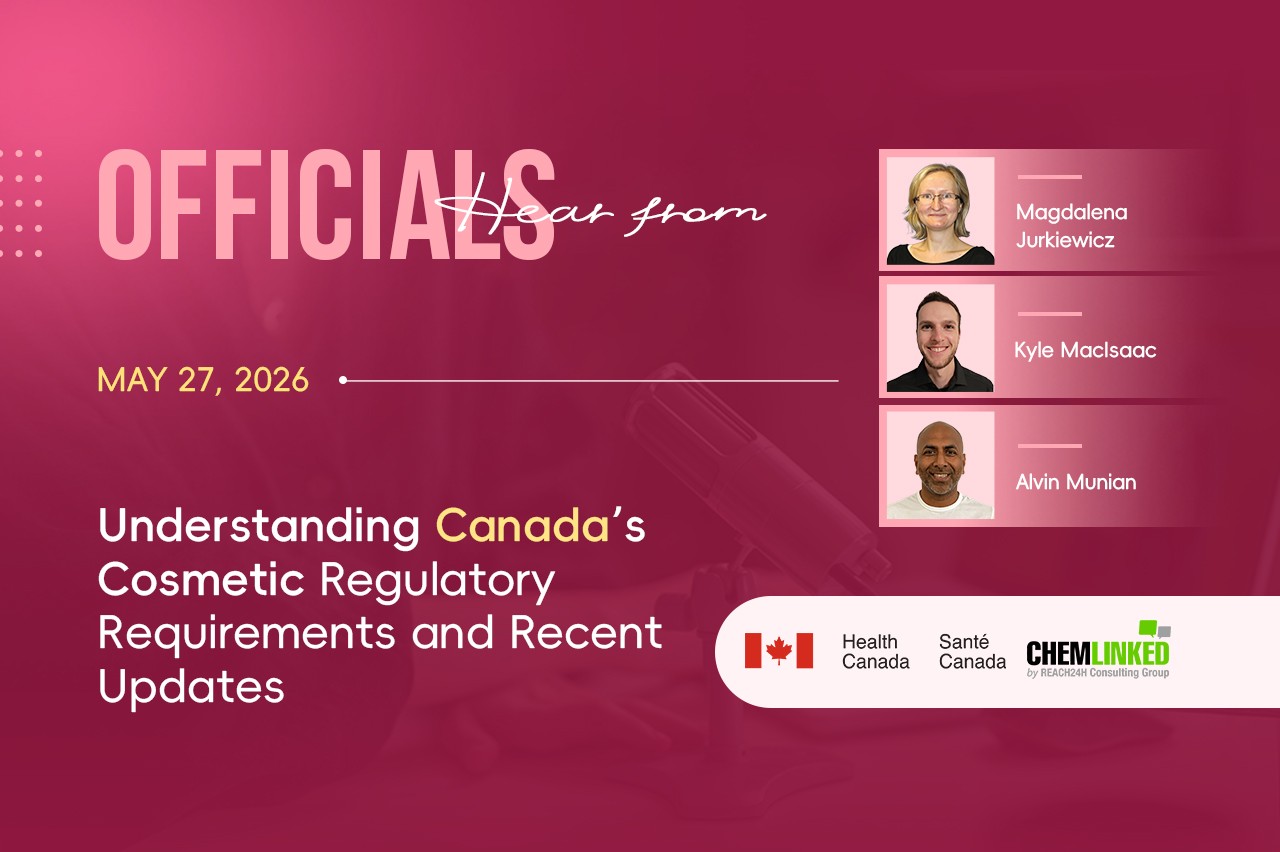
To help global beauty companies seamlessly access the Canadian market, ChemLinked invited three officials from Health Canada to explain Canada's current regulatory framework and offer guidance on both pre- and post-market requirements. The webinar will conclude with a live Q&A session, offering businesses an opportunity to engage with Health Canada regulators and have their questions addressed.
 We provide full-scale global cosmetic market entry services (including cosmetic registering & filing, regulatory consultation, customized training, market research, branding strategy). Please contact us to discuss how we can help you by