Request a Demo
Takehome:
- Strong potential, stable consumer demand and favorable policy support are all positive attributes which are contributing to positive growth trends in China’s cosmetic sector.
- China will attempt to align with global regulatory best practices and collaborate on development of a globally harmonized regulatory system.
- EU’s management on trace prohibited substances and China’s revised regulations were significant issues discussed in the meeting.
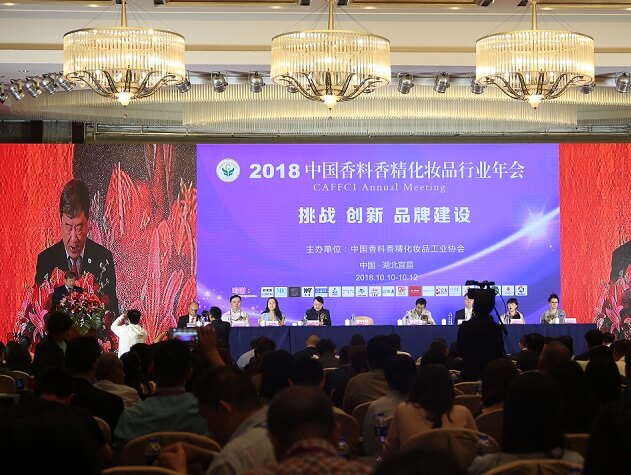
From Oct. 9th to Oct. 12th 2018, China Association of Fragrance Flavor and Cosmetic Industries (CAFFCI) held its annual conference, attended by a number of renowned international associations including Cosmetic Europe (CE) and Personal Care Products Council (PCPC), China government officials and industry experts. The meeting covered a wide range of topics such as the global economic landscape, market development, regulatory trends, technical issues and industry development. ChemLinked attended the conference, here are our major conclusion:
“Two Trends”
► The flourishing development and the optimistic prospects of China’s cosmetic sector
1. A meteoric rise and strong growth potential
Accompanying the upgrade in the Chinese economy and the focus on domestic consumption, China’s cosmetic market has witnessed a rapid growth in the past 40 years. According to CAFFCI, the overall annual growth rate of this industry has maintained double digits over the last several years and the market size has grown over 900%. In addition the number of cosmetics companies increased from more than 70 in 1980 to 4,568 in 2018. The market value increased from CNY 350 million ($50.5 million) to CNY 319 billion ($46 billion) in 2017. Chinese cosmetics were exported to more than 200 countries in 2017, amounting to $3.353 billion; imports of cosmetics from more than 70 countries reached $995.25 million.
Based on the current statistics, it is estimated that China’s cosmetic market will exceed CNY 400 billion by the end of 2018 and maintain rapid growth over the next several years.
(Source: Internet)
2. Stable consumer demand
Li Gang, the vice-president of China Academy of International Trade and Economic Cooperation gave a presentation on China-US trade spat and its impacts on global and China’s economy, in which he indicated that of the three major drivers of growth in China: 1) scilicet consumption, 2) export and 3) investment, that the cosmetic sector relies primarily on consumer demand and domestic consumption. Domestic consumption has been stable in recent years and thus cosmetic sector growth has suffered minimal impact as a result of China-US trade friction.
3. Favorable policy support
Li also pointed out that cosmetic enterprises, especially those in cross-border commerce, directly benefit from recently-released favorable policies like—
- In June, China decided to further reduce import tariffs on cosmetics from 8.4% to 2.9% since July 1st.
- In October, China planned to lower import taxes on high-end cosmetics from 60% to 50% from November 1, 2018.
- From Nov. 5 to Nov.10, 2018, the first-ever China International Import Expo (CIIE) will be held in Shanghai providing a more extensive platform for cosmetic enterprises to boost business and enhance global communication.
These 3 key policies help foster a China cosmetic sector with excellent development potential and lucrative investment prospects.
► The construction of global harmonized regulatory framework and industrial ecosystem
1. Global cosmetic regulatory convergence
In regards to regulatory trends, the CE executive director John Chave suggested that regulatory intelligence, i.e. a changing regulatory framework which not only applies to the supervision of the current market but can forecast future trends, is the key to future regulation and will significantly benefit the industry. Furthermore, John stated that successful regulations in the future shall be globally focused.
2. Establish a dynamic business ecosystem
When it comes to China’s regulations, representatives from some leading enterprises including L'Oreal, BASF and Shanghai Jahwa United put forward a suggestion that a dynamic business ecosystem which includes four main aspects, government regulation, enterprise’s self-discipline, industry associations’ participation and consumers’ awareness shall be established to promote the development and prosperity of the cosmetic sector. Each party in the ecosystem will contribute using their capabilities and dynamically interact with others. More specifically, the administrative authorities shall strengthen regulatory compliance enforcement, reinforce communication with enterprises and enhance consumer education. Enterprises should also establish mechanisms to aid in self-regulation and industry associations shall develop their roles as bridges between different parties and promote comprehensive product lifecycle management and safety and quality assurance.
“Discussed issues”
1. Technical issues
At the conference, John Chave clarified some misconceptions associated with the management on unavoidable trace elements (impurities/banned substances of extremely small amounts) in cosmetics using a comparison of rules between EU and International Cooperation on Cosmetics Regulation (ICCR). Key statements are listed below:
- Most impurities do not have specific limits set by the EU regulation. For those with specific limits, be aware that the values are non-legally binding and are only references for inspection authorities, as drawn from the concentration range of the majority of similar products on the market. For those without specific limits, it’s feasible to benchmark against similar products on the market.
- Presence of trace substances is allowed only provided the following conditions are satisfied: 1) In cases where no limits are set, the product is safe and its trace elements are technically unavoidable in GMP; 2) In cases where certain limits have been set, the product is safe and its trace elements respect existing limits.
- Responsible Person is liable for the justification of technical unavoidability of trace substances on account of mandatory safety assessment requirements.
- According to ICCR’s regulations for handling cosmetic trace impurities, stakeholders shall apply further reasonable and practical reductions by ALARA Principle (as low as reasonably achieve) which refers to currently achievable safe level that may differ by manufacturer and region rather than EU’s technically unavoidable level.
- Either way, the ultimate focus of management on trace prohibited substances lies in minimization in finished products.
2. Industry focus
Additionally, during CAFFCI the latest progress related to key industry issues in China’s cosmetic sector were also outlined including:
- The amendment of Regulations concerning the Hygiene Supervision over Cosmetics 1989;
- The public consultation results of Classified Management Directory of Pollutant Discharge Permits for Stationary Pollution Source (trial);
- The safety issues of thallium (Tl) in cosmetics.
- The public consultation results of Guidelines for Management on Service Life of Cosmetic Ingredients;
- The public consultation results of Guidance on Safety Evaluation of New Cosmetic Raw Materials.
 We provide full-scale global cosmetic market entry services (including cosmetic registering & filing, regulatory consultation, customized training, market research, branding strategy). Please contact us to discuss how we can help you by