Request a Demo
On April 10, 2024, China National Institutes for Food and Drug Control (NIFDC) issued a public announcement soliciting opinions on the Index of Cosmetics Safety Assessment Data from Authoritative Organizations and Ingredient Usage Information of Marketed Products. 1 Subsequently, on April 30, 2024, NIFDC released the finalized version of the Index of Cosmetics Safety Assessment Data from Authoritative Organizations and Ingredient Usage Information of Marketed Products. 2
1) Index of Cosmetics Safety Assessment Data from Authoritative Organizations
This Index is an objective collection of ingredients that meet the following criteria:
They have been used in cosmetics available in China;
They are not included in Safety and Technical Standards for Cosmetics (STSC);
Assessment conclusions for these ingredients have been published by authoritative agencies such as Scientific Committee on Consumer Safety (SCCS) and Cosmetic Ingredient Review (CIR).
The Index encompasses 3,651 ingredients and provides their corresponding serial number in IECIC, Chinese name, INCI name/English name, and previous/current name. In comparison to the consultation draft, 79 ingredients have been added to the finalized version of the Index.
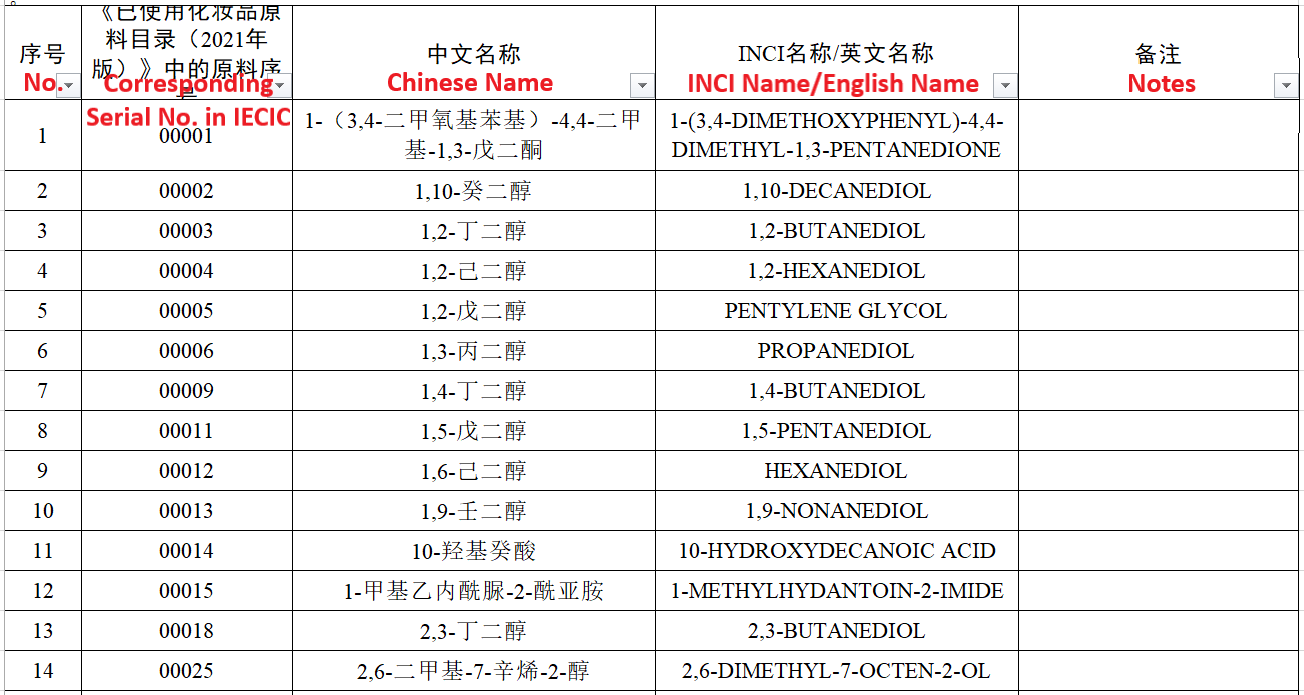 Excerpt of Index of Cosmetics Safety Assessment Data from Authoritative Organizations
The Index serves as a reference for enterprises conducting cosmetics safety assessments. Registrants and notifiers can utilize the assessment conclusions provided by authoritative agencies, including but not limited to SCCS and CIR, for these ingredients. When adopting assessment conclusions, the following requirements should be met:
1) Analysis of assessment conclusions: Conclusions that comply with China's cosmetic regulations and usage conditions can be adopted;
2) Staying updated: Given advancements in science and technology and evolving knowledge, the types of ingredients assessed and their assessment conclusions may change. Enterprises should prioritize the latest assessment conclusions;
3) Handling diverging conclusions: In cases where different authoritative agencies offer different assessment conclusions, enterprises should scientifically and reasonably adopt relevant conclusions. The reliability and relevance of the data should be the principle of selection.
2) Ingredient Usage Information of Marketed Products
Ingredient Usage Information of Marketed Products is an objective collection of ingredients that meet the following three criteria:
They have been used in special cosmetics available in China, and the special cosmetics registration certificate is still valid;
They are not included in STSC;
No assessment conclusions from authoritative agencies are available.
Ingredient Usage Information of Marketed Products includes 2,234 ingredients with their serial number in IECIC, Chinese name, INCI name/English name, previous name, application sites and application methods of the products containing the ingredient, and the concentration of ingredients used in the product. Notably, it encompasses a significant number of plant ingredients with Chinese characteristics, which greatly facilitates the access of safety data for these plant ingredients. In comparison to the consultation draft, the finalized version removes 16 ingredients.
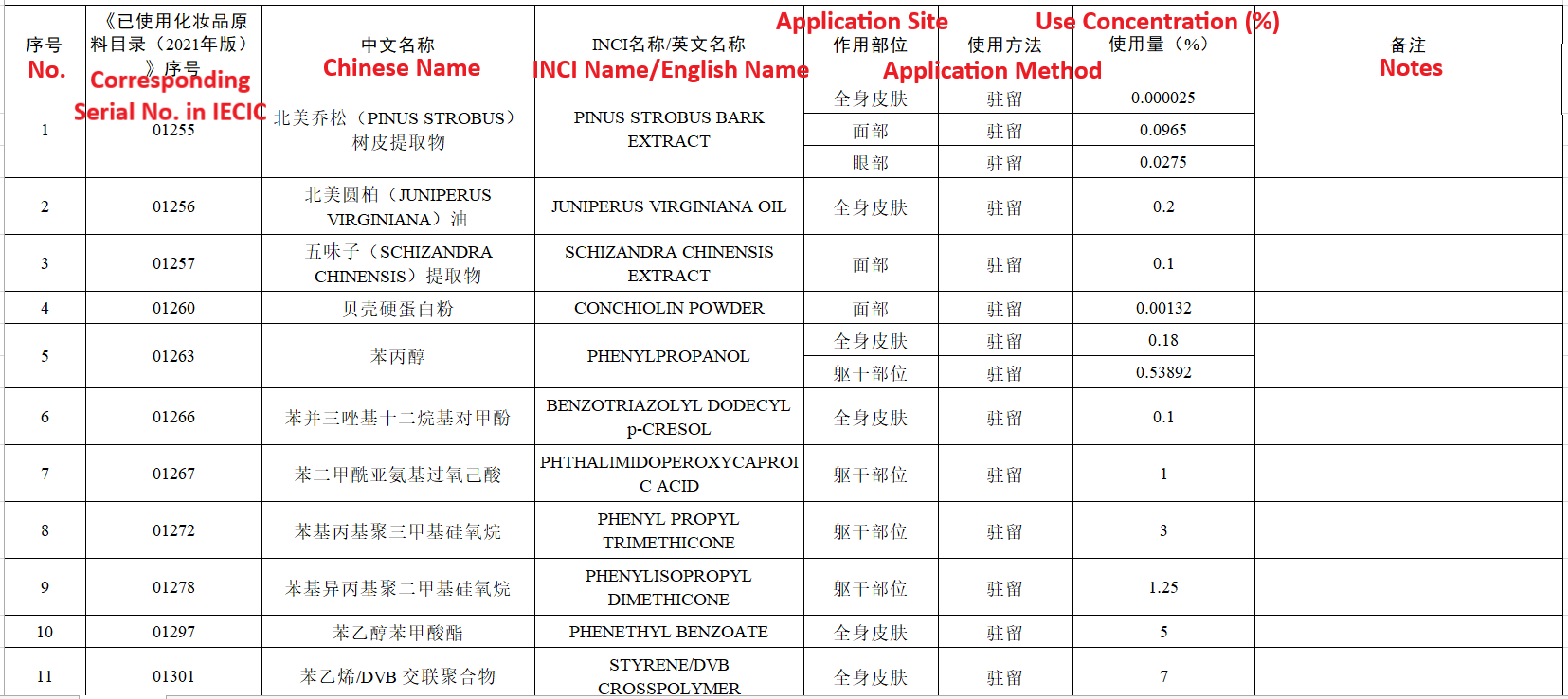 Excerpt of Ingredient Usage Information of Marketed Products
Data Adoption Requirements
The specified ingredient concentrations in Ingredient Usage Information of Marketed Products serve as a reference for enterprises conducting cosmetics safety assessments. Cosmetic registrants and notifiers should appropriately utilize the ingredient concentration based on the product's application method and site, following the following principles:
For the same ingredient with the same application site, if only the ingredient concentration of leave-on products is available, the concentration of this ingredient in leave-on products can be referred to in the safety assessment of this ingredient in rinse-off products. However, if only the ingredient concentration of rinse-off products is available, the concentration of this ingredient in rinse-off products cannot be referred to in the safety assessment of this ingredient in leave-on products;
For the same ingredient with the same application method, the safety assessment can be conducted in the order of 1) whole body skin, trunk area, face, lips, and eyes, or 2) whole body skin, trunk area, hands, feet, head, and hair. The ingredient concentration of product with a former-ranked application site can be referred to in the safety assessment of products with a later-ranked application site. However, when the product's application site is the eye and the ingredient concentration of products applied to other sites is referred to, the eye irritation of the ingredient should be separately assessed.
It's important to note that the regulatory authorities have not conducted a systematic evaluation of the 2,234 ingredients listed in Ingredient Usage Information of Marketed Products. Therefore, when using the concentration information provided in Ingredient Usage Information of Marketed Products, registrants and notifiers should comply with relevant national laws, regulations, standards, and technical specifications. They must also assume responsibility for ensuring the quality and safety of their products.
In cases where the concentration of an ingredient used in cosmetic products exceeds the concentration specified in Ingredient Usage Information of Marketed Products, registrants and notifiers are required to conduct safety assessments in accordance with Technical Guidelines for Cosmetic Safety Assessment. Alternatively, they can utilize other types of ingredient data specified in the Guidelines for Cosmetic Ingredient Data Usage to demonstrate the safety of the ingredients used in their products.
For ingredients not listed in Ingredient Usage Information of Marketed Products, NIFDC will make improvements based on the inclusion principles and feedback from enterprises.
Industry Comments
The release of Index of Cosmetics Safety Assessment Data from Authoritative Organizations and Ingredient Usage Information of Marketed Products includes a total of 5,885 ingredients, enriching the available ingredient data and providing a reference for cosmetic safety assessment.
However, there are still some challenges that arise despite the benefits provided by these two documents. Firstly, Ingredient Usage Information of Marketed Products focuses on the usage of ingredients in special cosmetics, resulting in a relatively small number of included ingredients and conservative specified concentrations. 58% of the ingredients have concentrations below 0.1%. However, general cosmetics utilize a wider range of ingredients with higher concentrations.
Secondly, Index of Cosmetics Safety Assessment Data from Authoritative Organizations does not specify maximum ingredient concentrations for products used in different areas. Consequently, safety assessors need to search for ingredient data when referring to the Index of Cosmetics Safety Assessment Data from Authoritative Organizations.
It is recommended that enterprises proactively sort out their ingredients and formulas in advance. When designing a formula, consideration should be given to whether the concentration of each ingredient meet the requirements of safety assessment. Moreover, it is advisable to identify any missing ingredient data and explore other data to supplement the existing information.
With extensive experience in cosmetic registration and notification, ChemLinked’s parent company REACH24H Consulting Group offers compliance solutions to assist overseas cosmetic enterprises entering into China. Welcome to contact us at [email protected] for more advice.

 We provide full-scale global cosmetic market entry services (including cosmetic registering & filing, regulatory consultation, customized training, market research, branding strategy). Please contact us to discuss how we can help you by