Request a Demo
Article Structure
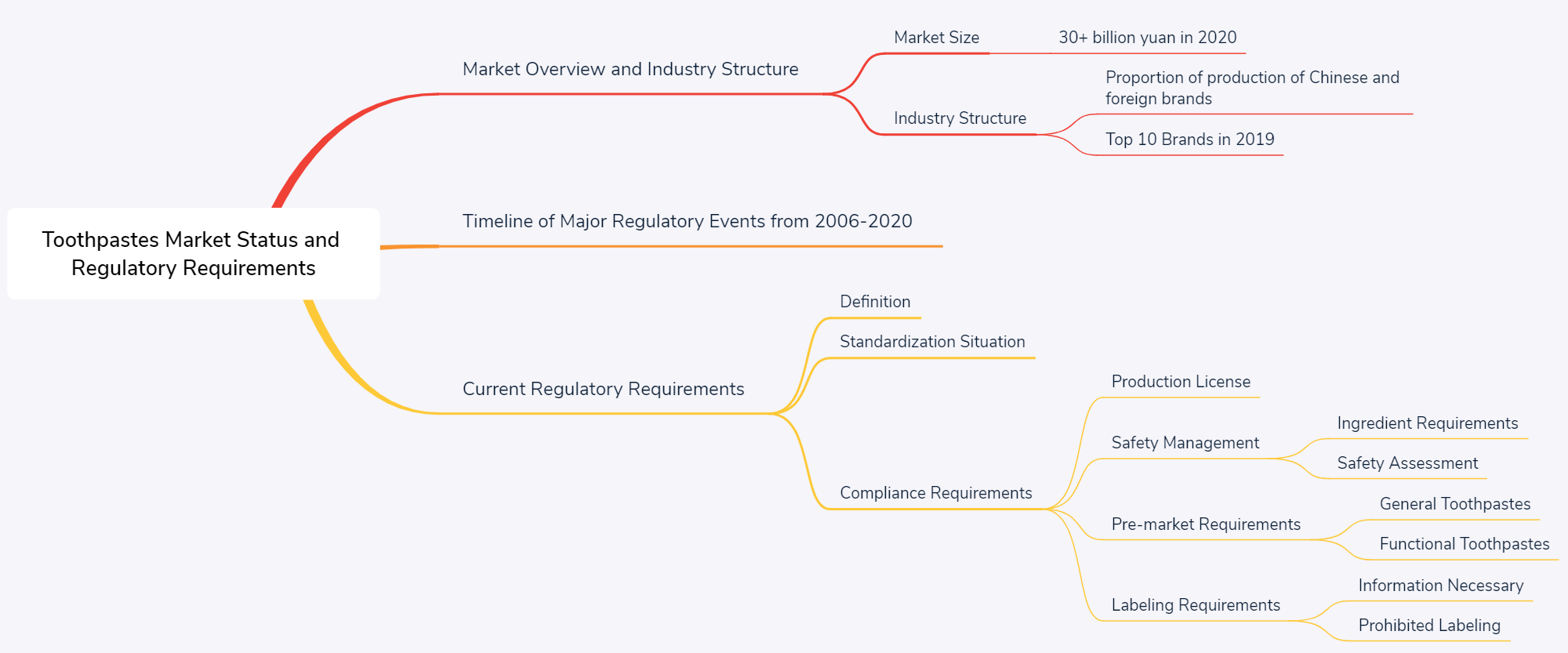
Toothpastes Market Overview and Industry Structure
1. Market Overview: Rising Demand for Toothpastes with the Increasing Oral Health Awareness in China
Compared to the previous year, the market size of Chinese toothpastes increased by 6.2% to 29.1 billion yuan in 2019, expecting to exceed 30 billion yuan in 2020 [1].

Source: 2019-2025 China's Toothpastes Industry Special Survey and Development Trend Analysis Report
2. Industry Structure
In terms of the toothpastes industry's overall structure, in 2018, local Chinese brands accounted for the highest proportion of the output, foreign brand products accounted for the second.

Source: Huaon
Multinational enterprises such as Procter & Gamble, Colgate, and Lion are optimistic about Chinese market and have established R&D centers, production bases, and sales platforms in China. Under the pressure of competition from foreign brands, local enterprises such as Yunnan Baiyao have invested a lot of capital in development. In 2019 industry statistics, Yunnan Baiyao ranked first among brands in the toothpastes industry in China.
Top 10 Brands in China’s Toothpastes Industry in 2019 | ||
No. | Brand | Enterprise |
1 | Yunnan Baiyao
| Yunnan Baiyao Group Co., Ltd. |
2 | Darlie
| Hawley & Hazel Chemical (Zhongshan) Co., Ltd. |
3 | Colgate
| Colgate Palmolive (China) Co., Ltd. |
4 | Crest
| Procter & Gamble (China) Co., Ltd. |
5 | Zhong Hua
| Unilever (China) Investment Co., Ltd. |
6 | Sensodyne
| GlaxoSmithKline (China) Investment Co., Ltd. |
7 | Lion
| Lion Daily Chemical (Qingdao) Co., Ltd |
8 | Oral-B
| Procter & Gamble (China) Co., Ltd. |
9 | Saky
| Guangzhou Weimeizi Industrial Co., Ltd. |
10 | Ora2
| Sunstar International Trade (Shanghai) Co., Ltd. |










Source: AskCI
Timeline of Major Regulatory Events for Toothpastes
Before 2006: Production license is not required for toothpastes.
In August 2006: The former General Administration of Quality Supervision promulgated the “Implementation Rules for Toothpastes Product Production License." According to this document, toothpastes shall be produced after obtaining a production license and shall label the QS (Quality Safety) mark. Only toothpastes producers with an annual output of more than 2,000 tons are eligible for the production license.
In 2010: China Oral Care Industry Association (COCIA) was established, and a complete standardization system was established from the procurement of the ingredients to the marketed product labeling.
In June 2011: The toothpastes production was included in the list of the restricted industries, and no production license would be issued.
In 2015: The draft for approval of CSAR classified toothpastes and other oral care products as cosmetics, but the specific management methods are not clear.
In January 2016: The former CFDA implemented the Practice for Cosmetics Production Licensing, regulating toothpastes as an independent unit of cosmetics to implement production license management. Toothpastes shall refer to the cosmetic management requirements and obtain a production license issued by the provincial FDA (now provincial MPA).
In October 2019: toothpastes was removed from the restricted industries' list, and the restriction on the production license was canceled.
In June 2020: The final CSAR stipulated that toothpastes does not belong to cosmetics, but shall be managed with reference to the general cosmetics provisions.
In July 2020: COCIA released an announcement to collect all the ingredients used in toothpastes that has been on the market in China before July 31, 2020. A list of Existing Toothpastes Ingredients in China will be formulated later.
In the second half of 2020: Administrative Measures for Toothpastes will be issued, which will clarify pre-market requirements for toothpastes, requirements for toothpastes ingredients, toothpastes efficacy claims, etc.
Current Regulatory Requirements
1. Definition
According to GB/T 8372-2017 Toothpastes, toothpastes refer to the paste materials formed by mixing main ingredients including abrasives, humectants, thickeners, foaming agents, fragrance compound, water, and other additives (containing functional ingredients used for improving oral health).
2. Standardization Situation
There are 19 national standards, 52 industrial standards, and 3 group standards for oral care and cleansing products. According to Sun Dongfang, the deputy director of COCIA, the standard for herbal toothpastes is under formulation.
Type | Number | Details | Example |
National Standard | 19 | For product: 2 |
|
Relate to method: 14 |
| ||
For basic management: 3 |
| ||
Industry Standard | 52 | For product: 25 |
|
Relate to method: 27 |
| ||
Group Standard | 3 | For the product: 2 |
|
Relate to method: 1 |
|
3. Compliance Requirements
1) Production License
In January 2016, the former CFDA promulgated the Practice for Cosmetics Production Licensing, regulating toothpastes as an independent unit of cosmetics to implement production license management. Toothpastes shall refer to the cosmetic management requirements and obtain a production license issued by the provincial FDA (now provincial MPA).
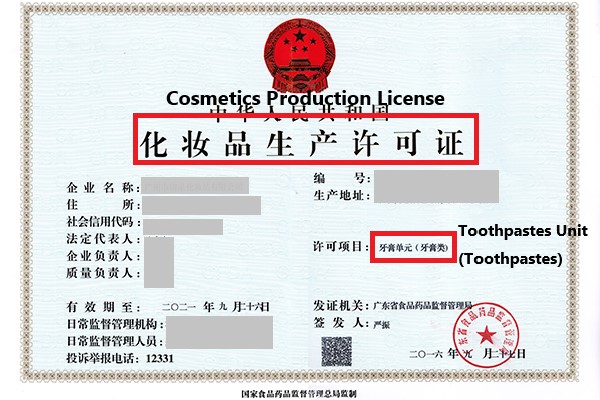
Toothpastes Production License (source: internet)
2) Safety Management
Ingredients used in toothpastes shall meet the requirements in GB 22115-2008 General Requirements on Raw Materials of Toothpastes.
Prohibited Ingredients | 1466 Including benzene, benzidine sulphate, carbon monoxide, chlorine, etc. |
Restricted Ingredients | 39 Including aluminum fluoride, ammonia, calcium fluoride, sodium nitrite, stannous fluoride, etc. |
Permitted Preservatives | 48 Including chlorobutanol, 2-chloroacetamide, formaldehyde and paraformaldehyde, sodium iodate, etc. |
Permitted Colorants | 102 Including CI 11920, CI 12490, CI 13015, CI 14270, CI 14700, etc. |
Each ingredient used should be conducted a safety assessment. To assess toothpastes ingredients' safety, stakeholders should first consider its hygiene, sensory and physicochemical indicators, and then follow the four steps of hazard identification, dose-response assessment, exposure assessment, and risk characterization.
Hygiene Indicators | ||
Hygiene Indicators | Requirements | |
Total numbers of the colony / (CFU/g) | ≤ 500 | |
Molds and yeasts / (CFU/g) | ≤ 100 | |
Thermotolerant coliform bacteria / g | No detection | |
Pseudomonas aeruginosa / g | No detection | |
Staphylococcus aureus / g | No detection | |
Lead (Pb) content / (mg/kg) | ≤ 10 | |
Arsenic (As) content / (mg/kg) | ≤ 2 | |
Sensory and Physicochemical Indicators | ||
Items | Requirements | |
Sensory Indicator | Paste | Uniform, without foreign matter |
Physicochemical Indicators | pH | 5.5a-10.5 |
Stability | The paste does not overflow out of the nozzle, does not separate the liquid, and the flavor and color are normal | |
Superhard particles | No scratches on the slide | |
Soluble fluorine or free fluorine contentb (the lower limit only applies to anticarious fluoride toothpastes) / % | 0.05-0.15 (applying to fluoride toothpastes) 0.05-0.11 (applying to children fluoride toothpastes) | |
Total fluorine content (the lower limit only applies to anticarious fluoride toothpastes) / % | 0.05-0.15 (applying to fluoride toothpastes) 0.05-0.11 (applying to children fluoride toothpastes) | |
Note: a For toothpastes with a pH lower than 5.5, the responsible party of the product shall provide two testing reports issued by qualified third-party organizations on the safety assessment of dental hard tissues (including tooth enamel and dentine) according to standard methods. The testing conclusions of the reports shall both meet the safety requirements of the standard methods. At least one of the reports shall be issued by the dental research institutes (school of stomatology, the provincial dental research institute) or the dental medical institutes (the tertiary dental specialty hospital, the dental department of a general hospital). b For the fluoride toothpastes which contains sodium monofluorophosphate or combination of sodium monofluorophosphate and sodium fluoride (stannous fluoride, ammonium fluoride), the detection method of soluble fluorine applies; for the fluoride toothpastes made with sodium fluoride or (stannous fluoride, ammonium fluoride) as the ingredient, the detection method of free fluorine applies; if the fluoride used is not sodium monofluorophosphate, sodium fluoride, stannous fluoride, or ammonium fluoride, the applicability of the detection method shall be discussed. | ||
The overall safety assessment of the toothpastes should also combine with the partial safety data of the finished product [2], including but not limited to past formulation experience, adverse reaction statistics of marketed products, epidemiological survey data, clinical data of the product, tests on the safety of oral soft tissues, tests on the safety of teeth/hard tissues, such as the relative dental abrasivity, RDA/Profilometry. Specific requirements can refer to Administrative Measures for Safety Assessment of Oral Care and Cleansing Products and Guideline for Safety Assessment of Oral Care and Cleansing Products.
3) Pre-market requirements
Toothpastes are classified into two categories, general toothpastes, and functional toothpastes. At present, the Chinese government does not implement registration or filing management for toothpastes. Products can enter the market as long as they comply with relevant national and industry standards.
Category | Scope | Current Pre-market requirements |
General toothpastes | Toothpastes only has the basic functions: cleaning the oral cavity, reducing teeth stains, reducing soft dirt, whitening teeth, reducing dental plaque, bringing fresh breath, refreshing taste, maintaining the health of teeth and periodontal tissue (including gingiva), and maintaining oral health. |
|
Functional Toothpastes |
|
*For toothpastes in which fluoride acts as the functional ingredient preventing caries, the clinical evaluation of caries prevention is not indispensable. * Toothpastes claiming the same efficacy, using the same functional ingredients, and the concentration is no less than the verified products, no further efficacy evaluation is required. |
The CSAR promulgated on June 29 stipulates that toothpastes will be managed with reference to the general cosmetics provisions. After toothpastes notification applicants conduct the efficacy evaluation in accordance with national standards and industry standards, they can claim that the toothpastes has efficacy such as anti-caries, plaque inhibition, anti-dentine hypersensitivity, and relieve gingiva problems, etc. The specific notification requirements remain to be seen until the release of Administrative Measures on Toothpastes.
4) Labeling Requirements
Information Necessary for Oral Care and Cleansing Products Labeling [3] |
Product name |
Manufacturer name and address (For imported products, country or region of origin and agent, importer or distributor’s name and address) |
Net content |
Ingredient list |
Manufacturing date and shelf life or batch number and expiry date |
Standard number |
Warnings |
Storage condition (if necessary) |
Product user manual (if necessary) |
Note:
|
Oral care and cleansing products are prohibited from labeling or claiming the following content:
Medical terms
False, exaggerated, misleading or confusing claims
Feudal superstition and violation of public order and good customs
Absolute terms
Claims prohibited by other laws, regulations, and national standards.
Toothpastes that has not been verified by efficacy evaluation shall not be marked with efficacy on the product label.
 We provide full-scale global cosmetic market entry services (including cosmetic registering & filing, regulatory consultation, customized training, market research, branding strategy). Please contact us to discuss how we can help you by