Request a Demo
On May 21, 2025, EU submitted a draft regulation to the WTO, proposing revisions to four ingredient lists of Regulation (EC) No 1223/2009 (Cosmetics Regulation). The draft is open for public comments until July 20, 2025, and expected to enter into force on May 1, 2026.1
This initiative follows the EU's adoption of Commission Delegated Regulation (EU) 2024/2564 in September 2024, which introduced harmonized classification and labelling for certain substances, including those newly classified as CMR substances (those classified as carcinogenic, mutagenic or toxic for reproduction). To align the Cosmetics Regulation with these updates, EU has prepared the current draft to ensure uniform enforcement of CMR prohibitions across the internal market, and to formally permit the continued use of certain CMR substances where safety has been demonstrated.
Outlined below are the proposed changes introduced in the draft, with revisions from the existing lists highlighted in red:
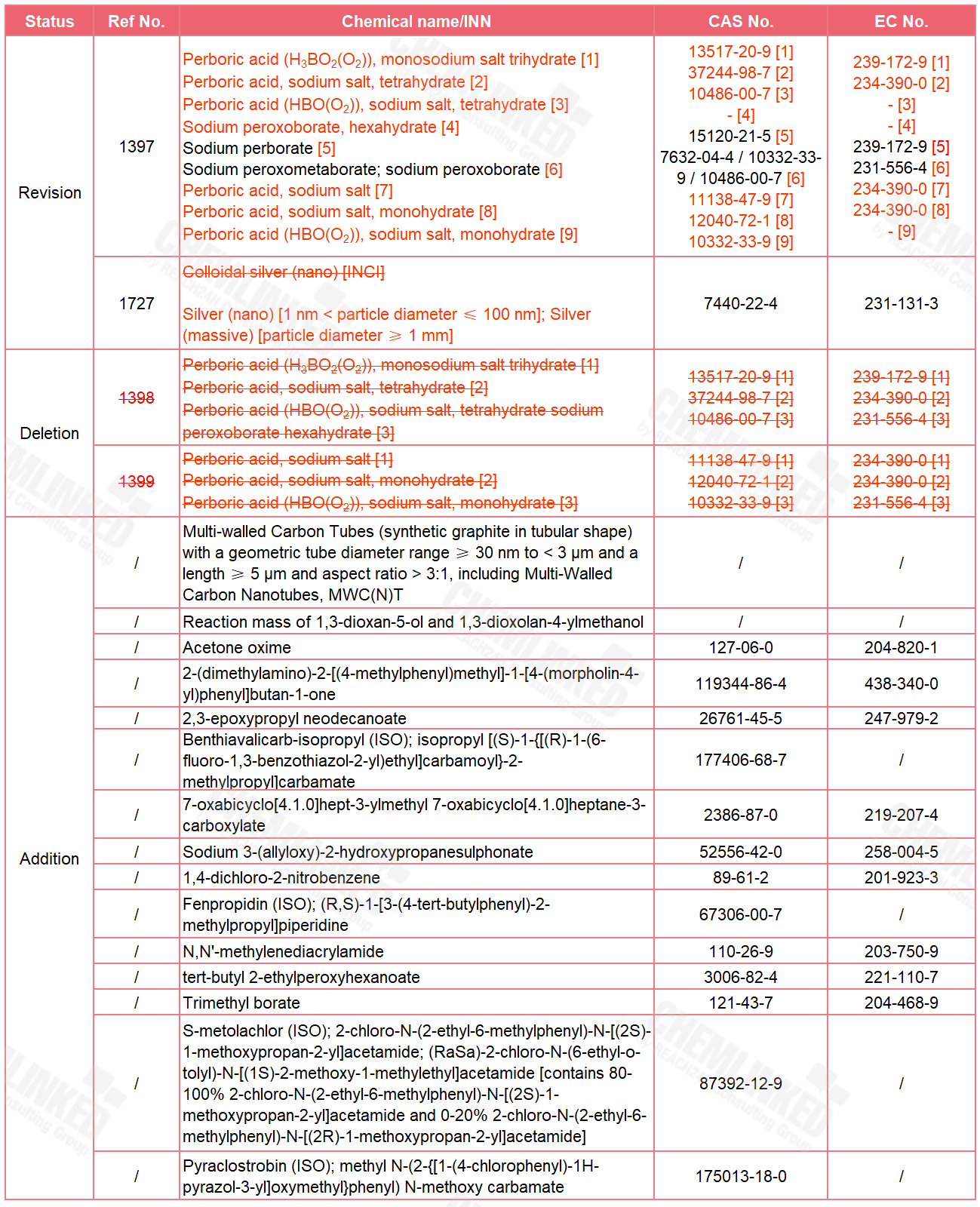
1. List of Prohibited Ingredients: 2 revised, 2 deleted, and 15 added
Perboric acid and its salts, which have been classified as CMR substances of category 1B, are currently listed under entries 1397, 1398, and 1399 of the prohibited ingredients list. As these entries cover structurally related perborate derivatives with similar health risks, EU plans to merge entries 1398 and 1399 into 1397, and delete the former two.
Silver is currently listed as authorized colorant in cosmetics, while its colloidal nanoform (1-100 nm) is prohibited. Under Commission Delegated Regulation (EU) 2024/2564, silver in its massive (≥1 mm), powder (>100 nm to<1 mm), and nano (1-100 nm) forms has been newly classified as a category 2 CMR substance. In response, the industry submitted an exemption request to the Scientific Committee on Consumer Safety (SCCS) for micron-sized particulate silver (silver powder), and the committee concluded in July 2024 that this form is safe for use under specific conditions. Based on these developments, EU intends to amend the prohibited ingredients list to include silver massive and silver nano.
Alongside the above revisions, EU proposes adding 15 newly classified CMR substances to the prohibited ingredients list. These substances are not yet regulated in the list, and have not been the subject of any exemption requests.
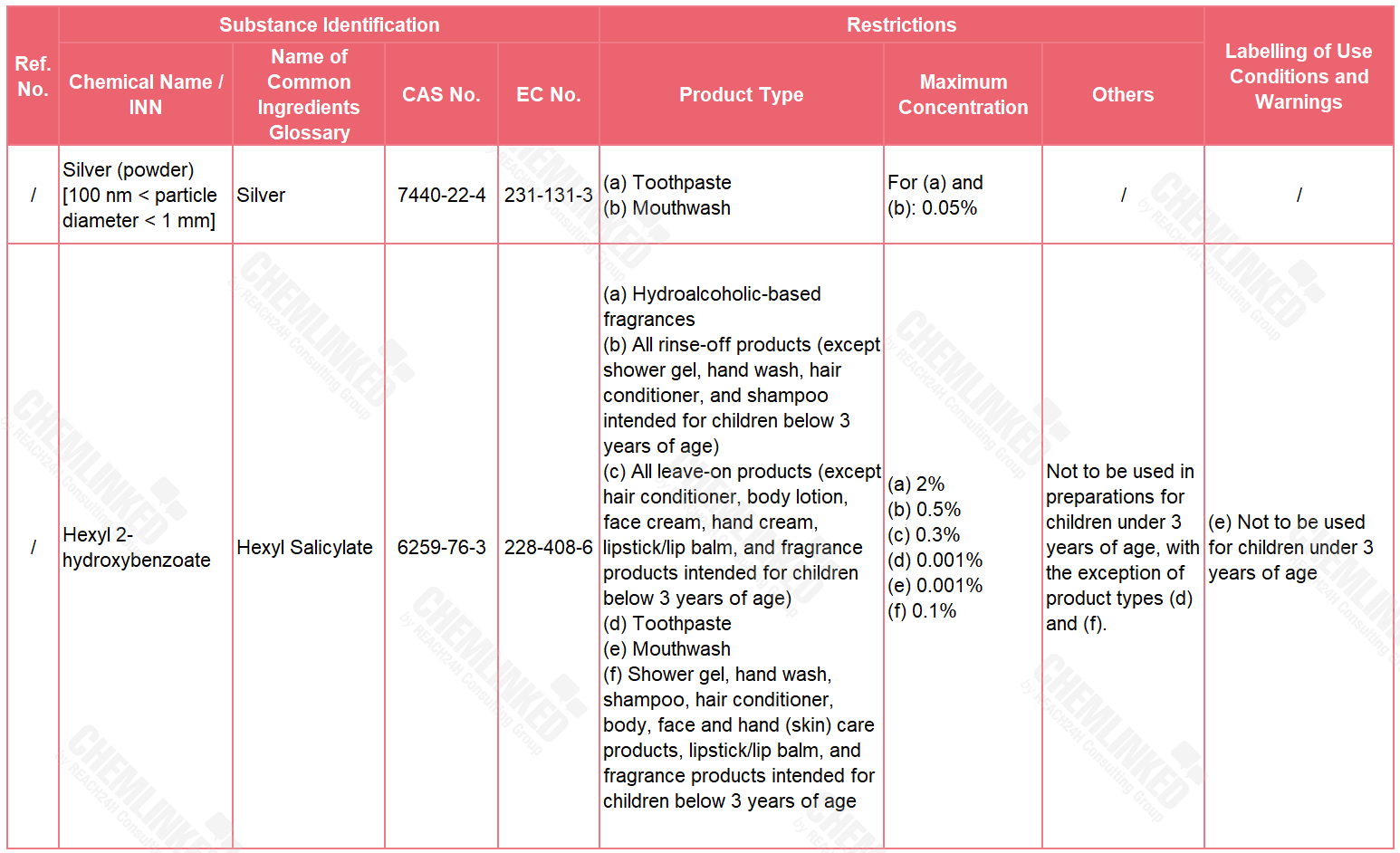
2. List of Restricted Ingredients: 2 added
Hexyl salicylate was classified as a category 2 CMR substance by Commission Delegated Regulation (EU) 2024/2564. To support its continued use in cosmetics, SCCS assessed its safety upon industry request, and confirmed in October 2024 that the substance is safe for use under specific conditions.
Taking into account this opinion and the one on micron-sized particulate silver mentioned earlier, EU intends to include both substances into the restricted ingredients list.
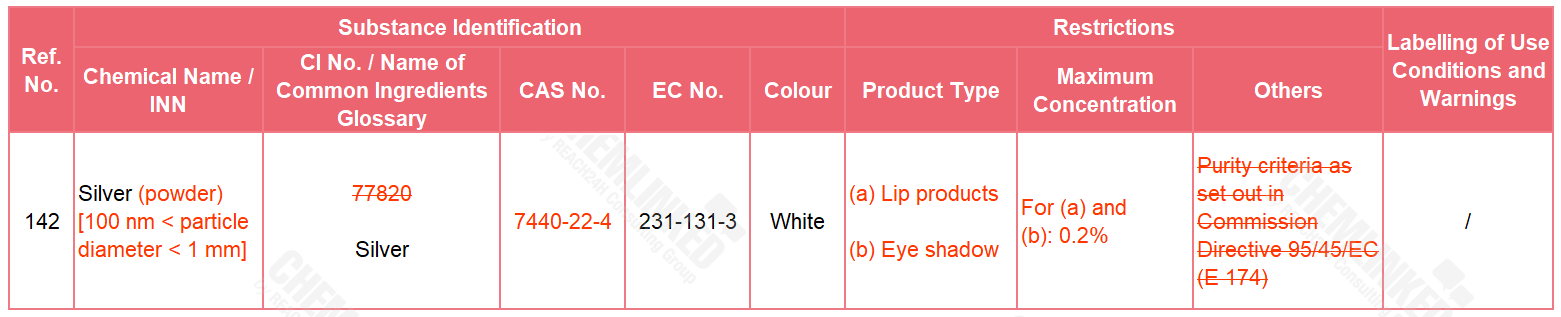
3. List of Permitted Colorants: 1 revised
As previously stated, silver is authorized for use as a colorant in cosmetics. Considering the new classification of silver and the SCCS's safety opinion on micron-sized silver, EU plans to revise the permitted use conditions for its use as a colorant accordingly.
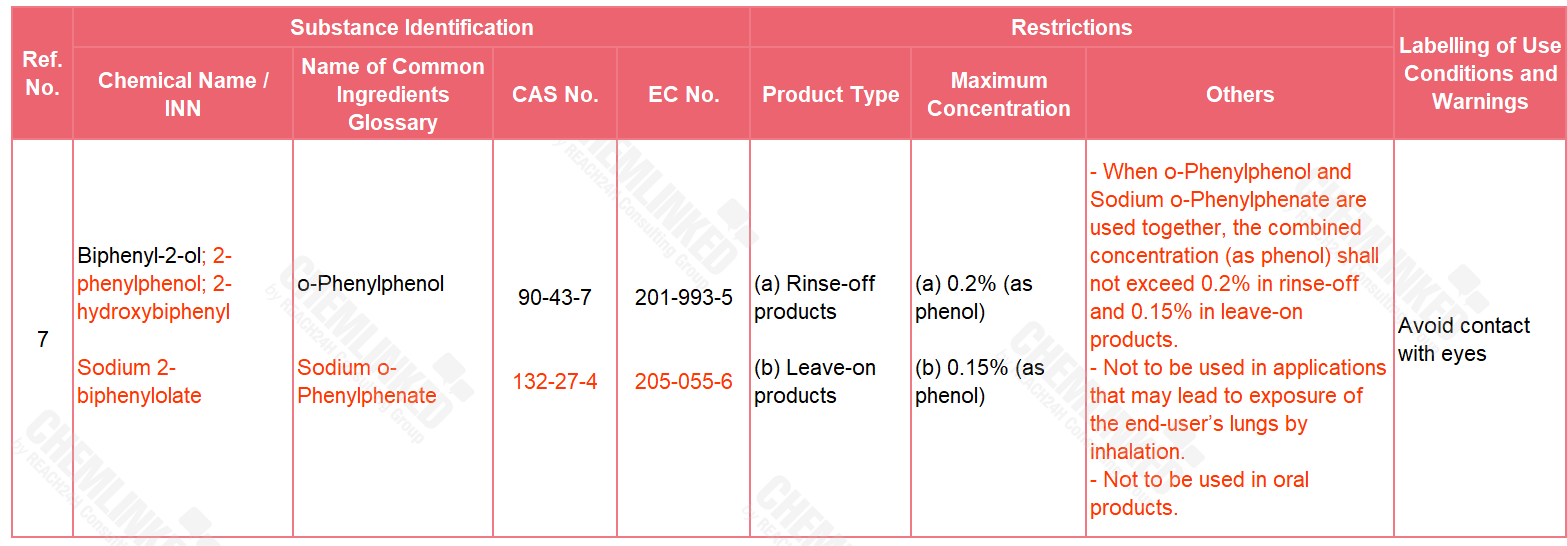
4. List of Permitted Preservatives: 1 revised
O-Phenylphenol, currently permitted as a preservative in cosmetics, was classified as a category 2 CMR substance under Commission Delegated Regulation (EU) 2024/2564. Following an exemption request submitted by the cosmetics industry for both O-Phenylphenol and its sodium salt, SCCS issued an opinion in October 2024, confirming that both substances are safe under specific conditions. In light of this, EU intends to revise the permitted preservatives list to include these updates.
Further Reading
EU Updates Cosmetic Ingredient Lists to Address Newly Classified CMR Substances
EU Proposes Updates to the Glossary of Common Ingredient Names
EU SCCS Finalizes Opinions on Three Cosmetic Ingredients Concerning Children Exposure

 We provide full-scale global cosmetic market entry services (including cosmetic registering & filing, regulatory consultation, customized training, market research, branding strategy). Please contact us to discuss how we can help you by