Request a Demo
China Cosmetic Supervision and Administration Regulation was officially implemented on January 1, 2021. A series of subsidiary regulations have been released continuously, making more scientific and rigorous adjustments to all aspects of the cosmetic industry.
The new regulations introduced the concept of “registrant/notifier", the entity that obtains the registration / notification certificate. The registrant/notifier shall set up a person in charge of quality and safety, establish a production quality management system, put the product on the market, and be responsible for the product's quality, safety, and efficacy claims.
However, the shortage of person in charge of quality and safety in China has plagued brands that entrust factories to produce cosmetics. In response to this problem, some brands choose to transfer the registration / notification right to factories that have been equipped with person in charge of quality and safety. The factories will apply for cosmetics registration/notification as the registrant/notifier instead of the brands.
This article discusses the reasons of the emergence of this approach, its specific steps, and whether it is compliant or not.
*The “brand” mentioned in this article refers to the brand that entrusts the factory to produce cosmetics.
1. Under the new regulations, why does the brand authorize the factory to register/notify cosmetics on its behalf?
There are two main reasons for the emergence of this approach:
For brand: the difficulty to recruit the person in charge of quality and safety who meets the qualification requirements;
For factory: the unwillingness to share the complete formula of the ODM product to the brand.
In Regard to Brands
The new regulations require registrant/notifier to be equipped with the person in charge of quality and safety with more than five years of experience. The high qualification requirement has deterred some brands.
Qualification Requirements "The person in charge of quality and safety shall have cosmetics, chemistry, chemical engineering, biology, medical science, pharmacy, food, public health or legal science and other cosmetic quality and safety-related professional and legal knowledge; and be familiar with relevant laws, regulations, rules, mandatory national standards, and technical practices; and have more than five years of experience in cosmetic production or quality management."
Source: Supervision and Administration Measures on Cosmetics Manufacture and Operation |
In China, the current situation is that there are few qualified person in charge of quality and safety, and they are not allowed to concurrently serve in two or more companies, resulting in a huge talent gap. Some brands’ user permission applications in NMPA registration/notification system were rejected due to the lack of or unqualified person in charge of quality and safety. Without user permission, brands cannot apply for registration/notification on their own.
In Regard to Factories
Another significant change in the new regulations is that when applying for cosmetics notification, the notifier needs to submit detailed formula, including the serial number, name, content, use purpose, supplier’s information of all the ingredients and compounding material’s content and ratio.
This new requirement has led to an embarrassing situation. If the brands apply for registration/notification, the factories need to provide them with a detailed formula. Factories worry that once the detailed formula is disclosed, the processing cost of the product and the formula system will also be open and transparent. 1
"Product detailed formula is the lifeblood of the processing factory," a person in charge of a factory said. Once the detailed formula is provided to the brand, the factory will lose its competitive advantage.
2. How to authorize the factory to register/notify cosmetics on the brand’s behalf?
Based on the above two problems faced by the brand and the factory, there has been a phenomenon that the brand authorizes the factory to do the registration/notification, mainly in three steps. 2
Step 1: The brand transfers the registration/notification right of a specific cosmetics to the entrusted factory through a contract. The two parties agree that the specific cosmetics produced by the factory can only be exclusively distributed by the brand (specific rights and obligations should be clarified in the contract);
Step 2: Based on the registration/notification right assigned by the brand, the entrusted factory shall register/notify specific cosmetics in its name. If the brand and the entrusted factory are both overseas enterprises, the entrusted factory need to designate a responsible person in China to handle the registration/notification work;
Step 3: The entrusted factory sells the finished cosmetics to the brand through a sales contract, and then the brand is responsible for product marketing in China.
3. Is it compliant to authorize the factory to register/notify cosmetics?
No Clear Answer from Officials
Some companies have consulted Guangdong Medical Products Administration (MPA) on this issue but didn’t receive a direct answer. 3
Question: If a cosmetic brand chooses not to be the registrant or notifier but appoints the entrusted factory to be the registrant or notifier, is the brand allowed not to set up a person in charge of quality and safety?
Guangdong MPA: Article 32 of Cosmetic Supervision and Administration Regulation clearly states: "Cosmetics registrants, notifiers and entrusted production enterprises shall have the person in charge of quality and safety to undertake corresponding product quality and safety management and product release duties. The person in charge of quality and safety shall have professional knowledge related to the quality and safety of cosmetics and more than five years of work experience in cosmetic production or quality and safety management." Parties excluding cosmetics registrants, notifiers, and entrusted manufacturers can choose whether to set up the person in charge of quality and safety according to their management needs. |
It is worth noting that the second draft Good Manufacturing Practices for Cosmetics issued on Sep. 9, 2021 stated that in the case of entrusted production, the entrusting party (brand) should be the registrant or notifier. Thus, the approach of authorizing entrusted factory as the registrant/notifier may pose regulatory risks.
Two Industry Opinions
There are divergent opinions in the industry on whether this approach is compliant, which can be summarized into two types:
This approach is compliant and may become a common phenomenon in the future;
It is a short-term transition approach that violates the spirit of the new regulations. Risks may emerge for both the brand and the factory.
Opinion 1: This approach is compliant and may become a common phenomenon in the future.
Cosmetic factory COSMAX believes that this approach is compliant and does not have any legal risks. 4 By the end of August, NMPA has publicized 543 domestic general cosmetics information of which the notifier is COSMAX.
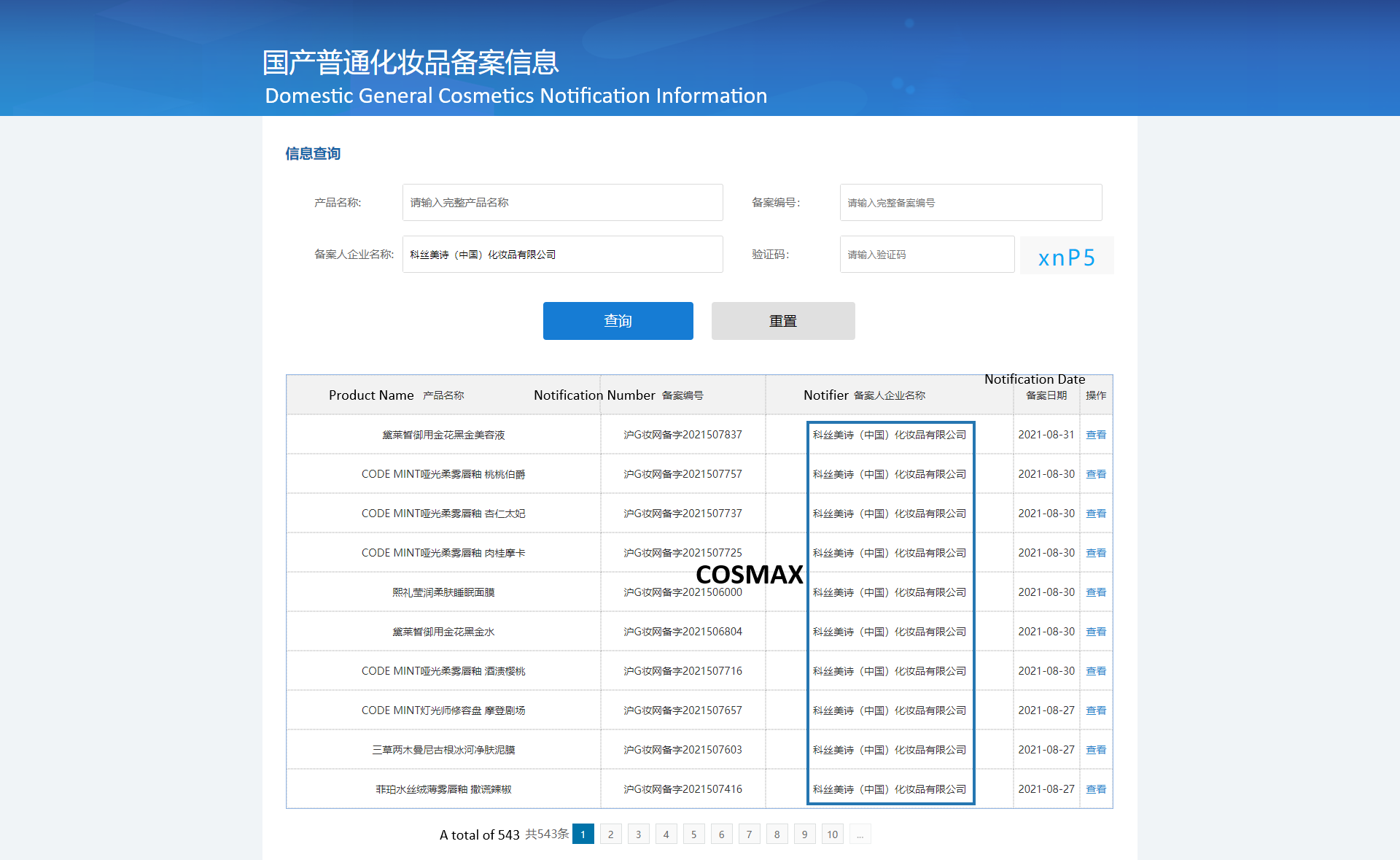 Image 1: General Cosmetics Information Notified by COSMAX
Source: Cosmetics Notification Information Disclosure Platform of NMPA
Another industry insider analyzes that due to the difficulty for brands to recruit a person in charge of quality and safety, and the factory’s unwillingness to share detailed formula, authorizing the factory as a registrant/notifier may become a common phenomenon in the future. 5
Intercos reminds stakeholders that to avoid risks, the authorization contract signed when transferring registration/notification rights should clearly define the responsibilities of both parties. For example, product quality and safety responsibilities are borne by the factory, and the brand bears the responsibilities related to marketing and advertising. 6
Opinion 2: It is a short-term transition approach that violates the spirit of the new regulations. Risks may emerge for both brand and factory.
The second view in the industry is that this approach is reasonable in the short term, which can be a transition for the brand without quality and safety personnel, and alleviate the factory’s worries about formula disclosure. But in essence, this approach is inconsistent with the spirit of the new regulations. 7
In recent years, consumer complaints about cosmetic quality is increasing. Through the regulatory reform, China NMPA intends to improve the regulatory level of cosmetics quality and the industry’s entry barriers, emphasizing the brands' main responsibility so that they can have a stronger awareness of quality and safety management.
However, if the brand authorizes the factory to undertake the registration/notification work, the factory becomes the first party responsible for product quality and safety, which increases management burdens for the factory but reduces the brand’s responsibility. This is contrary to the governance philosophy of NMPA.
In addition, this approach has some other risks for both factory and brand:
Usually, a factory helps more than one cosmetic brand in registration/notification. If one of the brands violates regulations during the sales process, the registrant/notifier (factory) faces penalties such as warning, fines, production suspension, then may affect the production cycle of other clients’ orders;
For brands, although this approach is convenient and fast, it may affect the brand's dominant position in product R&D to a certain extent, which is not conducive to building brand culture and product innovation.
NMPA's supervision of cosmetics quality will become more and more stringent. Brands should conform to the spirit of the new regulations and build a standardized product quality management system as early as possible to gain a long-term foothold in the industry.

 We provide full-scale global cosmetic market entry services (including cosmetic registering & filing, regulatory consultation, customized training, market research, branding strategy). Please contact us to discuss how we can help you by