Request a Demo
Since the enforcement of the Cosmetic Supervision and Administration Regulation (CSAR) in 2021, the China National Medical Products Administration (NMPA) has implemented a risk-based classification system for new cosmetic ingredients (NCIs). High-risk NCIs, such as preservatives and UV filters, are subject to a registration process, which involves complex application procedures, stringent approval criteria, and relatively long review period. Low-risk NCIs, on the other hand, only require notification, allowing them to enter the market once companies complete the online dossier submission. This dual-track approach lowers the entry threshold for lower-risk ingredients while maintaining strict oversight of higher-risk ones.
Based on publicly available data from NMPA's query platform, this article provides a review and analysis of NCI notifications and registrations for 2024.
90 NCIs Notified
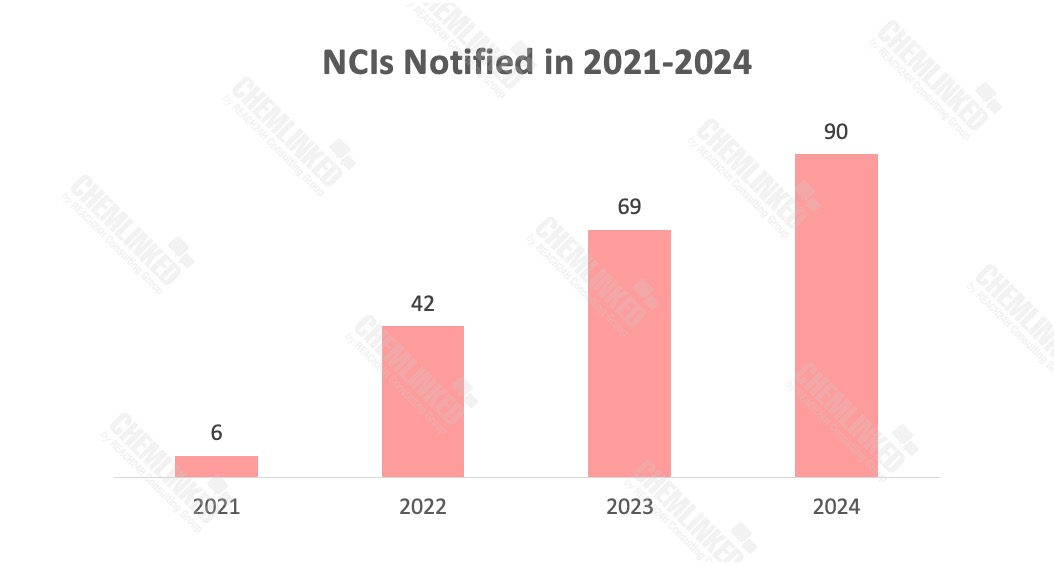
Between 2021 and 2024, China recorded a total of 207 NCI notifications (including those later cancelled or withdrawn), demonstrating a consistent upward trend. In 2024, a new record was set with 90 NCIs notified, marking a 30.4% year-on-year increase. These figures highlight the ongoing innovation and dynamism in NCI research and development within China's cosmetics industry.
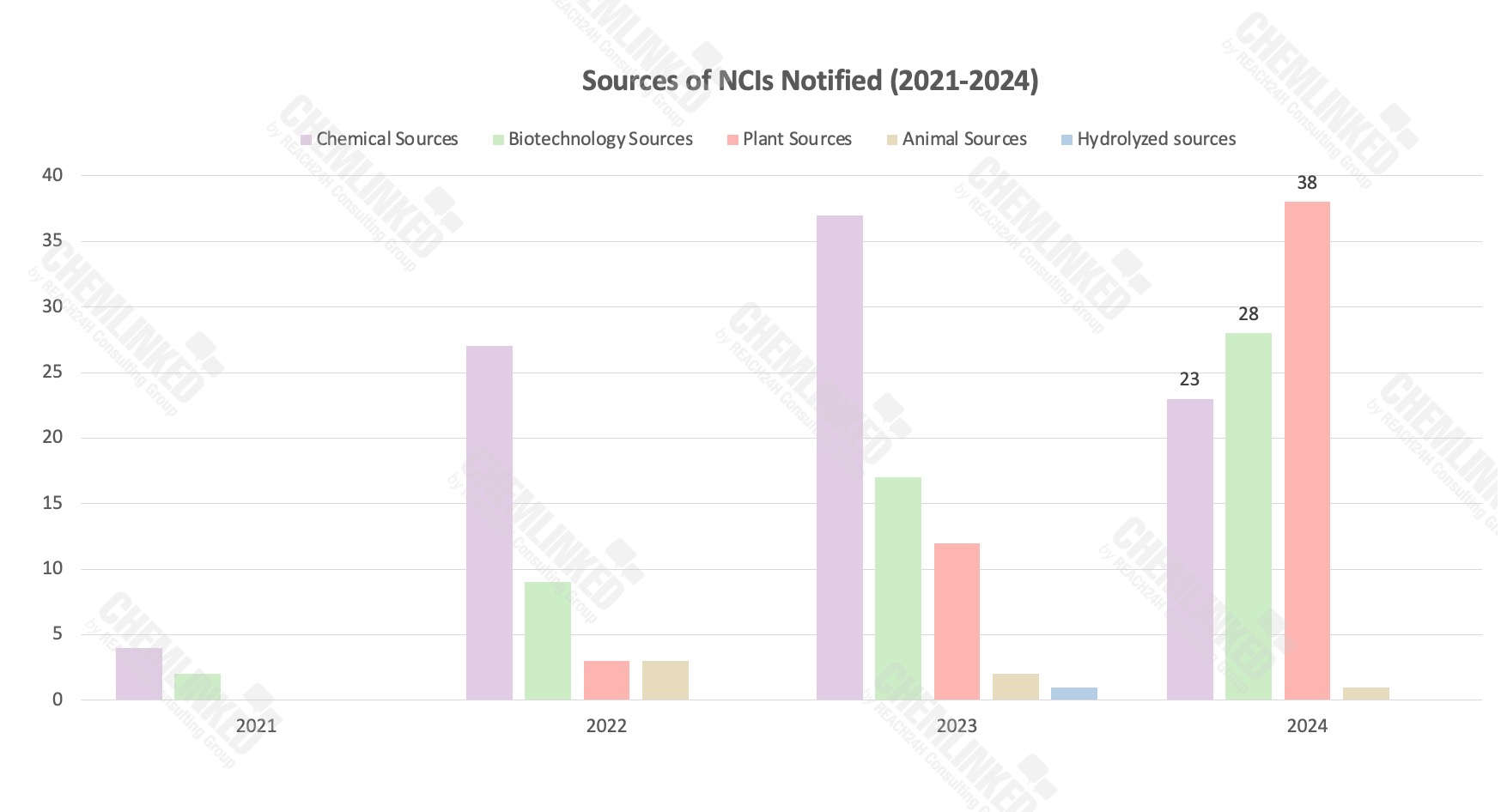
A notable trend observed in 2024 is the increasing proportion of plant-derived ingredients among the notified NCIs. Of the 90 new notifications, 38 were plant-derived, accounting for approximately 42% of the total.
This reflects the industry’s rising interest in natural and sustainable ingredients, driven by consumer demand for clean beauty and environmentally friendly formulations. Plant-derived ingredients not only align with market preferences but also offer advantages in terms of safety and efficacy, further contributing to their growing popularity in both the cosmetic industry and among consumers. As extraction technologies improve, these ingredients are becoming more competitive, surpassing other ingredient types in notification volume for the first time.
In terms of notifiers, Chinese domestic companies dominated, submitting 78 out of the 90 notifications, occupying 86.7%, while 12 notifications came from overseas companies, making up 13.3%.
The full list of NCIs notified in 2024 can be found below. At present, none of these NCIs have published technical details.
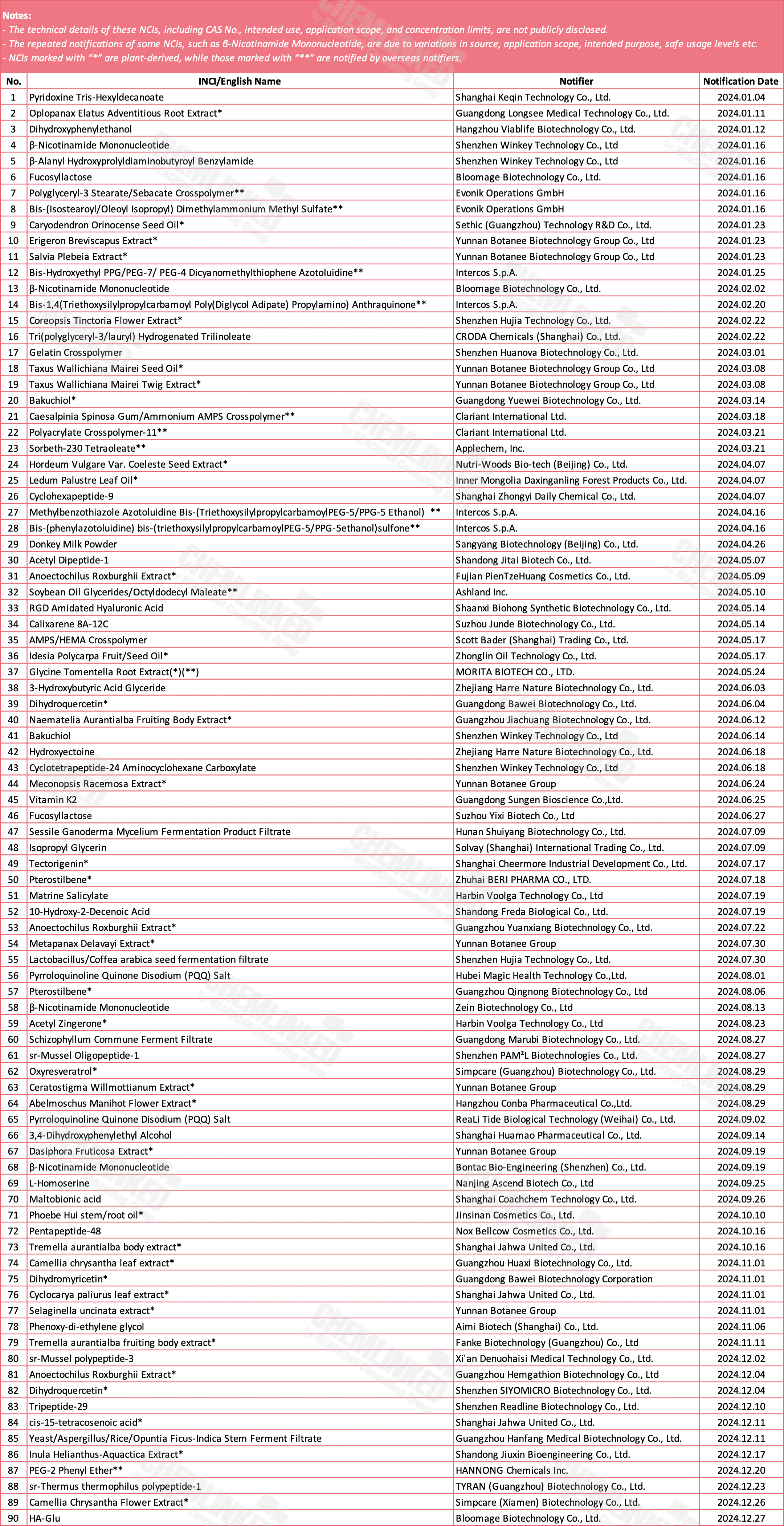 All Notified NCIs in 2024
13 NCIs Cancelled or Withdrawn
Despite the record-high notifications, 2024 also witnessed the first instances of notifications being cancelled or withdrawn. A total of 13 NCIs were affected: 7 had their notifications cancelled by regulatory authorities, and 6 were voluntarily withdrawn by the notifiers.
It is important to distinguish between "Notification Cancellation" and "Notification Withdrawal." Cancellation is an administrative action initiated by regulatory authorities due to non-compliance or other administrative reasons, whereas withdrawal is a voluntary decision made by the notifier. The reasons behind cancellations and withdrawals vary, but both can have significant financial and operational impacts on the applicant company and downstream stakeholders relying on the affected ingredients. To mitigate these risks, companies shall approach the NCI notification process with caution, ensuring that all submission materials are complete and accurate.
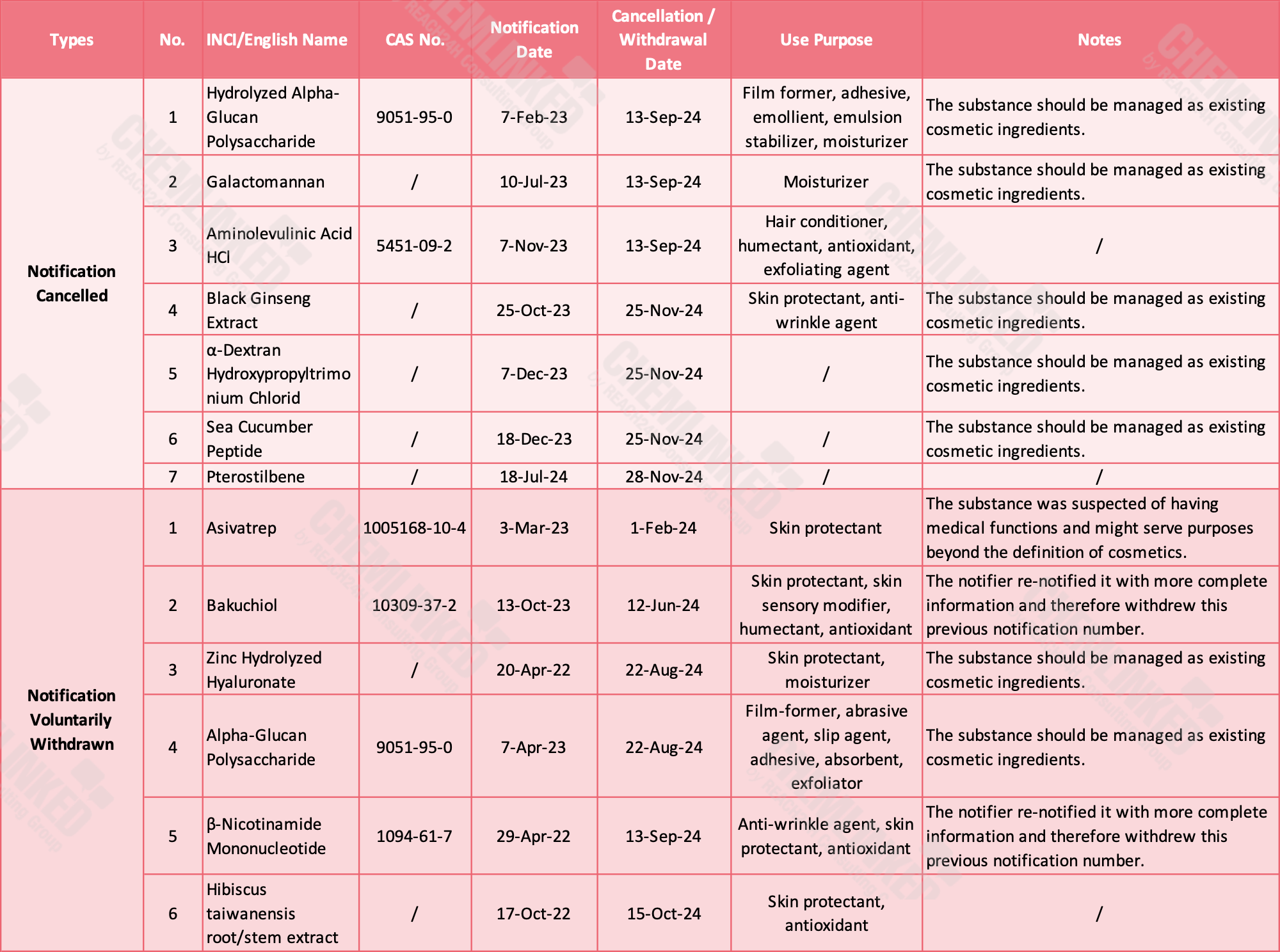 Cancelled/Withdrawn NCIs in 2024
One NCI Approved for Registration
In addition to increased notifications, 2024 saw a major regulatory milestone: the approval of the first high-risk NCI registration under the CSAR framework.
On November 4, 2024, the NMPA granted registration for Isobutylamido Thiazolyl Resorcinol (Thiamidol 630), an innovative whitening ingredient developed by Beiersdorf Group. This ingredient is approved for use in leave-on cosmetics, excluding products with potential inhalation risks.
This approval is particularly significant because Thiamidol 630 is the first high-risk cosmetic ingredient approved under CSAR since its implementation in 2021. It is also only the second whitening ingredient approved in China in the past 12 years. The successful registration of Thiamidol 630 demonstrates that, while stringent, the pathway for high-risk NCI approvals under CSAR is achievable. This case sets a precedent for future ingredient registrations in China.
For further insights, see: The First Approved Whitening Ingredient Under CSAR: A Milestone for China’s NCI Registration.

 We provide full-scale global cosmetic market entry services (including cosmetic registering & filing, regulatory consultation, customized training, market research, branding strategy). Please contact us to discuss how we can help you by