Request a Demo
Key terms:
Color fastness: Refers to the color’s resistance to fading or the weakening of hair dyes.
Abbreviations in this article include the following:
GB: Refers to the Chinese National Standards (issued by the Standardization Administration of China).
GB/T: Recommended Chinese National Standards.
QB/T: Recommended Light Industrial Standards.
SN/T: Recommended Industrial Standard of Commodity Inspection
CCGF, while not a standard, is a regulatory document that provides a reference for local departments to conduct provincial sampling inspections.
It’s an important to note that recommended standards do not mean non-standard. Manufacturers, importers and distributors are still required to comply with specific requirements.
Cosmetic Inspection Results of H1 2020
ChemLinked sorted out the inspection data published on NMPA’s official website in the first half of 2020, finding that a total of 108 batches of cosmetics have failed NMPA or provincial MPAs’ random inspections due to compliance problems. The range of products cover masks, skin care, sunscreens and hair dyes with hair dyes having the largest unqualified rate of about 53%.
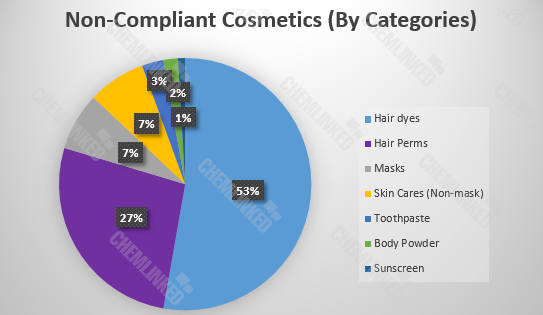
Reasons for inspection failures include the inconsistencies between the detected and labeled ingredients, ambiguous/missing labeling information, excessive addition of hair dyes, and expired registration certificate. Details are as follows:

Cause Analysis
The primary issue with hair dye products was that the ingredients claimed on the label or approved certificates did not correspond to the actual merchandise. The most common reason for the issue seems to be that enterprises fail to update their registration certificate prior to the product formula being changed or modified. As Provisions for Application and Acceptance of Administrative Licensing for Cosmetics states: “Any change/reformulation of ingredients has the potential to impact cosmetic safety and other indexes requires submission of a new filing/registration application as a new product."
However, this process is very complicated and time-consuming. It can take enterprises up to 2 years to fully complete the re-application, during which various documents and reports need to be submitted in addition to conducting tests and reviews.
To paraphrase the President of CAFFCI “cosmetics industry is a fast-moving consumer goods industry with rapid formula adjustment, driven by economic interests, some enterprises gamble to market a new product using the registration certificate and label of a previously registered product.”
Compliance Requirements
1. Definition and Classification
In China, hair dyes refers to a kind of beauty cosmetics that can change hair color. According to the dyeing principle and color fastness, they are generally divided into oxidative hair dyes and non-oxidative hair dyes.
Classification | Dyeing Principle | Features | Sub-category | Management |
Oxidative hair dyes | The colorless dye intermediate, oxidizing agent and coupling agent enter the inside of hair, become a macromolecule dye that will be enclosed in the hair fibers to color the hair by the oxidation reaction. | It has strong adhesion and rich colors, such as hair dye cream, liquid, powder, foam, etc. | — | Special use cosmetics |
Non-oxidative hair dyes | Products change the color of hair by adhesion or complexation. No oxidation reaction occurs in the process. | It is for temporary modification, such as hair spray, hair dye shampoo and conditioner. | Rinse off immediately after use, the original hair color can’t be restored. | |
Rinse off immediately after use, the original hair color can be restored. | Non-special use cosmetics |
The former type, oxidative hair dyes, are one of the most common and important types which mainly appear as two dosages. One dosage contains a dyestuff intermediate such as phenylenediamines and aminophenols; the other dosage is an oxidizing agent, usually hydrogen peroxide, sodium perborate, urea peroxide.
Due to the frequent use of aniline compounds, the dye intermediates are highly irritating and toxic and may cause skin sensitization. As a result, these products are classified as special use cosmetics which are subjecting to stringent pre-market administrative approval. It is only allowed to be manufactured and sold after obtaining a registration certificate with the NMPA.
2. Regulatory Status
At present in China, these are the relevant administration regulations on hair dye products:
No | Type | Regulations |
1 | Overarching regulation | Regulations Concerning the Hygiene Supervision over Cosmetics 1989 |
2 | Ingredient requirements | |
3 | Labeling requirements | GB 5296.3-2008 Instruction for use of Consumer Products—General Labelling for Cosmetics |
4 | Industrial standard, technical requirements | |
5 | Testing requirements | |
6 | Sampling inspection requirements | CCGF 211.3-2008 Implementation Specifications for Quality Supervision and Random Inspection of Hair Dye Products |
3. Ingredient Management
According to the Safety and Technical Standards for Cosmetics 2015, the hair dye agents in China are regulated in the form of a positive list, which includes 75 kinds of oxidized and non-oxidized hair dyes. The use of these ingredients in hair dyeing products shall comply with the requirements proscribed in the list, including the variety, dosage, purity, impurities, and warnings. Notably, 75 hair dyes are prohibited from being used to dye eyebrows and eyelashes.
The frequently-used hair dyes agents are as follows: (Please refer to Cosme-list for the full list):
Ingredient Name | Maximum acceptable concentration for cosmetic use | |
Oxidative hair dyes | Non-oxidative hair dyes | |
p-Phenylenediamine | 2.0% | - |
p-aminophenol | 0.5% | - |
m-aminophenol | 1.0% | - |
resorcinol | 1.25% | - |
2-Methylresorcinol | 1.0% | 1.8% |
… | … | … |
4. Testing Management
Prior to the registration of imported hair dyes, enterprises shall entrust a testing agency to conduct technical tests and generate a qualified report with sufficient data to substantiate products' safety and efficacy. According to the Working Rules for Cosmetic Registration and Filing Testing promulgated in September 2019, the products claiming to be used for the purpose of hair dye shall be tested for the hair dyes contained in the declared product formula.
The required test items include:
Physical and chemical test items: Mercury, Lead, Arsenic, Cadmium, Hair dye agent |
Toxicological test items:
|
The sensory and physicochemical indicators of hair dyes are as follows:
Items | Requirements | |||||||
Oxidative hair dyes | Non-oxidative hair dyes | |||||||
Hair dye powder | Hair dye liquid | Hair dye cream | ||||||
Single dosage | Double dosage | |||||||
Powder-powder type | Powder-liquid type | |||||||
Sensory Indicators | Appearance | In accordance with the prescribed requirements | ||||||
Odor | In accordance with the prescribed odor type | |||||||
Physicochemical Indicators | Heat-resistant | — | Maintained for 6 h at (40±1)°C, no significant difference after returning to room temperature compared with the test before | |||||
Cold-resistant | — | Maintained for 24 h at (-8±2)°C, no significant difference after returning to room temperature compared with the test before | ||||||
pH | Dyes | 7.0-11.5 | 4.0-9.0 | 7.0-11.0 | 8.0-11.0 | 7.0-12.0 | 2.5-9.5 | |
Antioxidants | 8.0-12.0 | 2.0-5.0 | — | |||||
Antioxidant content | — | ≤12.0% | — | |||||
Dyeing ability | Dye hair to a visible color | |||||||
The determination of dyeing agents mainly adopts to 4 types:
High-performance liquid chromatography,
High-performance liquid chromatography-tandem mass spectrometry,
Gas chromatography-mass spectrometry, and
Capillary electrophoresis-indirect chemiluminescence method.
Among them, high-performance liquid chromatography is widely used in the analysis and determination of dying agents in hair dyes due to its high penetration rate of instrument, high sensitivity, and fast analysis speed. Additionally, the Safety and Technical Standards for Cosmetics 2015 also recommends 2 methods for determining the content of hair dyes. Testing Methods of Hair Colorants: p-Phenylenediamine and other 7 kinds of components and the Testing Methods of Hair Colorants: p-Phenylenediamine and Other 31 Kinds of Components.
5. Labeling Management
The necessary labeling information of hair dyes consists of product name, manufacturer and distributor’s name and address, country of origin, registration certificate number, ingredient list, net content, warnings, instruction and storage condition, etc.
Concerning necessary label warnings, the following content must be marked on their labels:
Hair dyes may cause a severe allergic reaction.
Read the instruction before use, and do as required.
This product is not for the use of people under the age of 16.
Not for the use of eyebrows or eyelashes.
If in eyes, rinse immediately.
Wear proper gloves when applied in professional use.
Please do not dye hairs in case of rash on the face or inflammation, allergy or wound of the scalp, or if the user has a history of adverse effects caused by hair dyes.
It is noteworthy that hair dyes with the addition of certain dying agents have to mark the existence of them on the label. For example, the label of the hair dye cosmetics with 1-napthol needs to have the information “Contains 1-napthol”.
6. Future Management
As stipulated in the final version of the CSAR, China will implement a new cosmetics regulatory framework from January 1, 2021.
Similar pre-approval requirements
The cosmetic ingredients and finished products will be subject to a risk-based approach that assigns differentiated priority to different cosmetics categories based on their inherent characteristics. For instance, high-risk ingredients or special cosmetics will be subject to registration, while low-risk ingredients or general cosmetics will only require the notification. Hair dyes will continue with a strict treatment, requiring registration with the authorities. The specific registration requirements may refer to the Administrative Measures on Cosmetic Registration (Draft for Comments).
Stringent post-market supervision
In comparison with the current regulations, supervision on cosmetics will be stepped up. The medical products administration departments may carry out special sampling Inspections for cosmetics reported or founded to have more issues in their daily supervisions and inspections.
Additionally, penalties for violations will be refined with the base fines being increased and the scope of punishment will be extended to include the responsible people of the illegal units in question.
In any of the following circumstances, the responsible people may face the punishment result of a lifetime ban from engaging in cosmetics production and business activities in China.
Production of cosmetics without registration/notification licenses;
Production, operation or import of unregistered special cosmetics;
Production of cosmetics using prohibited ingredients;
Production of cosmetics using new ingredients that need to be registered but are not registered;
Illegal addition of substances that may harm human health to cosmetics;
Production of cosmetics using expired, discarded and recycled cosmetics or ingredients.
Hair dye stakeholders, especially those with a history of inspection failures, would be wise to ensure full compliance with cosmetic regulations including product ingredients, formula, packaging, labels, registration dossiers, providing complete and sufficient product technical information and ensure timely rectifications as to prevent being subject to previously mentioned penalties.
 We provide full-scale global cosmetic market entry services (including cosmetic registering & filing, regulatory consultation, customized training, market research, branding strategy). Please contact us to discuss how we can help you by