Request a Demo
Philippines FDA reveals 302 batches of non-compliant cosmetics in H1 2024
As part of its post-market surveillance activities, the Philippines Food and Drug Administration (FDA) regularly issues advisories on its website, regarding non-compliant cosmetics that could cause adverse effects. From January to June 2024, the Philippines FDA issued advisories on 302 batches of non-compliant cosmetics. The vast majority of these, 299 batches, were found to be unnotified with the FDA. The remaining 3 batches, however, were discovered to contain prohibited ingredients.
Reasons for Cosmetic Non-compliance
1) Lack of notification
In January 2008, the Bureau of Food and Drug, the predecessor of the Philippines FDA, published the Amendment to Bureau Circular No. 2007-013 "Updated Guidelines for the Implementation of ASEAN Cosmetic Directive and ASEAN Common Technical Documents”. This document marked the Philippines' adoption of cosmetic product notification requirements, mandating that cosmetics shall be notified to the competent authority of the Philippines before being placed on the market.
Since unnotified cosmetics have not gone through the FDA’s notification process, their quality and safety cannot be verified by the FDA. This lack of assurance may pose health risks to consumers, such as those associated with prohibited ingredients and/or heavy metal contaminants.
Given these concerns, in its advisories, the FDA advises the public not to purchase the abovementioned unnotified cosmetics, and warns all involved companies not to distribute these products until they have fulfilled the notification in accordance with existing regulations.
2) Detection of prohibited ingredients
As a member state of ASEAN, the Philippines integrated the technical documents of ASEAN Cosmetic Directive (ACD) into its national requirements. This integration includes five ingredient annexes, with Annex II specifically outlining ingredients prohibited for use in cosmetics. Cosmetics available on the Philippines market shall not contain any ingredient listed in this annex.
In H1 2024, there are 3 batches of cosmetics containing prohibited ingredients. The detected ingredients include:
Ref. No. in Annex II | Detected Prohibited Ingredient | CAS No. | Risk |
375 | Tretinoin | 302-79-4 | Also known as retinoic acid, tretinoin is commonly used in prescription medicines to treat skin conditions. It can cause skin irritation and photosensitivity reactions, and make skin more UV sensitive. |
1339 | Hydroquinone | 123-31-9 | Hydroquinone is an ingredient commonly found in adulterated skin-lightening cosmetics. It can cause skin irritation and dermatitis, and should only be used under medical supervision. Following ACD, hydroquinone is prohibited in cosmetics except for its professional use in artificial nail systems. |
The presence of the listed prohibited ingredients in cosmetics can result in adverse reactions. Therefore, the FDA cautions the public not to buy or use these products, and mandates that all concerned companies stop their distribution.
Here is the answer Here is the answer Here is the answer...
From January to June 2024, Malaysian National Pharmaceutical Regulatory Agency (NPRA) issued seven batches of non-compliant cosmetics found to contain mercury, hydroquinone, betamethasone 17-Valerate or Tretinoin, and urged the public to refrain from buying and using these products.
Non-compliant Product Type | Prohibited Ingredient Detected |
Toner Treatment | Hydroquinone and Tretinoin |
Night Glow | Hydroquinone, Tretinoin and Betamethasone 17-Valerate |
Whitening Face Cream | Mercury |
Night Cream | Mercury |
Night Glowing | Mercury |
Cream | Mercury and Betamethasone 17-Valerate |
Cream | Hydroquinone and Betamethasone 17-Valerate |
Non-compliance Reason Analysis
1) Products containing mercury
Mercury is prohibited to be used in cosmetics as it is harmful to health. To be specific,
it can be absorbed into the human body and cause damage to the kidneys and nervous system;
it can interfere with the brain development of young or unborn children;
it can cause rashes, irritation and other changes to the skin.
2) Products containing hydroquinone, betamethasone 17-valerate or tretinoin
Products containing hydroquinone, betamethasone 17-valerate or tretinoin are pharmaceutical products that must be registered with the Drug Control Authority (DCA) and should only be used under the guidance of a healthcare professional, as using them without proper supervision may cause unwanted side effects. To be specific:
Hydroquinone can cause skin redness, discomfort, unwanted skin color changes, skin irritation, reduce skin's protection from UV rays, and may increase the risk of skin cancer;
Betamethasone 17-Valerate can cause the skin to become thin and prone to irritation, acne, change skin pigmentation, and increase the risk of being absorbed into the circulatory system;
Tretinoin can cause skin redness, discomfort, soreness, peeling and hypersensitivity to sunlight.
These products’ notifications have been canceled and are no longer allowed to be sold in Malaysia. Distributors should stop distributing these products immediately. Any individual who commits an offence can be fined not more than RM25,000 or imprisoned not more than three years or both for the first offence, and fined not more than RM50,000 or imprisoned not more than five years or both for subsequent offences. A company found guilty can be fined up to RM50,000 for the first offence and up to RM100,000 for subsequent offences.
ChemLinked Comments
All reasons for non-compliance announced by NPRA in H1 2024 are the detection of prohibited ingredients. The ingredient use requirements in Malaysia and ASEAN are basically the same. The most obvious difference is that Malaysia has a list called the Poisons List, which is a cross-sectoral list. Cosmetics in Malaysia are prohibited from using ingredients included in the Poisons List (unless exempted).
When exporting cosmetics to Malaysia, companies should refer to the cosmetic ingredient lists and the Poisons List to confirm whether the product contains prohibited ingredients. The prohibited ingredients must be deleted or replaced to avoid unnecessary losses.
Under the Cosmetic Act B.E. 2558 (2015) (2015), Thailand’s overarching cosmetic regulation, the Thai Food and Drug Administration (Thai FDA) is empowered to make public the findings of any inspection or analysis of cosmetics not in compliance, or suspected of non-compliance, with the Act.
In the first half of 2024, the Thai FDA reported that 47 batches of whitening cosmetics sourced from online marketplaces failed inspection and analysis. The affected products include whitening creams, moisturizing creams, facial creams, anti-blemish creams, anti-acne creams, underarm whitening creams, anti-melasma creams, and whitening sets. The non-compliance was due to the detection of prohibited ingredients such as mercury and its compounds, glucocorticoids (betamethasone 17-valerate), hydroquinone, and retinoic acid.
Violators of the Act, such as manufacturers or importers who produce or import cosmetics with prohibited ingredients, may face a penalty of imprisonment up to five years, a fine not exceeding 500,000 baht, or both. Those selling cosmetics with prohibited ingredients may be subject to imprisonment up to three years, a fine not exceeding 300,000 baht, or both.
From January to June 2024, the Drug Administration of Vietnam (DAV) issued 22 public health warnings regarding 63 batches of non-compliant cosmetics. Upon reviewing the warning announcements, the reasons for non-compliance are listed as follows:
1) Non-compliant production: the products manufactured at the facilities do not meet the cosmetic production regulations.
2) Non-compliant label: inconsistencies in ingredients and/or product names between the notification dossier and label; the lack of required information, such as batch number.
3) Formula not matching the notification dossier: inconsistencies between the actual formula and the formula information provided in the notification dossier. For instance, titanium dioxide was listed in the notification dossier but not detected in the actual product; the prohibited ingredient isobutylparaben, and preservative methyl paraben, were detected in the product but not listed in the notification dossier.
4) Excessive microbial content: products found to contain microbial exceeding acceptable standards.
5) Excessive heavy metal content: products found to contain heavy metals like mercury exceeding permissible limits.
6) Lack of notification receipt number: Products found to have no notification receipt number.
7) Failure to meet qualitative indicators in quality standards for Vitamin E.
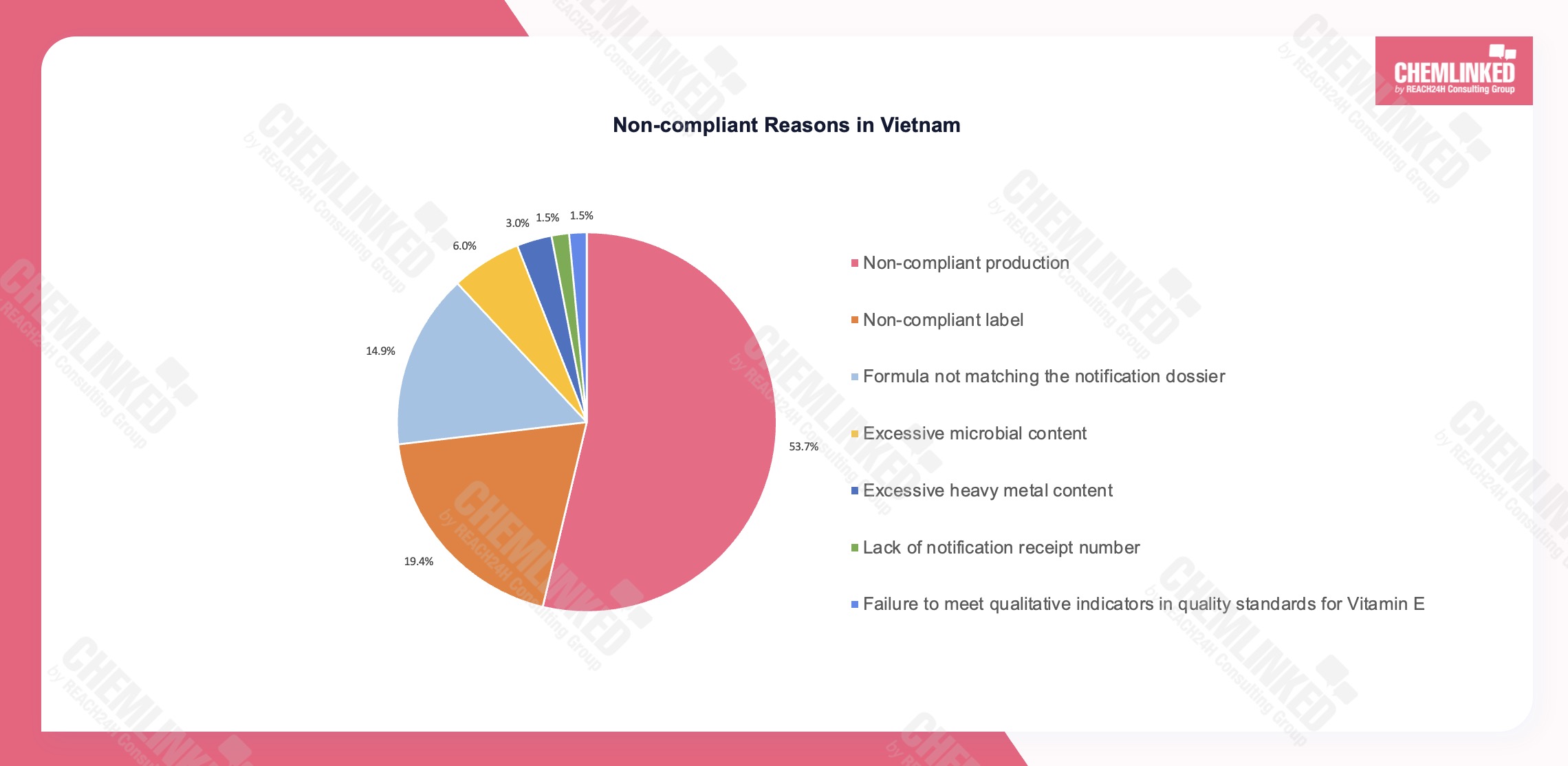 As illustrated in the figure above, non-compliant production, non-compliant labels, and inconsistent formula between the product and notification dossier are the primary reasons for non-compliant cosmetics in Vietnam over the past six months.
To address the potential safety hazards associated with the use of these non-compliant cosmetics, DAV has taken the following measures:
1) The competent departments of health should notify the businesses and users to immediately stop trading and using non-compliant cosmetics and facilitate their return to the suppliers. These departments should also oversee the recall and destruction of these products, handle the regulation violations, and report the outcomes to the DAV.
2) Distributors should immediately cease the circulation of these products, return unsold items to suppliers, and initiate a recall of sold products. Suppliers must promptly issue product recall notices to distributors, recall sold items, accept the return of products from distributors, and arrange for their destruction. Further, suppliers must submit product recall and destruction reports to DAV within the specified timeframe.
3) For some products lacking necessary information on the label which prevents traceability, as well as those containing forbidden ingredients, relevant departments will continue to inspect, verify, and trace the batch sources, and impose penalties on the violating companies.
4) For some products found with inconsistent formulas between the product and notification dossier, as well as those exceeding microbial limits and having non-compliant labels, their notification numbers have been revoked.
Singapore's Health Sciences Authority (HSA) publishes non-compliant cosmetics containing potent ingredients found overseas on a monthly basis. This information serves as a critical warning for cosmetic enterprises, both domestic and international, who wish to maintain a presence in the Singapore market.
The potent ingredients detected in these cosmetics include Mercury, Betamethasone, Hydroquinone, Retinoic Acid, etc. These ingredients are prohibited for general use in cosmetics in accordance with ASEAN Cosmetic Directive (ACD).
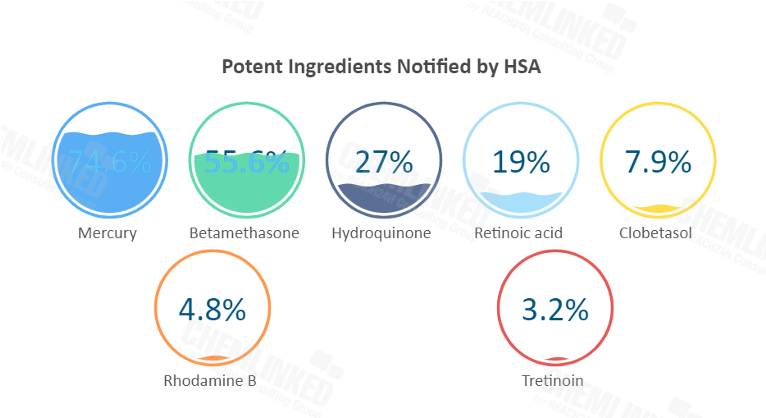
According to the HSA, out of the 63 batches of non-compliant cosmetics reported as of June, 47 were found to contain mercury, making mercury the most commonly found prohibited substance. The second is betamethasone, which is present in 35 out of the 63 non-compliant cosmetic batches.
From January to June 2024, Japan Pharmaceuticals and Medical Devices Agency (PMDA) notified a total of 351 batches of non-compliant cosmetic and quasi-drug products, of which the majority were cosmetics. The reasons for the recalls are diverse, including labeling issues such as incorrect or missing labels; foreign matter contamination; product deterioration; ingredient-related problems such as the addition of prohibited ingredients or exceeding ingredient limits; as well as the lack of relevant manufacturing/sales permits.
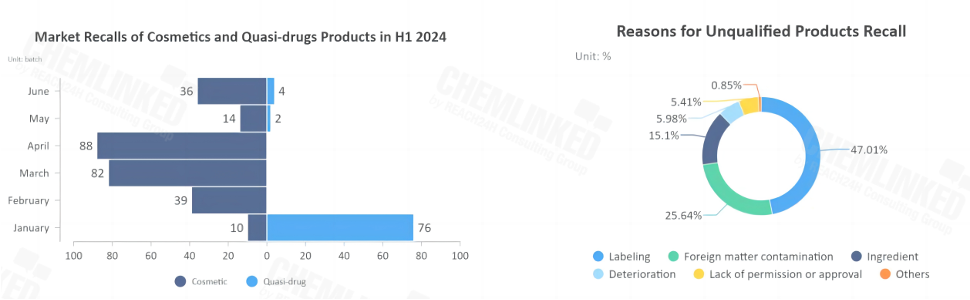 Among them, unqualified label is the primary reason, accounting for nearly half. The most frequently reported errors are incorrect ingredient names and incorrect descriptions of manufacturer information. Secondly, the presence of foreign matter in the products is also a significant issue. In addition, the proportion of ingredient errors is also high, involving incorrect ingredient specifications and the excessive use of certain ingredients.
Noncompliance label and advertisement is the main issue for South Korea in H1 of 2024. According to the data disclosed by the Ministry of Food and Drug Safety (MFDS), the authority cracked down 106 noncompliance cases against Korean cosmetic requirements, amongst which 81 cases are about improper labeling and adverting. Details are as below:
Penalty Date | Noncompliance | Company Name |
2024-01-08 | Advertisement likely to mislead consumers into thinking the cosmetic is a medicine | 유진컴퍼니 |
2024-01-08 |
| 토브가든 |
2024-01-17 | Advertisement likely to mislead consumers into thinking the cosmetic is a medicine | 주식회사보타닉센스 |
2024-01-22 |
| 프롬더네이처 |
2024-01-22 |
| 알렉스 |
2024-01-23 | Advertisement likely to mislead consumers into thinking the cosmetic is a medicine | 스키노베이션 |
2024-01-31 | Advertisement likely to mislead consumers into thinking the cosmetic is a medicine | 골드무역 |
2024-01-31 | Advertisement likely to mislead consumers into thinking the cosmetic is a medicine | 주식회사킹케어 |
2024-02-06 | Advertisement likely to mislead consumers into thinking the cosmetic is a medicine | 키라 |
2024-02-06 | Advertisement likely to mislead consumers into thinking the cosmetic is a medicine Advertisement likely to deceive or mislead consumers by misrepresentation Advertisement about quality, efficacy, etc. that cannot be objectively verified | 주식회사비에티 |
2024-02-13 | Advertisement likely to mislead consumers into thinking the cosmetic is a medicine | ㈜제이에스케이 |
2024-02-16 | Advertisement likely to deceive or mislead consumers by misrepresentation | 트리코 |
2024-02-20 | Advertisement likely to mislead consumers into thinking the cosmetic is a medicine | 좋은직구2호점 |
2024-02-21 | Advertisement with absolute expressions | 주식회사퍼셀 |
2024-02-21 | Advertisement likely to mislead consumers into thinking the cosmetic is a medicine | 아나시스(ANACIS) |
2024-02-22 | Advertisement likely to mislead consumers into thinking the cosmetic is a medicine | 주식회사슈엘로 |
2024-02-22 | Advertisement likely to mislead consumers into thinking the cosmetic is a medicine | 리가(riga) |
2024-02-22 | Advertisement likely to mislead consumers into thinking the cosmetic is a medicine | 제이에이치유로 |
2024-02-23 | Advertisement likely to mislead consumers into thinking the cosmetic is a medicine | 에이그린 |
2024-02-26 | Advertisement likely to deceive or mislead consumers by misrepresentation | (주)피플스 |
2024-03-04 | Advertisement likely to mislead consumers into thinking the cosmetic is a medicine | 루씨드(Luccid) |
2024-03-04 | Advertisement likely to mislead consumers into thinking the cosmetic is a medicine | 수둥 |
2024-03-06 | Advertisement likely to deceive or mislead consumers by misrepresentation | 주식회사담다다담 |
2024-03-06 | Advertisement likely to mislead consumers into thinking the cosmetic is a medicine | 더순해 |
2024-03-07 | Advertisement likely to mislead consumers into thinking the cosmetic is a medicine | 자기관리프로젝트 |
2024-03-07 | Advertisement likely to deceive or mislead consumers by misrepresentation | 동국헬스케어엠앤아이주식회사 |
2024-03-11 | Advertisement likely to mislead consumers into thinking the cosmetic is a medicine | 알리코제약(주) |
2024-03-12 | Advertisement likely to mislead consumers into thinking the cosmetic is a medicine | 다모숲 |
2024-03-13 | Advertisement likely to mislead consumers into thinking the cosmetic is a medicine | 주식회사 비비씨 |
2024-03-14 | Advertisement likely to mislead consumers into thinking the cosmetic is a medicine Advertisement likely to mislead consumers into thinking the cosmetic is a functional cosmetic | 하율코스메틱 |
2024-03-15 | Advertisement likely to mislead consumers into thinking the cosmetic is a medicine Advertisement likely to deceive or mislead consumers by misrepresentation | 주식회사미스미네랄 |
2024-03-22 | Advertisement likely to mislead consumers into thinking the cosmetic is a medicine | 원뷰티코스메틱주식회사 |
2024-03-27 | Failure to label all required items | 주식회사바이모션 |
2024-04-02 | Advertisement likely to mislead consumers into thinking the cosmetic is a medicine | 주식회사낭만거북이 |
2024-04-09 | Advertisement likely to mislead consumers into thinking the cosmetic is a medicine | 주식회사 올포레코리아 |
2024-04-11 | Advertisement likely to mislead consumers into thinking the cosmetic is a functional cosmetic | (주)네오팜 |
2024-04-12 | Advertisement likely to mislead consumers into thinking the cosmetic is a medicine | 도매컴퍼니 |
2024-04-15 | Advertisement likely to mislead consumers into thinking the cosmetic is a functional cosmetic | 노익스 |
2024-04-17 | Advertisement likely to mislead consumers into thinking the cosmetic is a medicine | 바이오인터체인지(주) |
2024-04-22 | Advertisement likely to mislead consumers into thinking the cosmetic is a medicine | 리진바이오젠 |
2024-04-23 | Advertisement likely to deceive or mislead consumers by misrepresentation | 주식회사뉴본라이프 |
2024-04-23 | Advertisement likely to mislead consumers into thinking the cosmetic is a medicine | 주식회사폴라이브 |
2024-04-23 | Advertisement likely to mislead consumers into thinking the cosmetic is a medicine | 주식회사제이브로스앤컴퍼니 |
2024-04-24 | Advertisement likely to deceive or mislead consumers by misrepresentation | 바르니 |
2024-04-26 | Advertisement likely to mislead consumers into thinking the cosmetic is a functional cosmetic | 해규 |
2024-05-02 |
| (주)울트라브이 |
2024-05-07 |
| 꽃담 |
2024-05-08 |
| 주식회사 리움코퍼레이션 |
2024-05-16 | Advertisement likely to mislead consumers into thinking the cosmetic is a medicine | (주)아밍제이 |
2024-05-16 | Advertisement likely to mislead consumers into thinking the cosmetic is a medicine | 주식회사코위닝(Co-Winning INC.) |
2024-05-16 | Advertisement likely to mislead consumers into thinking the cosmetic is a functional cosmetic | (주)피앤피바이오팜 |
2024-05-20 | Advertisement likely to mislead consumers into thinking the cosmetic is a medicine | (주)워크플로컴퍼니 |
2024-05-20 | Advertisement likely to mislead consumers into thinking the cosmetic is a medicine | 핏테크(FITECH) |
2024-05-20 | Advertisement likely to mislead consumers into thinking the cosmetic is a medicine | (주)르솔레이글로벌 |
2024-05-20 | Advertisement likely to mislead consumers into thinking the cosmetic is a medicine | 주식회사보늬 |
2024-05-20 | Advertisement likely to mislead consumers into thinking the cosmetic is a medicine | 자연비누 |
2024-05-20 | Advertisement likely to mislead consumers into thinking the cosmetic is a functional cosmetic | 딜리몰 |
2024-05-20 | Advertisement likely to mislead consumers into thinking the cosmetic is a medicine | 팜스비앤비 |
2024-05-20 | Advertisement likely to mislead consumers into thinking the cosmetic is a medicine | (주)엔제이코스랩 |
2024-05-21 | Advertisement likely to deceive or mislead consumers by misrepresentation | 비비솔루션 주식회사 |
2024-05-30 | Failure to label the allergenic fragrances in the cosmetic | (주)동구밭 |
2024-06-03 |
| 다원메디스 |
2024-06-03 | Advertisement likely to mislead consumers into thinking the cosmetic is a functional cosmetic | 바르니 |
2024-06-03 | Advertisement likely to deceive or mislead consumers by misrepresentation | 세이무역상사 |
2024-06-03 | Advertisement likely to deceive or mislead consumers by misrepresentation | (주)로즈로드 |
2024-06-10 | Failure to provide all required labeling items | 설은화장품 |
2024-06-10 | Advertisement likely to mislead consumers into thinking the cosmetic is a functional cosmetic | 씨앤에이치트레이드주식회사 |
2024-06-10 | Failure to label all ingredients | 더라미주식회사 |
2024-06-11 |
| 주식회사 페슬 |
2024-06-11 | Advertisement likely to mislead consumers into thinking the cosmetic is a medicine | 주식회사토브 |
2024-06-13 | Advertisements that went beyond the typical scope of the cosmetic | 주식회사고밤비 |
2024-06-14 | Advertisements that went beyond the typical scope of the cosmetic | 주식회사라이트하우스코스메틱 |
2024-06-17 | Advertisement likely to deceive or mislead consumers by misrepresentation | 한방미인화장품HBMIC |
2024-06-17 | Advertisement likely to mislead consumers into thinking the cosmetic is a functional cosmetic | 주식회사 비엑스랩 |
2024-06-17 | Advertisement likely to deceive or mislead consumers by misrepresentation | 시온의대로 |
2024-06-18 | Advertisements that went beyond the typical scope of the cosmetic | (주)이삼오구 |
2024-06-28 | Advertisement likely to deceive or mislead consumers by misrepresentation | (주)안트로젠 |
2024-07-01 | Advertisement likely to mislead consumers into thinking the cosmetic is a medicine | (주)보네스티 |
2024-07-01 | Label and advertisement likely to mislead consumers into thinking the cosmetic is a functional cosmetic | 미소플레이스 |
2024-07-10 |
| 한국생명공학연구소(주) |
2024-07-10 | False expiration date on the secondary package | 디에이치인터내셔널 |
Seen from the above list, “labels and advertisements likely to mislead consumers into thinking the cosmetics are medicines”, and “labels and advertisements likely to mislead consumers into thinking the cosmetics are functional cosmetics” and the main compliances reasons. Claiming a cosmetic having antibacterial, anti-inflammatory effects, or other medical efficacies is strictly prohibited in South Korea. The scope of improper labels and advertisements for general cosmetics is specified in the Cosmetics Act and its subordinate law is compiled as below:
Improper labels and advertisements for general cosmetics stipulated under the Article 13 of Cosmetics Act | Prohibited labels and advertisements stipulated under the Attachment Table 5 of Enforcement Rule of Cosmetic Act |
1) Labels and advertisements likely to mislead consumers into thinking the cosmetics are medicines | a. Product name, effectiveness and other expressions likely to mislead consumers into thinking the cosmetics are medicine. |
Further reading
Typical Non-compliant Cosmetic Cases in China: H1 2024 Review
 We provide full-scale global cosmetic market entry services (including cosmetic registering & filing, regulatory consultation, customized training, market research, branding strategy). Please contact us to discuss how we can help you by