Request a Demo
On March 18, China State Council published a Decision on Amending Some Administrative Regulations [1], Article 45 specifically stipulates the amendment requirements of the existing effective Cosmetics Hygiene Supervision Regulations. This decision took effect upon its issuance.
The amendments to the Cosmetics Hygiene Supervision Regulations mainly focused on two aspects (the full revised regulation is accessible here):
1. Clarify competent authorities. After China’s largescale institutional reform, the supervision responsibilities of cosmetics originally designated to hygiene departments has now been taken over by the National Medical Products Administration. The new regulations accordingly made some refinements of the expressions relating to competent authority's name:
The expressions pertain to “Health Administration Departments” in Article 3, Article 9 Section 1, Article 10 Section 1, Article 19, Article 23, Article 29, Article 30, Article 32 of the 1989 CASR were modified to “Cosmetic Supervision and Administration Departments”;
The expressions “Industry and Commerce Administrative Department” in Article 29 was modified to “Market Supervision and Administration Departments”;
Article 17 was changed to “The cosmetic supervision and administration departments at all levels shall exercise hygiene supervision over cosmetics”;

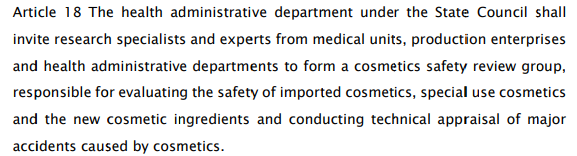
Article 18 was changed to “The cosmetic supervision and administration departments under the State Council shall invite research specialists and experts from medical units, production enterprises and health administration departments to form a cosmetic safety assessment group, responsible for evaluating the safety of special use cosmetics and the new cosmetic ingredients and conducting technical appraisal of major accidents caused by cosmetics.”;
Article 22 was changed to “The cosmetic supervision and administration departments and the cosmetic hygiene supervisors at all levels are not allowed to have a hand in the production, sale or supervision of the making of cosmetics in the guise of a technical consultancy and service provider”.

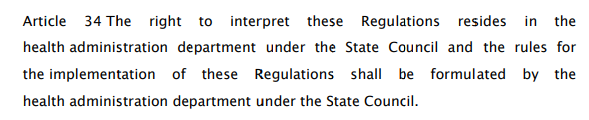
Article 34 was changed to “The enforcement rules of these regulations shall be formulated by the cosmetics supervision and administration departments under the State Council”.
2. Optimize cosmetic administration approval procedures. In the course of carrying out State Council’s reform on streamlining administration, the management on imported non-special use cosmetics has been entirely changed to filing management from registration. Additionally, the administrative license for cosmetic production and the administrative license for hygiene of cosmetic manufacturing enterprise have been integrated into a single Cosmetic Manufacture License. Based on the current practices, the new Cosmetics Hygiene Supervision Regulations thereby made several corresponding updates, as listed below:
The expression of “Hygiene License” in Article 12 and the expressions regarding “Hygiene License for the Production Enterprise of Cosmetics” in Article 13, Article 24, Article 25, Article 28, Article 29 Section 2 of the 1989 CASR were modified to “Cosmetic Manufacture License”;
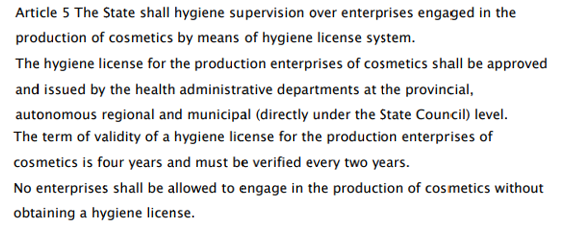
Article 5 was changed to “The State shall implement the cosmetic manufacture license system to the enterprises engaged in the production of cosmetics. The Cosmetic Manufacture License shall be approved and issued by the cosmetic supervision and administration departments at the provincial, autonomous regional or municipal (directly under the Central Government) level. The term of validity of a Cosmetic Manufacture License is 5 years. No enterprise shall be allowed to engage in the production of cosmetics without a Cosmetic Manufacture License”;
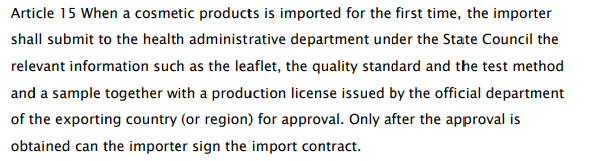
Article 15 was changed to “For first imported special use cosmetics, the importer has to submit relevant materials such as the product specification, the quality standards and the testing methods as well as a sample, together with the certification documents approved by the exporting country (region) for production to the cosmetic supervision and administration departments under the State Council. Only after the approval is obtained can the import contract be signed. For other first imported cosmetics, they shall be filed in accordance with regulations”.
Other Modifications
Article 26 Section 1 was amended to “Those who violate the regulation—import or sell imported cosmetics that have not been approved or inspected—shall be punished by having their goods and illegal earnings confiscated and will be issued a fine of 3 to 5x their illegal profits”.

The chronology of the revision to 1989 Cosmetics Hygiene Supervision Regulations
In 2013, CFDA (now SAMR) initiated a program to reform Cosmetics Hygiene Supervision Regulations aiming to further standardize cosmetic production and operation as well as reinforce cosmetic supervision and administration.
On November 8, 2014, CFDA started to solicit public opinion on the revised version, which was renamed Cosmetic Supervision and Administration Regulations (CSAR).
On July 20, 2015, the Legislative Affairs Office of China State Council promulgated a written draft of Cosmetic Supervision and Administration Regulations for public consultation.
On August 15, 2018, a Second Written Draft of Cosmetic Supervision and Administration Regulations that made subtle refinements to the 2015 draft was worked out for a new round of public consultation.
On March 18, 2019, China State Council officially approved the partial revisions of the 1989 Cosmetics Hygiene Supervision Regulations. Although there appears to be little substance to the new regulations, it marks a significant legislative improvement in the cosmetic industry given that the State Council’s revisions are the first officially-approved revisions to the 1989 cosmetic regulations in the past 3 decades since its promulgation.
Currently, China NMPA is still in the process of amending the Cosmetic Supervision and Administration Regulations, whose contents are overhauled compared with the current regulations. According to China’s 2019 Cosmetic Supervision Work Plan, the pending CSAR has gone through its last phase of development before promulgation and is likely to be enacted in this year.
 We provide full-scale global cosmetic market entry services (including cosmetic registering & filing, regulatory consultation, customized training, market research, branding strategy). Please contact us to discuss how we can help you by