Request a Demo
Thailand
Q1. Is it allowed to register a cosmetic that contains hialuronic acid?
A1: Assuming that hialuronic acid is the same ingredient as hyaluronic acid, this ingredient is acceptable for use as a cosmetic ingredient. There are many cosmetic products containing hyaluronic acid that have been approved by the Thai FDA and launched in the Thai market.
Q2. What test reports are required for the importation of cosmetics into Thailand?
A2: Almost no cosmetics imported into Thailand require submission of a test report or certificate of analysis. Certain types of cosmetics may be exceptions to this, such as SPF50+ sunscreen products, which must be supported with their SPF test report. Microbiological and heavy metal test reports should be kept at the importer's premises. The FDA may request an inspection of the importer's office, and the test report must be available to prove the quality of the product throughout its life cycle.
Q3. Which changes shall be notified to the Thai FDA (e.g., formulation change, change of warehouse, etc.)?
A3: Any change of the importer's warehouse must be notified to the Thai FDA. Regarding the formulation change, this depends on whether the change of formulation impacts the product name, ingredient names, or percentages of active ingredients.
Q4. Are there any regulations or guidance on sending samples to potential partners in Thailand from overseas suppliers?
A4: Yes, Thailand has regulations with regard to importing samples from overseas suppliers. The importer must submit an application according to the procedures prescribed in relevant notifications of the Ministry of Public Health.
Q5. Is Thai regulations more similar to European or American regulations in skincare products? E.g., in terms of claims, packaging, formulation, etc.
A5: Thai cosmetics regulations follow the ASEAN cosmetics guidelines, which are closer to the European regulations than the US FDA’s regulations.
Q6. Is there a list of prohibited claims for cosmetics imported to Thailand?
A6: Yes, there is a list of prohibited claims for cosmetics provided by the FDA in the 2019 manual on advertisement of cosmetic products.
Q7. Who is responsible for failing to comply with Thai regulations? The importer or the overseas exporter?
A7: Liability for missing compliance obligations according to the Thai regulations, such as cosmetic labeling, would be with the importer. If products are found to be unsafe for use, according to the product liability law, the importer and overseas exporter/manufacturer shall be jointly liable for the damage caused by the unsafe products.
Click here to view the complete Q&A collection and the webinar recording on Thailand cosmetic regulations.
Indonesia
Q1. Can the manufacturer send the product information file (PIF) to the cosmetic notification holder (CNH) only if required by Health Authorities?
A1: Based on the Regulation of the National Agency for Drug and Food Administration (BPOM) No. 14 of 2017 on the Product Information File, a CNH must have a PIF prior to applying for a cosmetics notification. Therefore, although a PIF is not required for the submission of cosmetics notification, PIF is required to be provided to the CNH prior to applying for the cosmetics notification.
Q2. Is it necessary to have a government-issued certificate for GMP compliance? Is an ISO 22716 certificate verified by a third party acceptable?
A2: Based on BPOM Regulation No. 12 of 2020 on Cosmetics Notification Procedures, it is required to provide a copy of GMP certificate issued by the government authorities or institution recognized in the country of manufacture and legalized by the Embassy/Consulate General of the Republic of Indonesia.
Q3. What is the minimum testing requirement for cosmetics exporting to Indonesia?
A3: The minimum testing requirements for cosmetic products are stipulated in BPOM Regulation No. 12 year 2019 regarding Contamination in Cosmetic Products which includes the following test parameters:
Microbial contamination: total plate count, total yeast and mold, specific microbes (Pseudomonas aeruginosa, Staphylococcus aureus, Candida albicans);
Heavy metal contamination: Lead (Pb), Arsenic (As), Mercury (Hg), and Cadmium (Cd);
Chemical contamination: 1,4 Dioxane (for cosmetics containing ingredients produced through an ethoxylation process, such as sodium laureth sulphate and polyethylene glycol).
The certificate of analysis for importation is valid for one year from the date of issuance. For heavy metal testing, a certificate of analysis can be reused as long as there is no change in formula and no report of post-market noncompliance.
Q4. During the notification, most challenges are on product names instead of claims on packages. Are claims on packages more possibly to be scrutinized during post-market inspection rather than at notification?
A4: Claims on packages are more scrutinized during post-market inspection than at notification. The reason is that the cosmetics label is not required to be submitted for cosmetics notification, but is only included in the PIF. Only use claims are required to be submitted for notification. Therefore, during the notification process, product name and use claims will be heavily reviewed and assessed by BPOM.
Q5. Is it compulsory to put the BPOM notification number on the label? What are the requirements for sunscreen products to be marketed in Indonesia? Should the applicant submit SPF test results for the notification application?
A5: The BPOM notification number is required to be put on the cosmetics label. For sunscreen products, it is not required to submit SPF test result for the notification application. The test result must be included in the PIF, which must be kept and maintained by the CNH. The SPF value, however, must be indicated on the cosmetics label.
A mandatory warning "Do not stay too long in the sun, even while using a sunscreen product" as well as usage directions must be stated on the label. There are additional strongly recommended warnings that may be included, such as "re-apply frequently to maintain protection, especially after sweating, swimming or toweling," "over-exposure to the sun is a serious health threat," and "do not use on wounded skin."
Q6. If the product cannot be HALAL certified by October 2026, how to keep selling the product in Indonesia?
A6: If the cosmetic product is not halal certified by October 2026, the cosmetic product can still be sold by complying with the prevailing requirements for non-halal product declaration at that time. However, there are currently no regulations regarding non-halal declarations. It is expected that the authorities will set forth relevant requirements closer to the deadline for complying with halal certification.
Q7. Indonesia must follow the ASEAN Cosmetic Directive. Are there any matters especially need attention?
A7: Although Indonesia follows the ASEAN Cosmetic Directive, there are some specific regulations set forth by BPOM. For example, BPOM allows imported cosmetics containing isopropylparaben, isobutylparaben, and/or benzylparaben to be notified in Indonesia with the following restrictions:
1. Isopropylparaben, isobutylparaben, and/or benzylparaben must be allowed for use as cosmetics ingredients by the country of origin.
2. It complies with the conditions set forth in Annex III of BPOM Regulation No. 23 of 2019 regarding Technical Requirements on Cosmetics Ingredients with regard to the maximum use limit, labeling, and warning requirements, as well as other limitations of use.
Therefore, while the ASEAN Cosmetic Directive prohibits the use of isopropylparaben, isobutylparaben, and/or benzylparaben in cosmetics, BPOM allows the use of the aforementioned ingredients with restrictions.
Q8. Is there anything to consider when switching from local manufacturing to importation from EU countries?
A8: BPOM Regulation No. 12 of 2020 on Cosmetics Notification Procedures includes the following additional requirements for imported cosmetic products from EU countries:
1. Letter of appointment (LOA), valid for at least six months. Please note that the cosmetics notification is valid for three years. If the LOA is terminated before the end of the validity period of the LOA, BPOM will conduct a clarification to the prior importer before granting a notification to the new CNH.
2. Certificate of free sale (CFS), legalized by the Indonesian Consulate in the country of origin.
3. GMP certificate, valid for at least six months, legalized by the Indonesian Consulate in the country of origin. If the validity period exceeds five years, or if no validity period is indicated on the certificate, the GMP certificate will be considered valid for five years.
Click here to view the complete QA collection and webinar recording on Indonesian cosmetic regulations.
Malaysia
Q1. Can the brand owner be listed as the manufacturer for registration?
A1: Yes, the brand owner who manufactures cosmetic products can be listed as the manufacturer as long as they have a Good Manufacturing Certificate or the ISO22716 Certificate.
Q2. Shall we indicate the content of each ingredient during notification?
A2: It is not mandatory to declare the percentage of all ingredients during notification. Only the percentage for the restricted ingredients are required to be declared.
Q3. Is it necessary for cosmetic products exporters to have/hold a GMP certificate?
A3: Yes, GMP is mandatory for all cosmetic manufacturing companies (including outsourced manufacturers). You can provide the ISO22716 certificate as the equivalent of the GMP certificate.
Q4. Are there any language requirements for the notification documents?
A4: Yes, all the documents for submission shall be translated to English. For the artwork, it should be either in the local language or English language.
Q5. Is testing mandatory for compliance for cosmetic products, and what is the minimum requirement to meet?
A5: For any cosmetic product, safety assessment shall be done from at least three aspects. Namely, ingredients, chemical structure, and level of exposure. This is the baseline set out by the NPRA, which is also in line with Article 8(d) of the ASEAN Cosmetics Directive.
To obtain a notification, tests reports are not mandatory. However, applicants are required to follow the following points:
The approach in ensuring the safety of a cosmetic product:
(a) Careful selection of cosmetic ingredients, making sure that the ingredient will be safe at a given concentration in a given finished product;
(b) Cosmetic products shall not contain any ingredients that are prohibited by the local government (Poison Act 1952 and the Guidelines);
(c) Checking local tolerance of the finished product;
(d) Selection of adequate packaging to maintain the quality of the cosmetic products and to avoid the risks of misuse or accident as far as possible;
(e) Quality control, mainly microbiological, chemical and stability studies of the cosmetic product’s shelf life and packaging;
(f) Adequate post-market procedures in case of side effects;
(g) If any visible product change or adulteration is advised from the marketplace, ensuring corrective action and follow-up measures.
Q6. Is there any specific regulation related to Heavy Metal and Microbial contaminants? If any imported product whose Certification of Authenticity (COA) has not completed as per regulation, is it mandatory to do local testing in Malaysia if the factory cannot add relevant information on the COA during importation?
A6:
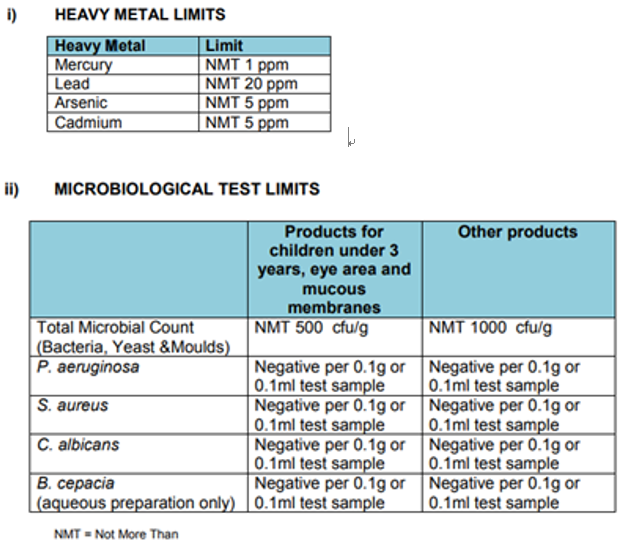
COA will be required during the audits, not during the importation.
Local testing is required if manufacturers fail to provide testing results of the above specifications.
Q7. Is there any specific requirements for baby products and sunscreen?
A7: No specific requirements for baby products; however, if you have certain claims such as dermatologically tested, hypoallergenic, tear-free, you have to have supporting documents to justify them.
As for sunscreen, the requirements are as follows:
Scope: This guideline applies only to sunscreen products whose primary function is UV protection. It does not apply to products that make claims of secondary UV protection, such as moisturizing and skin lightening.
Sunscreen should protect against both UVB & UVA.
a) Guideline for sunscreen product labeling:
1. It is not allowed to make claim that implies:
100% protection against UV A & B
The reapplication of the product is unnecessary, e.g., whole day protection
Waterproof and sweatproof
2. Claims should be easily understood and unambiguous
3. Claims of UV protection should not be made if SPF<6
Classification SPF level | SPF level |
Low | 6≤SPF<15 |
Medium | 15≤SPF<30 |
High | 30≤SPF<50 |
Very High | ≥ 50 |
Q8. Is it possible to sell cosmetic products in Malaysia without a Halal certification?
A8: Yes, it is possible to sell without halal as long as the cosmetic product completes notification. Halal certification is not a mandatory requirement.
Q9. Is there any regulation for cross-border e-commerce trading?
A9: There is no specific regulation on cross-border e-commerce trading; however, to market your products online, you should first entrust a local company/holder applying for notification on behalf of you.
Q10. Is there an obligation for new cosmetic ingredients in place?
A10: All new ingredients which are not registered with local authority must be reviewed before they can be used in a formulation. 2 portals are available that authority uses as a guideline:
1. CosIng-European Commission database compiles the information on cosmetic substances and ingredients contained in the Cosmetics Regulation (EC) No. 1223/2009 of the European Parliament and the Council.
2. PCPC-The Personal Care Products Council (PCPC) is the leading national trade association representing 600 global cosmetics and personal care products companies.
All ingredients listed on CosIng-European Commission database or permitted by PCPC means they are justified to be added into the local database. If not available in the above portals, the following documents shall be submitted:
1) MSDS-Material Safety Data Sheet
2) Toxicology reports
3) Other safety reports
Q11. What’s the difference of Malaysian regulation and ASEAN’s requirements?
A11: Malaysian guidelines are 90% similar to ASEAN’s. The following are some country-specific requirements:
1. Labelling requirements (local language or English, animal-derived ingredients have to be declared);
2. Claims are required to be reviewed by officer (certain claims approved in other ASEAN countries might not be approved in Malaysia).
Click here to view the complete Q&A collection and the webinar recording on Malaysian cosmetic regulations.
Vietnam
Q1. Is registration with authorities required in Vietnam before placing a product on the Vietnamese market? What are the requirements and mandatory documentations for cosmetics importation into Vietnam?
A1: Yes, before importing cosmetic products into Vietnam for circulation, the organization responsible for placing the cosmetic product on the market (i.e., the registrant) must complete the cosmetic notification procedure with the Drug Administration of Vietnam to obtain receipt numbers for the cosmetic product notification letter. The registrant must then keep the PIF at their office as the cosmetic products are circulating on the market. In addition, the authority will carry out post-market inspections when the product is on the market.
Below are the required documents to register a cosmetic product:
1) Two copies of the notification form with proclamation data;
2) Legalized original or notarized copy of the letter of appointment from the product manufacturer or owner to grant permission to the registrant to distribute the products on the Vietnam market; and
3) Legalized original or notarized copy of a valid certificate of free sale (CFS). The CFS is not required in some cases, such as when the cosmetic product is produced/exported and circulated in a member country of the Comprehensive and Progressive Agreement for Trans-Pacific Partnership (CPTPP); or registered in ASEAN countries.
Q2. How long does the cosmetic registration process take?
A2: For registering a cosmetic application, it takes 7-10 working days from the submission of complete dossiers.
Q3. How can a brand in North America request the CFS for exportation to Vietnam?
A3: We assume that you are concerned about a cosmetic brand manufactured (or circulated and exported) from the U.S., Mexico, or Canada in North America. For brands in Mexico or Canada, which are member countries of the CPTPP, it is not required to submit a CFS for cosmetic exportation to Vietnam. For brands in the U.S., the CFS should be issued by the US FDA; however, if the cosmetic product is registered in an ASEAN member country, it is not required to submit a CFS.
Q4. Is it necessary to provide the PIF to the distributor right after the notification of a cosmetic product?
A4: The PIF is checked during a post-market inspection. Thus, providing the PIF to the local distributor is not compulsory right after the cosmetic notification. Still, it is recommended to provide the PIF before circulating the product in the Vietnamese market.
Q5: Can the information compulsory in Vietnamese be over labeled? If yes, when, in Vietnam, or at customs?
A5: It is allowed to present the information compulsory in Vietnamese on a sticker adhering to the packaging/label; but the sticker cannot cover any original information on the packaging/label. The sticker can be added to in Vietnam, after customs clearance but before circulating products in the Vietnam market.
Q6. Are there any specific requirements for fragrances in Vietnam?
A6: Under the updated Annexes of the ASEAN Cosmetic Directive, which Vietnam follows, some specific fragrances are banned in cosmetic products or are only permitted under certain conditions. On the label, perfume and aromatic compositions and their raw materials can be indicated by the word "perfume," "fragrance," "aroma," or "flavor." There is no need to list each fragrance ingredient individually.
Q7. Does Vietnam have a chemical inventory list for checking whether the chemicals used as the ingredients (e.g., fragrance chemical) in a cosmetic product are allowed?
A7: Yes, Vietnam has a chemical inventory list. However, if you would like to identify if chemicals are allowed to be used as a cosmetic ingredient, please check the Annexes of the ASEAN Cosmetic Directive, which Vietnam respects and follows.
Q8. Is there any restriction or specific regulation on hand sanitizer?
A8: Hand sanitizer is not a cosmetic product in Vietnam but is classified as a germicidal preparation managed by the Vietnam Health Environment Management Agency. Thus, hand sanitizer is subject to other regulations, not by cosmetic regulations.
Q9. How do hand soaps fit into the registration scheme? Are there different requirements for hand soaps compared to beauty products?
A9: Hand soap—assuming it has the main function of cleaning hands—can be classified as a cosmetic product in Vietnam. Thus, it is required to conduct the cosmetic notification procedure with the Drug Administration of Vietnam before importing the hand soap into Vietnam for circulation. However, if the hand soap has an additional antiseptic or antibacterial function, this additional function must be listed as the second function of the product. There are no other different requirements for hand soaps than for beauty products.
Click here to view the complete QA collection and webinar recording on Vietnam cosmetic regulations.
 We provide full-scale global cosmetic market entry services (including cosmetic registering & filing, regulatory consultation, customized training, market research, branding strategy). Please contact us to discuss how we can help you by