Request a Demo
For years, cosmetic products in India were governed by the Drugs and Cosmetics Act 1940 and the Drug and Cosmetics Rules 1945 (“1945 Rules”), which were primarily designed to manage pharmaceuticals and only few provisions concerning the control of cosmetics. India’s Ministry of Health and Family Welfare (MOHFW) had earlier planned to sort out cosmetic-related provisions from the 1945 Rules to develop a separate and updated cosmetic regulation for effective compliance management. In November 2018, a draft Cosmetics Rules 2018 was issued for public consultation.
On December 15, 2020, the MOHFW officially released the finalized regulation-Cosmetics Rules 2020 (“2020 Rules”) under the provisions of the Drugs and Cosmetics Act 1940 with immediate effect.1 The 2020 Rules, consisting of 72 rules, 13 schedules, and 24 appendixes, lays down the regulatory requirements for the manufacture, testing, labeling, import, registration, distribution, and sale of cosmetics in India.
Highlights of the 2020 Rules
The key points of the 2020 Rules are outlined below:
1. The concept of “new cosmetics” is introduced for the first time.
As per the 2020 Rules, a “new cosmetic” refers to a cosmetic that contains a novel ingredient that has not been used anywhere in the world or is not recognized for use in cosmetics in any national or international literature.1
The manufacture and import of a new cosmetic require prior approval from the Central Licensing Authority and submission of requisite data on product safety and effectiveness. Besides, the safety of new cosmetics shall be tested by the manufacturer in line with the IS 4011: 2018 Methods of Test for Safety Evaluation of Cosmetics.
2. The license application procedures of cosmetics are streamlined.
Under the 2020 Rules, businesses pertaining to cosmetic registration or manufacture licenses shall go online. A special e-portal of the Central Government is built to handle relevant applications. This move represents the digitization of the regulatory process for cosmetics, which will certainly increase operational efficiency and reduce costs for both the applicants and the regulators.
Moreover, the 2020 Rules also simplify applications by reducing duplication of regulatory processes and formalities for identical products and brands. Importers can make a single application and obtain a single registration certificate for the import of one or more cosmetics manufactured by the same manufacturer in a single manufacturing unit, which can be one factory or multiple factories functioning conjointly.
3. The administrative fees for imported cosmetics are changed with the introduction of a new fee structure.
Based on the previous practices, the 2020 Rules establish a new fee structure of cosmetic administrative items, including the fee for the registration certificate, manufacturing license, approval of laboratory carrying out the test on cosmetics and their raw materials, and test or analysis by the Central/state cosmetics laboratories.
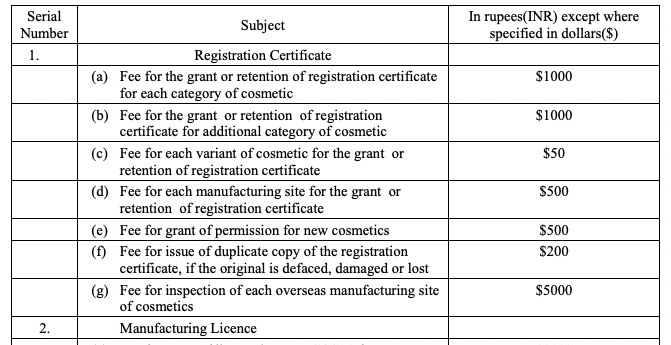
Notably, the relevant administrative fees for the registration of imported cosmetics are changed significantly, as shown below:
The registration fee for imported cosmetics is reduced by half, from $2000 per category to $1000 per category. The additional fee of $50 per variant remains the same as before.
A fee of $500 for each manufacturing site is newly added, indicating that products manufactured in different overseas manufacturing sites will be liable for multiple additional costs. Furthermore, a fee of $5000 for inspection of each overseas manufacturing site is set.
4. The prohibition of import and the exemption of import registration are specified.
Cosmetic categories prohibited from import | Cosmetic categories exempted from import registration |
|
|
5. The validity of import registration certificates is extended.
Previously, the validity of registration certificates for imported cosmetics is 3 years. Under the 2020 Rules, the registration certificate shall remain valid in perpetuity, provided that its retention fee is paid before the expiry date of 5 years from the date of issuance.
6. The quality control requirements of cosmetic products are improved.
To exert more stringent quality control, cosmetic manufacturers must declare the full composition of products in the manufacturing records, even those with a concentration of less than 1%.
Also, the government is setting up the first Central Cosmetics Laboratory of the country and appointing inspectors across states. The premises licensed to manufacture cosmetics will be subject to inspections by the appointed inspectors every three years to ensure full compliance with the Drugs and Cosmetic Act 1940 and Cosmetics Rules 2020.
Transitional Measures
To ensure smooth transitions and help enterprises cope with new rules, the 2020 Rules stipulate that all approvals, licenses, and certificates issued under the previous 1945 Rules before 15 December 2020 will continue to be valid till the later of their expiry dates; or a period of 18 months from the date of promulgation of the new rules.
ChemLinked Comments
Cosmetics had formerly not received adequate attention in comparison to drugs in India. The implementation of the long-awaited Cosmetic Rules 2020 serves as a historical landmark for India on its way to the modernization of its cosmetic oversight and alignment of its regulatory framework with global trends. Cosmetics regulations are now in a separate category with assigned rules under the purview of the Drugs and Cosmetics Act 1940. 2 The industry is now ushering into a new era of healthy, orderly, and sustainable development.
The cosmetic import business is expected to flourish in India in the future, spurred by a series of incentives including the reduction of registration costs, the extension of license validity, the simplification of administrative procedures, etc.
 We provide full-scale global cosmetic market entry services (including cosmetic registering & filing, regulatory consultation, customized training, market research, branding strategy). Please contact us to discuss how we can help you by