Request a Demo
The concept of Original Equipment Manufacturer (OEM) is originally derived from the garment industry. With globalization and the fast growth of the world’s economy, OEM has become a popular business model and now been adopted by many different industries including the computer, electrical appliance, food and cosmetics.
OEM vs. ODM
What is OEM? In short, it is a business model in which one company commissions another manufacturer to produce its products with the company’s specific requirements. In international trade, it is also called “processing trade”, meaning a company remains in charge of the “core elements” including R&D, product design and distribution channel control, but commissions the production part to the third party. Cosmetic OEM has various cooperation modes such as sampling processing, formula processing, supplied materials processing and supplied package filling. Similar to OEM, the Original Design Manufacturer (ODM) plays the role of third party manufacturer but different from OEM, it provides full services of supply chain integration from branding to marketing.
The essential difference between OEM and ODM is that in OEM the commissioned manufacturer is not allowed to produce its own brands or any other brands, nor give out the product design to other companies. In other words, the commissioning party owns the intellectual property. On the other hand, the ODM has the right to re-produce and rebrand the same products if the commissioning party doesn’t buy out the copy right.
OEM Pros & Cons
So, why does OEM prevail in many different industries on a global scale? It can probably be explained by globalization and work specialization. Due to high domestic labor, production and transportation costs, brands are increasingly looking to outsource their production base to other parts of the world such as China.
The “Pros”
For well-known brands, OEM is one strategic option available to maximize profit while minimizing investment risks. Through commissioning production overseas to local manufacturers, companies effectively cut the production costs, lower the risk of market expansion and increase product competitiveness. More and more multinational companies have transferred their business models to OEM to realize quick market entry and minimized investment risks and costs.
OEM is also an important means for foreign companies looking to expand its market into other countries such as China. Instead of setting up its own manufacturing base in China, foreign enterprises normally opt for OEM because choosing the former option means an enterprise is faced with risks associated with higher costs and an extended duration of market entry while the OEM business model avoids those problems and takes advantage of China’s current “high volume, low cost” production capacity. For local manufacturers, idle production capacity can be utilized making OEM a win-win situation.
The “Cons”
The biggest concern companies may have is associated with maintaining their reputation and the integrity of their brand. Companies need to be extra cautious when selecting their OEM partners to avoid product quality issues and loss of credibility which can have negative impact on brand reputation and competitiveness. On the other hand, commissioned manufacturers might also have concerns over its profit margin and any of its own brands. OEM can certainly increase revenue; however, the manufacturer normally receives a much lower price to produce OEM products, resulting in a low profit margin. Moreover, a large volume of OEM production can use up the entire production capacity of a manufacturer which can impact the competitiveness of a manufacturer’s own brands.
In a nutshell, the advantages of OEM outweigh its disadvantages, it is the trend and effective mean for multinational companies to enter a new market.
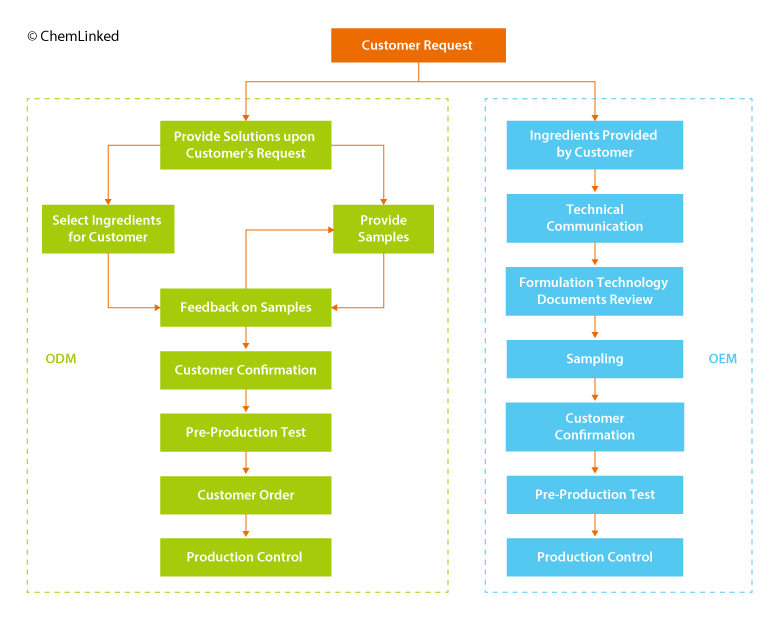
OEM & ODM Flow Chart
 We provide full-scale global cosmetic market entry services (including cosmetic registering & filing, regulatory consultation, customized training, market research, branding strategy). Please contact us to discuss how we can help you by