Request a Demo
Shortly after the release of the updated version of the Ingredient Usage Information of Marketed Products, the China National Institutes for Food and Drug Control (NIFDC) issued a notice on February 19, 2025, soliciting public opinions on the Information on the Use of Some Ingredients Included in the International Cosmetic Safety Assessment Data Index (Draft for Comments). The public comments will end on March 4, 2025.
Overview of the International Index
The Index of Cosmetics Safety Assessment Data from Authoritative Organizations (now renamed the International Cosmetic Safety Assessment Data Index, hereinafter referred to as the "International Index") is a comprehensive database of 3,651 ingredients that originally published on April 30, 2024. It includes ingredients used in cosmetics available in China but not listed in the Safety and Technical Standards for Cosmetics (STSC), and have published safety assessment conclusions from globally recognized authorities such as the Scientific Committee on Consumer Safety (SCCS) and the Cosmetic Ingredient Review (CIR).
The Index provides key details such as IECIC serial numbers, Chinese names, INCI/English names, and previous or current name (if applicable), serving as a critical reference for enterprises conducting safety assessments.
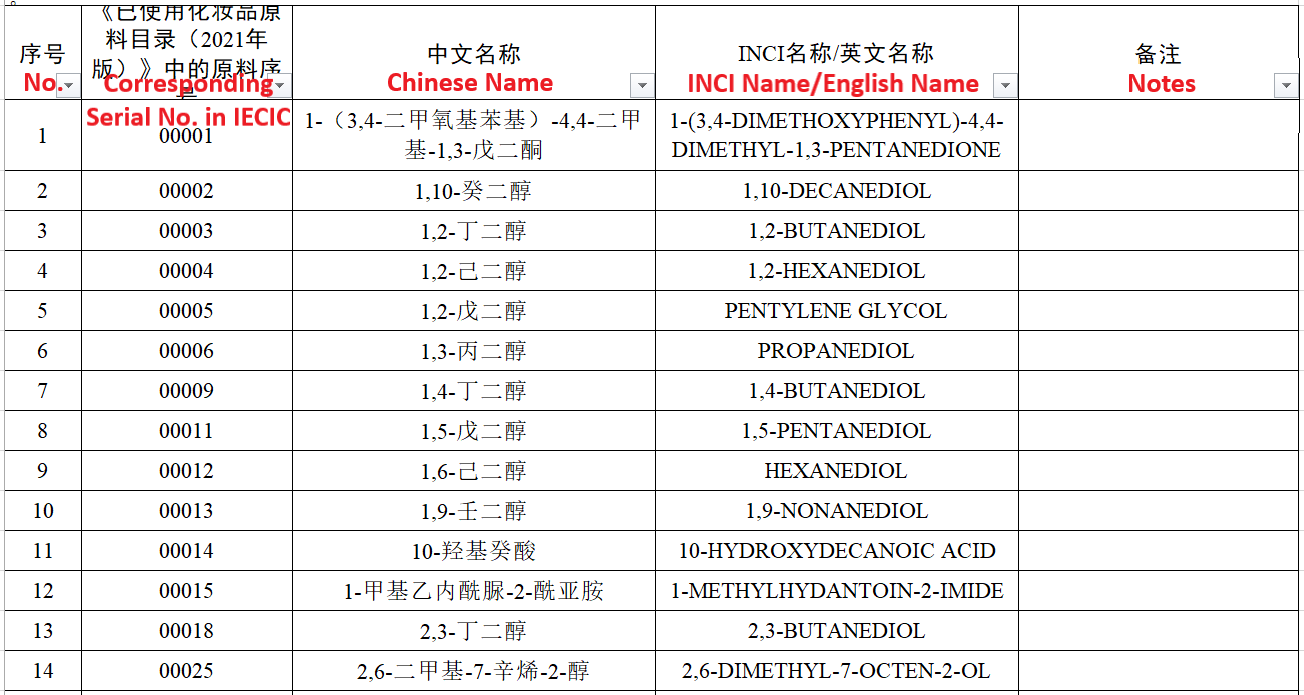 Excerpt of Index of Cosmetics Safety Assessment Data from Authoritative Organizations
Background and Purpose
This draft is a supplementary file to the International Index, addressing industry concerns that some ingredients listed in the International Index lack assessment conclusions or have restricted use conditions, limiting their applicability in safety assessments. To resolve this issue, the NIFDC has sorted out the assessment status of ingredients included in the International Index and compiled real-world usage data of some of these ingredients based on their use in registered and notified cosmetics, providing expanded references for ingredient safety assessments.
For instance, 10-hydroxydecanoic acid has been assessed by CIR, concluding that it is safe in leave-on products at concentrations up to 0.1%, provided the formulation is non-irritating and non-sensitizing. If a company cannot prove these conditions, the CIR conclusion cannot be used for safety assessment. However, the draft includes an additional recorded usage level of 0.15% for leave-on whole-body products, offering an alternative reference for safety evaluation.
Highlights of the Draft
1. Expanded Ingredient Safety Data
The draft includes 979 ingredients and 2,704 usage information entries, detailing each ingredient’s IECIC serial number, Chinese name, INCI/English name, application sites, application methods, and concentration levels.
These data entries do not overlap with the updated Ingredient Usage Information of Marketed Products, significantly expanding the available reference data for cosmetic safety assessments.
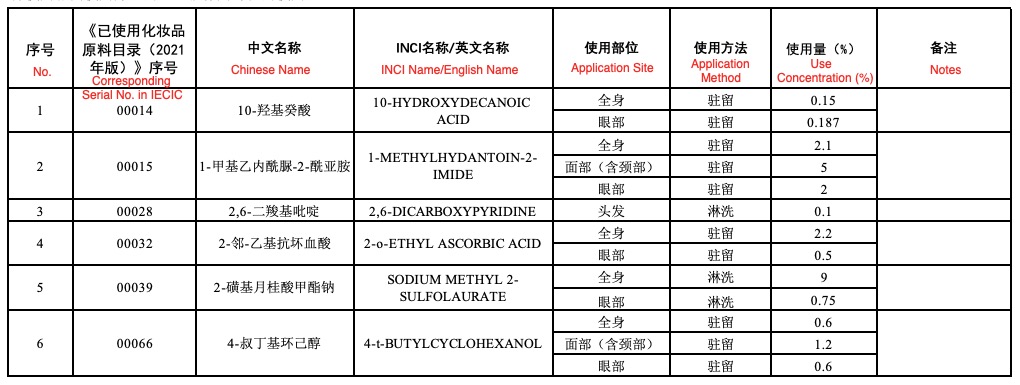 Excerpt of Information on the Use of Some Ingredients Included in the International Cosmetic Safety Assessment Data Index (Draft for Comments)
2. Consistent Reference Principles
The draft follows the same principles as the Ingredient Usage Information of Marketed Products for handling the ingredients’ application sites, methods, and concentration levels. Key principles include:
For the same ingredient applied to the same area, if only a leave-on concentration is recorded, it can also serve as a reference for rinse-off products.
For the same ingredient used in the same way but applied to different areas, reference priority follows this order: whole body → trunk → face (including neck) → hands & feet → head → hair → lips → eyes → nails (fingers and toes). The ingredient use amount for the former areas can serve as a reference for later areas.
Moreover, when the product is applied to eyes and the use amount for other areas is referenced, the ingredient must be assessed for eye irritation separately. Specifically:
The usage levels for hands and feet, head, or hair cannot serve as the reference for lips and eyes.
For ingredients intended for body hair, only the usage level for the whole body or trunk can serve as the reference.
If the application area includes both the head and hair, the use amount for the head can be referenced.
If the application area includes the face (including neck), eye area, and/or lips, the use amount for the face (including the neck) can be referenced. If the eye area is included, additional assessment of eye irritation is required.
For ingredients used in products targeting multiple areas, the use amount for the former area with the same application method should be referenced.
3. Scope of the Draft
The draft does not introduce new ingredients beyond those already listed in the International Index. For ingredients not covered, registrants and notifiers can feedback relevant materials as required during the consultation period if they have conducted assessments in accordance with the Technical Guidelines for Cosmetic Safety Assessment (2021 Edition).
4. Data Adoption Requirements
While the draft provides valuable reference data, it is important to note that the 979 ingredients listed have not undergone systematic evaluation by regulatory authorities. Cosmetic registrants and notifiers must ensure compliance with national laws, regulations, and technical standards, conducting thorough safety assessments and assuming full responsibility for product quality and safety.
 Comments
China’s Guidelines for Use of Cosmetic Ingredient Data outline seven recognized categories of safety assessment references, including 1) Restricted ingredients, permitted preservatives, permitted sunscreens, permitted colorants, and permitted hair dyes listed in STSC; 2) Assessment conclusions published by international authoritative agencies specializing in cosmetics safety assessment; 3) Safety limits or conclusions published by authoritative organizations such as WHO and FAO, etc.
Once finalized, the draft will serve as a supplementary resource for evidence type 2—assessment conclusions published by international authoritative agencies. By organizing usage information for 979 ingredients, it further complements the Ingredient Usage Information of Marketed Products, expanding the data available for cosmetic safety assessments and supporting industry compliance and innovation.
 We provide full-scale global cosmetic market entry services (including cosmetic registering & filing, regulatory consultation, customized training, market research, branding strategy). Please contact us to discuss how we can help you by